A Hairy Woodpecker’s bill is nearly as long as its head. A Downy Woodpecker’s bill is about a third the length of its head.
A Downy Woodpecker’s bill is dinky.

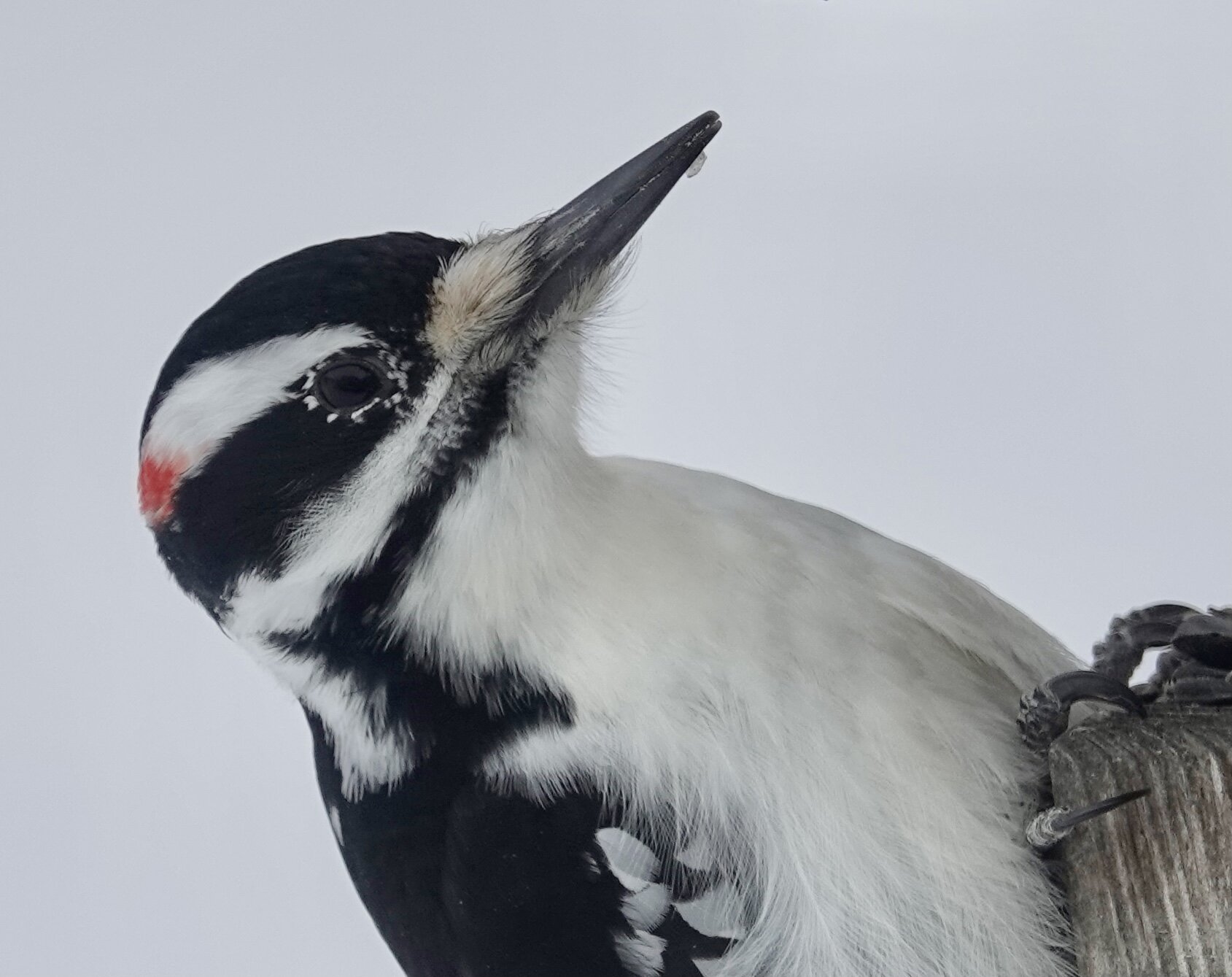
A Hairy Woodpecker’s bill is nearly as long as its head. A Downy Woodpecker’s bill is about a third the length of its head.

A Downy Woodpecker’s bill is dinky.

The Black-capped Chickadee’s song is a two-note whistled “fee-bee” and its call is “chickadee-dee-dee.”

The junco looks at winter though dark eyes as you’d expect from a Dark-eyed Junco.

The elegant blue "eyebrows" are one way to tell an Alaskan Steller's Jay from those of the western interior states where the markings are white.
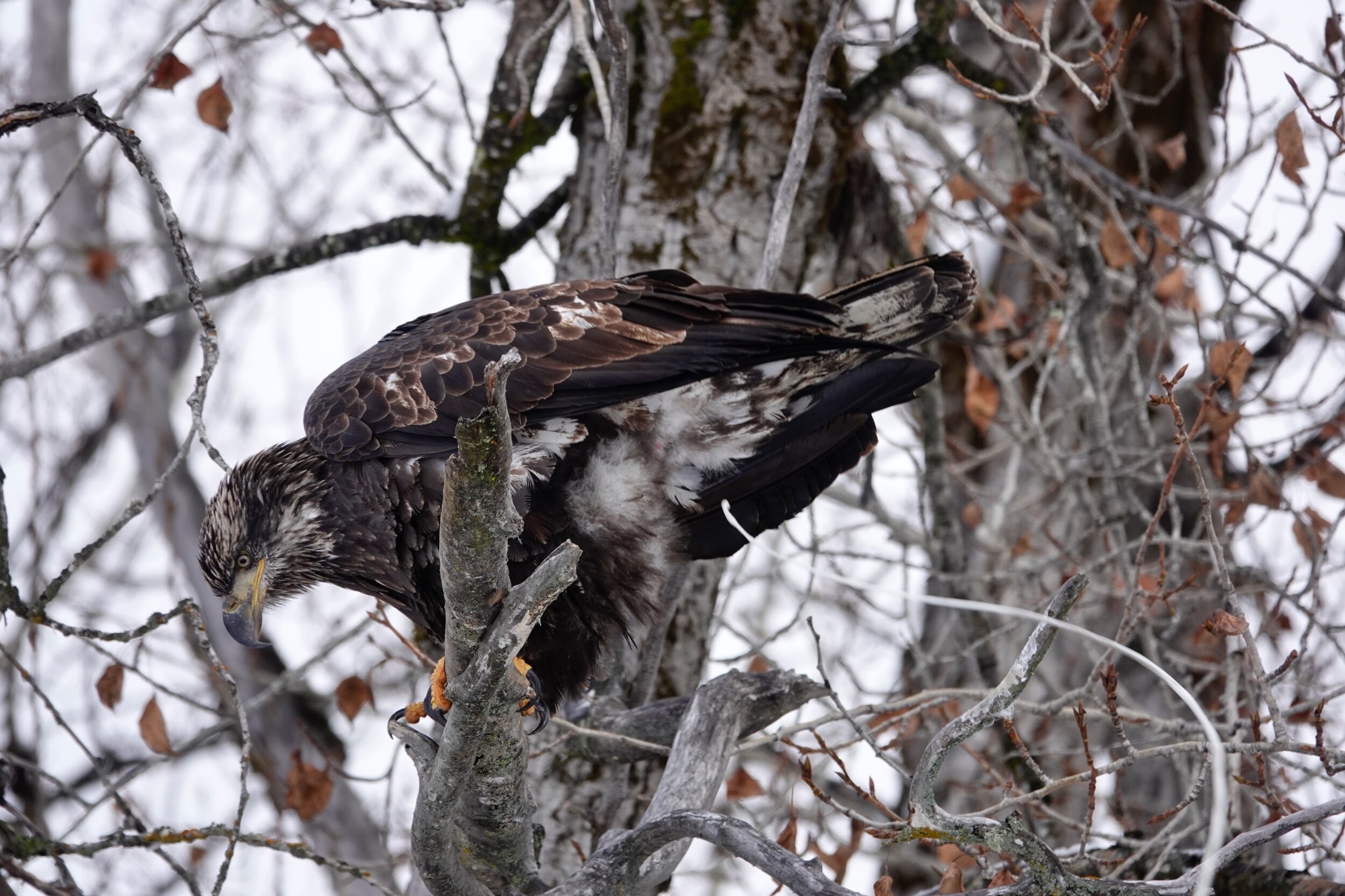
It saves on toilet paper. It’s called a slice when a raptor propels its droppings out and away from a nest or perch as this young Bald Eagle is doing.

The Black-billed Magpie is a crow wearing a tuxedo.

The Bald Eagle watched fish like a hawk.
Naturally
A house sparrow missing his tail was in the yard. If Jim Rockford were still around, I'd have him put a tail on the bird. Dark-eyed juncos are snowbirds. Old Man Winter gave them a lot of responsibility, but they came through with 8 inches of the white stuff in the recent storm. Some red-bellied woodpeckers take their red bellies everywhere. Others, not so much. The red belly isn't always easily noticed. A friend from Maine brought up the chestnut colors on the south end of a northbound white-breasted nuthatch. A nervous rooster pheasant in the yard behaved hawkwardly. Its presence made a nice birthday pheasant for my wife. A cat sat on a warm rock I'd placed into a heated dog dish I've convinced the birds is a birdbath.
Squirrels left footprints in the snow with their larger hind feet appearing in front of the smaller front feet. Rabbit tracks resemble those of squirrels except the front feet aren't paired with hind feet and form a triangular shape. I can tell where rabbits have fed as twigs and shrubs show clean diagonal cuts.
Alberta rats
Norway rats are destructive — they can carry disease and eat crops. For over 70 years Alberta has been determined to stop rats from calling Alberta home, concentrating efforts along the Saskatchewan border, banning the animals as pets, and investigating any hint of a rat inside the province. Out of 481 rat reports in 2020, 26 were actual rats. About half of the sightings were muskrats. Rats ride into Alberta on vehicles.
Q&A
Barb Lamson of Mankato asked where squirrels live in the winter. Do they stay in their tree nests? How do they stay warm? Squirrels live in two types of structures: Dens, which are holes in trees and dreys, which are densely packed masses of sticks and leaves typically located high in the forked branches of large trees. Dens, insulated with dried leaves and other materials, are preferred for winter and brood chambers, but dreys are sturdy and weather-resistant. Dreys require more maintenance. Squirrels fatten up as much as possible, grow a thicker coat that helps keep them warm, and use shivering to generate body heat. In cold weather, squirrels might share a nest in order to share body heat, but this can lead to disputes.
"Are birds at feeders more likely to fall victim to predators?" According to a Cornell Laboratory of Ornithology study, avian predators are attracted to busy feeders, but cats aren't more active at feeding sites. Evidence suggested feeders may provide safe havens from predation. There are more birds to sound alarms. Feeders may reduce foraging time and exposure to predators.
"Why do beavers build dams?" A dam, made of trees and mud, blocks or slows water flow in a river or stream, creating a pond. They build lodges in those ponds, which provide protection from predators like wolves, coyotes or mountain lions. They offer warm places to sleep and raise young. Lodges are built of sticks, grasses and mud, and have underwater entrances. Ponds are important habitats for other wetland animals.
"What's the white covering on trees called?" If it's not snow, it could be rime ice that happens in areas of dense fog when fog droplets come in contact with surfaces below freezing. Or hoarfrost, which is similar to dew and occurs on cold, clear, calm nights when water vapor freezes onto below-freezing surfaces. Hoar refers to the frosty coating, coming from the word hoary, which means white or gray with age.
Diane Norvell of Owatonna asked if it's unusual to see robins in Minnesota in January. The great poet Anonymous wrote, "The north wind doth blow, and we shall have snow, and what will the robin do then, poor thing? He’ll sit in a barn, and keep himself warm, and hide his head under his wing, poor thing!" A small percentage of our robins spend the winter in Minnesota. And why not? It's a winter wonderland. Wintering robins become gregarious, finding security in flock numbers and sleeping in conifers to stay warm at night. They frequent areas with open water. Robins can survive cold weather if they find enough food to stoke their furnaces. They feed on fruits and berries of hackberry, crabapple, hawthorn, juniper, sumac, mountain ash and buckthorn. Robins that migrated south wander north into areas when and where the temperatures average about 37° and earthworms are emerging. Our wintering emotional support robins follow the food. They move around in search of food and shelter.
Thanks for stopping by
"This is one time where television really fails to capture the true excitement of a large squirrel predicting the weather." — Phil Connors (played by Bill Murray) in "Groundhog Day."
"In the depth of winter, I finally learned that within me there lay an invincible summer." — Albert Camus
Do good.
©Al Batt 2021

A red-bellied woodpecker with a red belly. Photo by Al Batt

This is how squirrels find acorns under the snow. They use a dowsing or divining rod.

For some reason, this House Finch couldn’t look me in the eye.

This cardinal lost its tail and may not remember where it is. Perhaps it was lost in a fright molt to escape a predator. Feathers that are pulled out begin regrow immediately.

A starling sheds snowflakes by becoming a portable cement mixer.

A European Starling’s bill begins to turn yellow as the breeding season approaches.

Sasquatch, the junior version.
Red Squirrel.

Snow cardinals are not hatched. They are made.

If the only bird I saw today was a Red-bellied Woodpecker, I’d still be happy. I’d be incredibly concerned, but happy.

A Pine Siskin wears evidence of a correct weather forecast.

Opossums are notoriously poor spellers.

This Blue Jay is as happy as a Blue Jay with a peanut.

Gray birds can brighten a gray day.
Dark-eyed Junco.

Gray birds can brighten a gray day.
Dark-eyed Junco.

A sad sight at The Archway in Kearney, Nebraska.

A tough little bird is the House Sparrow.

The squirrels have a big chair.

The snow umbrella for squirrels is a product that needs work.

The cardinal rule of looking at cardinals is to look at each one at least twice. The female is more subdued in color than the male, but is equally splendid.

The cardinal rule of looking at cardinals is to look at each one at least twice. The female is more subdued in color than the male, but is equally splendid.

I’ve not seen many American Tree Sparrows this winter. More’s the pity.

The Horned Lark is the only native lark in North America. Yet, you’d never know it by talking to the bird.
Naturally
Birds are endlessly entertaining. Watching them helps us where we need help. The Association for the Preservation & Appreciation of Chickadees has bribed me with endless cuteness in the hopes I'd think kindly of chickadees. There are seven species of chickadees in North America. Each one is my favorite bird.
I saw a glimpse of an accipiter. It was a shadow and then gone. They move as fast as time. It was a Cooper's hawk or a sharp-shinned hawk. I called it a Shooper's hawk and a Coop-shinned hawk. I was fine with that. The chickadees alerted everyone.
A hairy woodpecker flew onto a window feeder containing suet. The tired suction cups gave way and the entire feeder fell to the ground while the woodpecker was on it. The bird flew up into the air and landed on another feeder nearby where it looked down at the crashed feeder as if it were wondering who had pulled the ground out from under it.
I spoke virtually to the New Haven (Conn.) Bird Club. They told me their Christmas Bird Count had produced 127 species. I did one in Minnesota that had 32. I was Connecticut dreaming on such a winter’s day.
A pileated woodpecker spent time in my yard. It appeared massive at the suet feeder. I've been a member of the American Birding Association (ABA) for a goodly number of years. The ABA is a nonprofit organization, founded in 1969, dedicated to recreational birding primarily in the continental United States, Hawaii and Canada. Each year, the ABA picks its Bird of the Year. This year it's the Pileated Woodpecker. How do you pronounce that? It's wu̇d-pe-kər.
Carol Thomas of Minneapolis sent me this, "Up From the Egg: the Confessions of a Nuthatch Avoider" by Ogden Nash. "Bird watchers top my honors list. I aimed to be one, but I missed. Since I’m both myopic and astigmatic, My aim turned out to be erratic, and I, bespectacled and binocular, exposed myself to comment jocular. We don't need too much birdlore, do we, to tell a flamingo from a towhee; yet I cannot, and never will,Bunless the silly birds stand still. And there's no enlightenment so obscure as ornithological literature. Is yon strange creature a common chickadee, Or a migrant alouette from Picardy? You rush to consult your Nature guide and inspect the gallery inside, but a bird in the open never looks like its picture in the birdie books —
Or if it once did, it has changed its plumage, and plunges you back into ignorant gloomage, that is why I sit here growing old by inches, watching the clock instead of finches, but I sometimes visualize in my gin the Audubon that I audubin."
Q&A
“What makes the blue snow in my yard?” The urine of rabbits or deer that have eaten buckthorn.
"When is the mating season for squirrels?" Fox squirrels mate twice a year, typically December to February and June through July, and have two or three babies. Gray squirrels mate twice a year, typically December to February and June through August, and have two to four babies. Red squirrels mate in late winter and have two to five babies. Red squirrels typically produce one litter per year, but in some years reproduction is skipped and in other years some females breed twice. The babies of all three species are born hairless and are completely independent at 12 weeks. All three species nest in hollow trees or in treetop dens called dreys, which are ball-shaped nests made of leaves, twigs and bark.
"Why are they called evening grosbeaks?" Grosbeak comes from the French gros for “thick” and bec for “beak,” and these finches have thick beaks strong enough to crack cherry pits. John James Audubon never saw this bird and the grosbeak wasn't described to science until 1825. Although it shares the name with the rose-breasted grosbeak, the two aren't closely related. The rose-breasted grosbeak is in the cardinal family, while the evening grosbeak is a finch. It was named the evening grosbeak because it was thought to sing mostly at dusk. That's incorrect as it's vocal most of the day. They are vacuum cleaners at feeders. Feathered hogs at a trough. A friend in North Carolina told me of a man there who'd fed over a ton of sunflower seeds primarily to a flock of the beautiful grosbeaks in his yard. Evening grosbeak populations have dropped steeply according to the North American Breeding Bird Survey. There are many possible causes.
Thanks for stopping by
"Compassion, in which all ethics must take root, can only attain its full breadth and depth if it embraces all living creatures and does not limit itself to mankind." — Albert Schweitzer
"The best theology is probably no theology; just love one another." — Charles Schulz
Do good.
@Al Batt 2021

Each yard needs a watch chickadee. Photo by Al Batt

I just reread the wonderful “Charlotte’s Web.” This Argiope aurantia is not Charlotte.

I am nuts about Red-breasted Nuthatches.

Red and redder. Purple Finch and Northern Cardinal.

The cardinals are getting along. There is the singing of a happy song.

The cardinals are getting along. There is the singing of a happy song.

A black squirrel, the melanistic form of a Gray Squirrel. This color makes it difficult for the squirrel to become invisible when freezing in place on gray tree bark.

It looks as if this starling has enjoyed a snow cone.

A Gray Squirrel pretending to be bark.

The Blue Jay knows that in cold weather, it’s important to be fluffy.

A Red-winged Blackbird tries to hide from winter.

I watched Cedar Waxwings build a nest one perfect June day in North Dakota. How many waxwings does it take to make a museum?

What happens after you hug a tree.

I’ve decided to organize my closet. That’s a task best done in a crocswise fashion.

How a junco might look with a bad case of dandruff.

My wife’s birthday is just around the bend. This might make a nice birthday pheasant for her.

The rooster pheasant was behaving hawkwardly.

Some Red-bellied Woodpeckers take their red bellies everywhere. Others, not so much.

Someone’s traveling cat finds warmth by sitting on the flat rock in my heated birdbath. The camera-shy feline does so only does so in the dark.

A Eurasian Tree Sparrow is not one to have cold feet.

Are you kidding me? Is that more snow coming down?

A White-crowned Sparrow wearing a bike helmet.

Every circus needs an acrobat. I’m glad the local circus has a Black-capped Chickadee.

This White-tailed Deer has donned its winter coat. The coat has no zippers or buttons.
Naturally
My morning started out with a shower. I hoped to clear the cobwebs from my mind. The invigorating stream of water hadn't been hitting me for long before I noticed I wasn't alone in the shower. What does a spider think when it finds a man in its shower? I can only know what I think and did. I said, "Good morning, spider, I hope you'll have a pleasant day."
A friend sent me an email saying, "To hear a duck quacking is a most fortunate omen, indicating the coming of prosperity." I enjoy hearing from pals, but this forward was much more appreciated than the tired political ones and gave me high hopes for everyone's economy.
Once my morning ablutions had been completed, I went for a walk. During these times and all others, I find comfort in birds. Some snowy days, they all become snowbirds. A blue jay flew into the feeder, selected a peanut in the shell and flew to a tree. It flew back to the feeder with the peanut still in its bill. It dropped the goober onto the feeder and took another peanut more to its liking. I don't think I've ever had a bird return food before. I suppose the best-if-used-by date of the peanut had expired. A house finch makes a wonderful neighbor. It beautifies the neighborhood, sings songs I enjoy hearing and borrows no tools. I spotted a brown creeper, white-winged crossbill and Eurasian collared-dove.
Nature gives me bearings and values. Birds brighten my days. A new birdie's headlights illuminated a recent morning. It was a stranger to my yard. The chestnut-capped and white-cheeked visitor was slightly smaller than a house sparrow. A Eurasian tree sparrow was hanging around with a gang of house sparrows in my yard. They are related species. The bird was a lovely surprise. I’d not seen one in my county before. In Eurasia, this species is widespread and abundant. I saw them when I've worked there and I've seen some in this country. There is a small population in the United States derived from a shipment of songbirds (bullfinches, chaffinches, greenfinches, linnets and Eurasian tree sparrows) brought from Germany and released in St. Louis in April 1870. Introducing the songbirds was meant to enhance the native avifauna and provide familiar bird species for newly settled European immigrants. The Eurasian tree sparrow population took hold and the birds are now found in parts of Missouri, Illinois and southeastern Iowa, but are fairly local. The tougher house sparrow, more aggressive and adaptable, may keep them out of areas. This tree sparrow isn't a bird of cities, preferring farms, lightly wooded residential areas and other more natural places than the house sparrow that is at home with pavement and concrete. The welcome visitor found sustenance in the seeds from my feeders. I was as happy as a lark to see that sparrow.
Q&A
"Why do cardinals arrive so early and stay so late at my bird feeders?" Because that's when the seed prices are lowest. Those redbirds never miss taking advantage of a sale. The male is a dandy. His red plumage is bright and distinct in daylight and attracts attention (both wanted and unwanted). His bright color diminishes in dim light. That makes male cardinals as inconspicuous as their mates at twilight and less easily seen by predators like cats. And avian predators like Cooper’s hawks are inactive at dawn and dusk. Cardinals often live year-round near bird feeders. They have a short commute. They can stay later because their flight home is a brief one. Cardinals feed at dawn and dusk because they have less competition at feeders in low light. That means they don't have to wait behind birds who have clipped a ton of coupons.
"What is a jack snipe?" The jack snipe is a small wading bird native to parts of Europe, Asia and Africa. It's the world’s smallest snipe. A brown marsh bird with a long bill. This country has its relative, the Wilson's snipe. I've heard a pectoral sandpiper called a jack snipe. When called that, it doesn't come any closer. Have you been one of the lucky ones who went on a snipe hunt as a youngster? If so, I hope you're not still holding that bag you're supposed to stuff with the snipe you'd catch. I further hope they didn't drench you in snipe spit, which is purported to be a never-fail snipe lure.
Thanks for stopping by
"Black are my steps on silver sod; Thick blows my frosty breath abroad; And tree and house, and hill and lake, Are frosted like a wedding cake." — Robert Louis Stevenson
"You can't always get what you want. But if you try sometimes, you just might find you get what you need." — The Rolling Stones
Do good.
©Al Batt 2021

Eurasian Tree Sparrow photo by Al Batt

Eurasian Tree Sparrow photo by Al Batt

A wintering White-throated Sparrow.
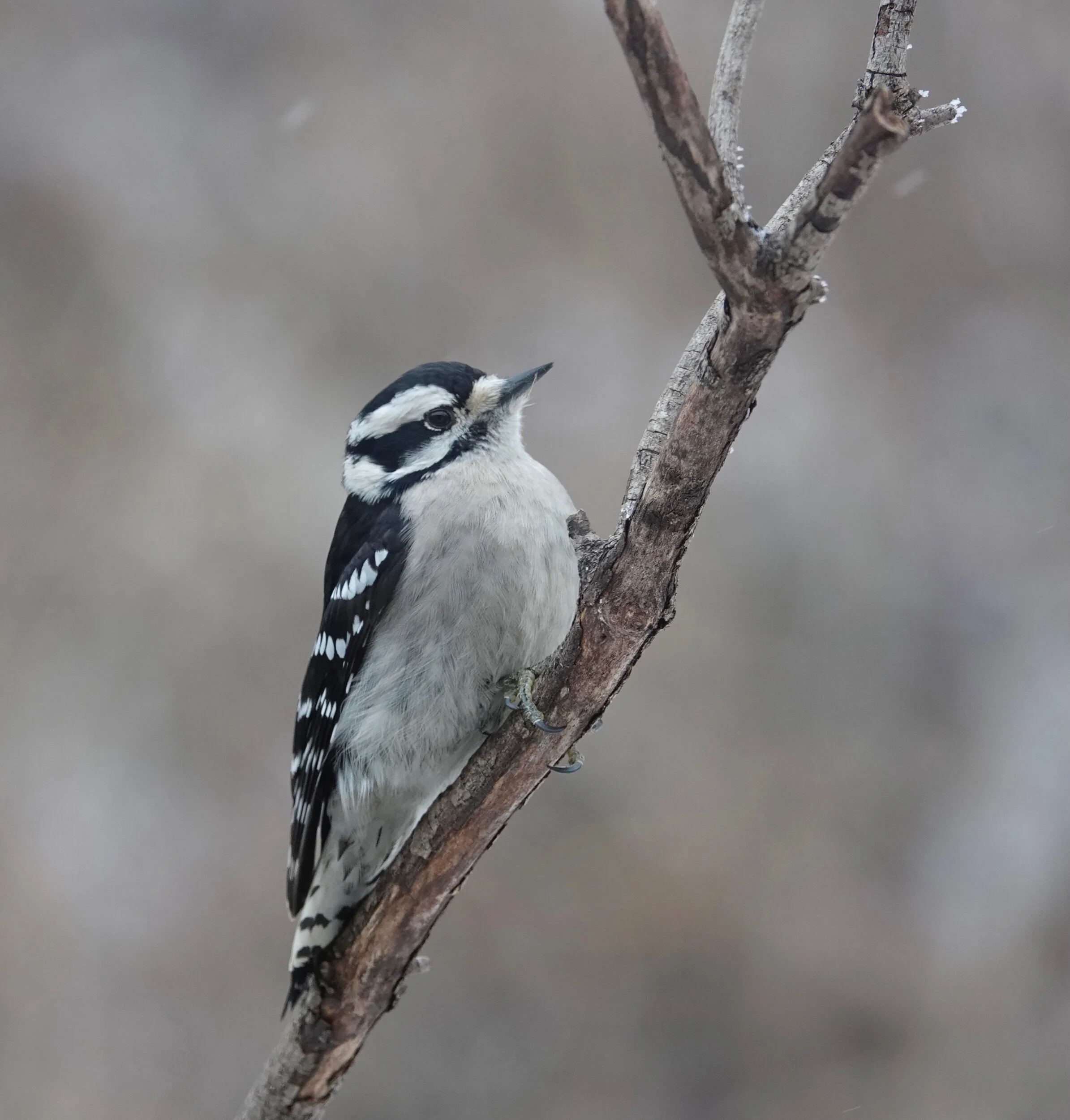
Ma

Pa

A Dark-eyed Junco is a snowbird. Old Man Winter has given it a lot of responsibility, but this one came through with 6 inches of the white stuff in the recent storm.

A friend brought up the interesting colors on the south end of a northbound White-breasted Nuthatch. True that.