A squirrel trying to make a living

Naturally

 Birds are meant to invoke awe and wonder. A love of birds is a reason to go outside. I'm constantly amazed as I watch birds trying to make a living. No bird carries a wallet or a purse. They survive without a credit card. It was -19° and the house sparrows were chirping merrily. It invigorated this listener. When I was a lad, hawks were called chicken hawks, including the beautiful red-tailed hawk. I ate more chickens than any red-tailed hawk ever did. The hawk's diet varies with availability, season and location, but mammals such as voles, mice, rats, rabbits and ground squirrels are major prey items. Tree squirrels and chipmunks are less important prey to this hawk, which is generally brown above and whitish below.
 I watched a strange cat sneak through the yard at -19° with a windchill I didn't want to know. Cats want to be outdoors. Humans want to use hard drugs, eat too much and drive too fast. Being outdoors is as bad for a cat as those other things are for us.
 I saw an American kestrel on a utility wire. The mourning dove-sized bird had slate-blue wings that identified it as a male. The female's wings are rusty. A kestrel often bobs its tail while perched.
 The news had a couple of odd nature-related things. A call to save an injured goose on the Raisin River in Detroit caused a fire rescue crew to suit up and crawl onto the treacherous ice. Once close, they discovered the goose was a decoy. Officials considered it an unexpected training session.
 Gray squirrels are an invasive species in the UK and the government there is trying to lure the squirrels into feeding boxes with small pots containing hazelnut spread spiked with an oral contraceptive. Prince Charles played a key role in setting up the UK Squirrel Accord, which aims to manage the negative impacts of invasive gray squirrels in the UK.
 I watched the fox squirrels in my yard. They survive our cantankerous winters because they keep working at it.
Q&A
 "What does beaver scat look like?" Beaver scat isn't often seen because beavers typically defecate in the water. Beaver scat is predominantly wood material. Their feces disintegrate quickly in water because they're mostly wood pulp in either a round or elongated pellet up to an inch in diameter. The scat resembles wood chips or sawdust glued together and is usually a light brown to tan color. The Beaver Institute says the preferred tree species of beavers include alder, aspen, apple, birch, cherry, cottonwood, poplar and willow. Aspen, poplar and cottonwood are their favorites. If the supply of their preferred trees is low they will harvest oaks and maples. Conifers are their least favorite. I see them gnawing on ash trees and enjoying the bark of willows. 
 "Why don't the feet of birds freeze?" Bird feet are little more than bone, sinew and scale, with few nerves. A countercurrent heat exchange system means the arteries that transport blood to the legs lie in contact with the veins that return blood to the bird’s heart. The warm arteries heat the cooler veins. Because the veins also cool the arteries, the bird’s feet are closer to the environmental temperature and don’t lose as much heat as they would if they were at body temperature.
 This system isn’t as effective in mourning doves and their feet are prone to freezing. Pigeons and chickens suffer frostbite. Frostbitten feet on other birds aren’t an impossibility. On a barely related note, the rock pigeon, the pigeon we see in farm and city, was trained for communication by the United States Army Pigeon Service or Signal Pigeon Corps. During WWII, this force consisted of 3,150 soldiers and 54,000 pigeons. Over 90% of Army messages sent by pigeons were received. The pigeon named G.I. Joe received the Dickin Medal for gallantry that saved at least 1,000 lives. From 1917 until 1957, the US Army Pigeon Breeding and Training Center was based at Fort Monmouth, N.J. 
 "Do raccoons wash their food before eating?" They aren't germaphobes. It's a myth. When they find something that might be food, they roll it around in their front paws to determine what it is. If a raccoon encounters a likely item at a distance from water, they will roll it around in their paws without involving any water. Research has determined that wetting the paws increases their sensitivity. Their scientific name, Procyon lotor, means "washing bear." Raccoons typically weigh 14 to 40 pounds, sometimes more. If raccoons had opposable thumbs, they might be our overlords.
Thanks for stopping by
 "You were made and set here to give voice to this, your own astonishment." — Annie Dillard
 "When a man is wrapped up in himself he makes a pretty small package." — John Ruskin
 Do good.

©Al Batt 2021

A fox squirrel hard at work making a living during the winter. Photo by Al Batt

A fox squirrel hard at work making a living during the winter. Photo by Al Batt

It’s a beautiful winter day when the blue pops out of the white.

It’s a beautiful winter day when the blue pops out of the white.

It’s a beautiful winter day when the blue pops out of the white.

I would love to meet the Badger from The Wind in the Willows by Kenneth Grahame. This is not that badger.

I would love to meet the Badger from The Wind in the Willows by Kenneth Grahame. This is not that badger.

One of the many places I didn’t make it to in 2020 was Sitka, Alaska, for their wonderful Whale Festival. I need more whale tail tales.

One of the many places I didn’t make it to in 2020 was Sitka, Alaska, for their wonderful Whale Festival. I need more whale tail tales.

Each humpback whale fluke is like a fingerprint and can be used to identify a whale.

Each humpback whale fluke is like a fingerprint and can be used to identify a whale.

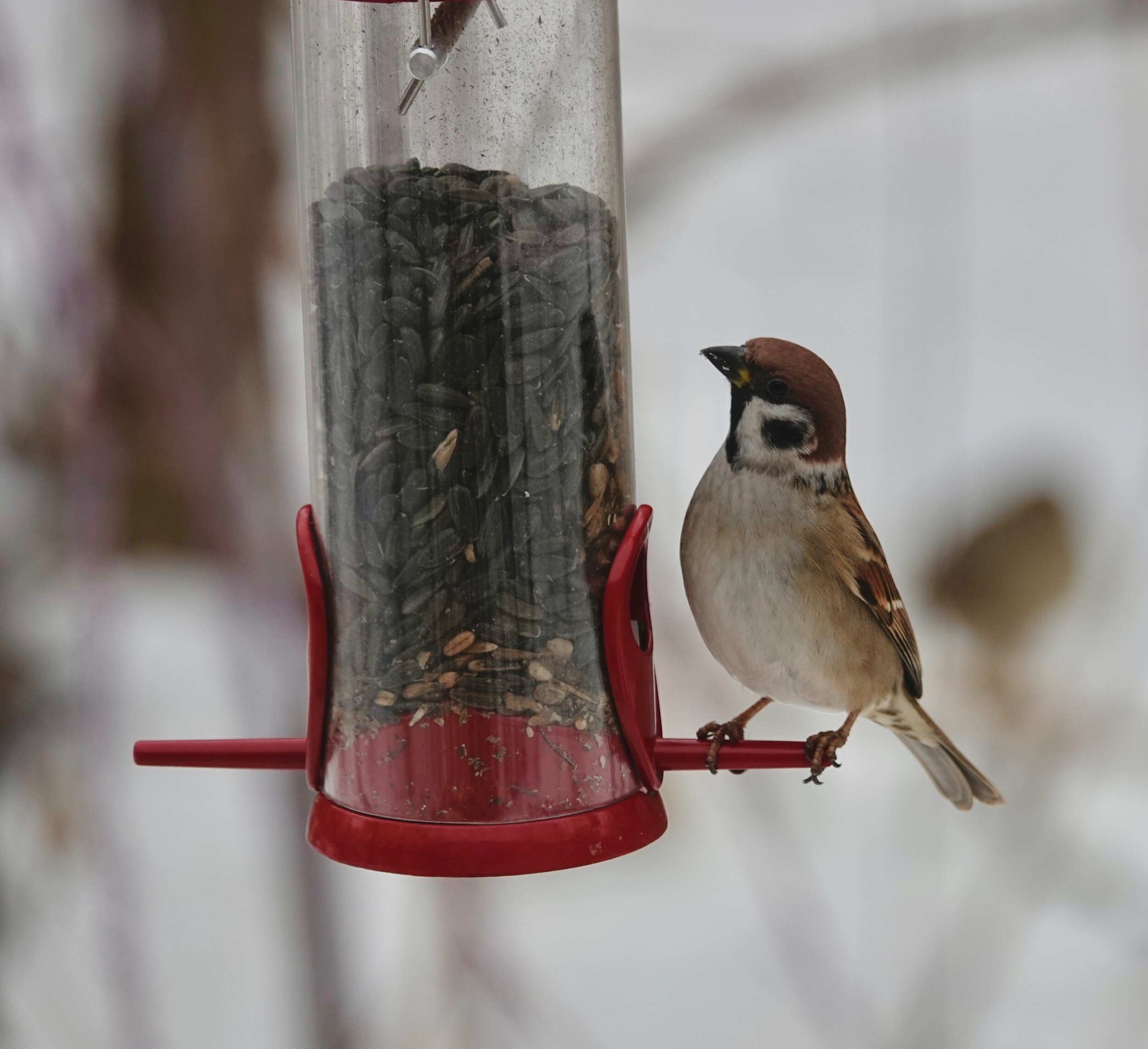
When the weather drops below 20 degrees below, putting a foot into the feathers is a fine thing for a House Sparrow to do.

When the weather drops below 20 degrees below, putting a foot into the feathers is a fine thing for a House Sparrow to do.

When the weather drops below 20 degrees below, putting a foot into the feathers is a fine thing for a House Sparrow to do.

When the weather drops below 20 degrees below, putting a foot into the feathers is a fine thing for a House Sparrow to do.

When the weather drops below 20 degrees below, putting a foot into the feathers is a fine thing for a House Sparrow to do.

It was an isolated snowstorm, limited to a Blue Jay’s bill.

It was an isolated snowstorm, limited to a Blue Jay’s bill.

The starling’s bill is yellowing. Spring must be right at the tip.

The starling’s bill is yellowing. Spring must be right at the tip.

If Jim Rockford were still around, I’d have him put a tail on a bird.

Naturally

 It was one above zero. Crows gathered in the woods near my window. It was a murder in the first degree.
 A friendly chickadee landed on a feeder while I was filling it. It snacked on nyjer seeds. I don’t see chickadees as regular consumers of those thistle seeds. Robert Louis Stevenson wrote, "A birdie with a yellow bill Hopped upon my window sill, Cocked his shining eye and said: 'Ain't you 'shamed, you sleepy-head!'" A European starling’s bill turns yellow as the breeding season approaches. 
 I'm seeing flocks of horned larks. Some spend the winter in southern Minnesota. The horned larks that migrated south begin returning north into Minnesota in early February. 
 A cardinal and a house sparrow are each missing a tail in my yard. Not the same tail. If a feather is broken, it remains broken until the next molt. If a feather is pulled out, regrowth begins immediately. I doubt it's a fraternity initiation. Birds could lose their tail feathers in a fright molt while trying to avoid being captured. Those feathers come out easily, leaving the would-be predator with a mouthful of feathers. Tails are important, but not critical to survival.
 I've heard from a good number of people who have seen Carolina wrens this winter. Matt Young, the collections management leader at the Cornell Lab of Ornithology’s Macaulay Library, said the red crossbill is the most recorded bird in that library with the Carolina wren next.
Q&A
 "How do you pronounce 'leucism'?" I hear it sometimes pronounced "loo-si-zim," but I say "loo-kiz-em." Leukemia is pronounced "loo-kee-mee-ah," not "loo-see-mee-ah." Both words come from the Greek word leukos (lyoo-kos) meaning white.
 "How can an owl catch a crow?" Great horned owls snatch them from the crows' nightly roosting sites.
 Joyce Tabor of Askov wrote, "When I sit in the living room at night, I hear owls hooting. Are they calling so they can mate or is it too early?" Great horned owls can be noisy during territorial formation and pair bonding in December and January. They lay eggs in late January into March, varying with location. When a pair of owls call a duet, the female usually hoots first and hers is higher-pitched. The male replies in a deeper voice. Females are larger than males, but the smaller male has a bigger syrinx.
 "What do opossums eat?" If opossums went to school, they'd flunk spelling, but they'd eat their homework because opossums eat almost anything, including birdseed, worms, compost, snakes, acorns, insects, slugs, eggs, young birds, berries, decayed or overripe fruit, grain, ticks, garbage and carrion. Winter is tough on them. The opossum's naked ears, nose, and tail are susceptible to frostbite.
 "Does a camel's hump hold water?" No, it stores fat. The camel uses it as nourishment when food is scarce.
 "Do juncos eat suet?" They do, especially any bits that fall to the ground. It makes sense as juncos feed on spruce budworms and consume insects during their breeding season.
 "Does the osprey eat anything other than fish?" The osprey is the only hawk on the continent that eats almost exclusively live fish, which account for 99% of an osprey’s diet. On rare occasions, ospreys have been observed feeding on dead fish, birds, snakes, voles, squirrels, muskrats and salamanders. The osprey is one of the few birds found on every continent except Antarctica. The peregrine falcon is another.
 "Do vultures circle dying animals?" They don't stalk dying creatures as a wounded animal could harm them. Circling vultures don't necessarily indicate the presence of a dead animal. Circling vultures may be gaining altitude for long flights, searching for food or exhibiting playfulness. Vultures soar on thermals of warm, rising air that allow them to conserve energy in flight. They rely on thermals of warm air to remain aloft while scanning the ground for food.
 "Will screech owls eat fish?" Eastern screech owls eat many kinds of small animals, including mammals (especially mice and voles), birds, insects, reptiles and amphibians. Their diets include bats, tadpoles, moths, crickets, worms and fish. A bald eagle and an osprey aren't the only birds that watch fish like a hawk. If they can catch it, screech owls eat it. 
 "Why are moths attracted to lights?" Like a moth to a flame, moths and other insects gather around lights. Scientists don’t know why this fatal attraction occurs but speculate moths might think the light is the moon that aids their navigation. Or they might mistake it for daylight and become confused.
Thanks for stopping by
 "When February sun shines cold, there comes a day when in the air the wings of winter slow unfold, and show the golden summer there." — Philip Savage 
 "The words of the reckless pierce like swords, but the tongue of the wise brings healing." — Proverbs 12:18
 Do good.

© Al Batt 2021


This cardinal had lost his tail and didn’t know where to find it. The good news is that it’s growing back. Photo by Al Batt  If Jim Rockford were still around, I’d have him put a tail on this cardinal.

This cardinal had lost his tail and didn’t know where to find it. The good news is that it’s growing back. Photo by Al Batt If Jim Rockford were still around, I’d have him put a tail on this cardinal.

A Dark-eyed Junco is a fine looking bird

A Dark-eyed Junco is a fine looking bird. Most dictionaries say junco is borrowed from the Spanish junco, meaning reed or rush. There is no NFL, NBA, NHL or MLB team nicknamed the Juncos. That’s a shame.

A Dark-eyed Junco is a fine looking bird. Most dictionaries say junco is borrowed from the Spanish junco, meaning reed or rush. There is no NFL, NBA, NHL or MLB team nicknamed the Juncos. That’s a shame.

A junco with snow goggles.

A junco with snow goggles.

The young and the nestless

The young and the nestless. Young European Starlings from this past summer.

The young and the nestless. Young European Starlings from this past summer.

It was -19° and the House Sparrows were chirping merrily. It invigorated the listener.I

It was -19° and the House Sparrows were chirping merrily. It invigorated the listener.I

The Red-winged Blackbird female found winter cold because the winter day was gelid.

The Red-winged Blackbird female found winter cold because the winter day was gelid.

Some Carolina Wrens want to be Minnesota Wrens

Nature by the yard

 Juncos are gray birds that brighten a gray day. A pine siskin wore the evidence of a correct weather forecast. The proof was a few snowflakes perched on the bird's back. Happiness is in the bag. Sunflower seeds. Chickadees moved to and from the feeders at the rate of the candy on an "I Love Lucy" TV episode, the one where Lucy and Ethel got jobs as candy makers at Kramer's Kandy Kitchen. They worked in the wrapping room assembly line where their task was to wrap every chocolate candy as it went by on a conveyor belt. The speed of the conveyor forced them to eat the candies or stuff the sweets into their hats and blouses.
 A friend, Penny Jacobsen of Albert Lea, called to recommend the book, "Braiding Sweetgrass: Indigenous Wisdom, Scientific Knowledge, and the Teachings of Plants" a nonfiction book by Robin Wall Kimmerer and published by Milkweed. It's a wonderful book I'd just started reading not long before her kind call.
 I haven't seen a chipmunk in the yard since New Year's Day. Chipmunks hibernate in winter, but they don’t sleep through the season. Hibernation means something different to each species. Some call the chipmunk's a torpor. It's a restless hibernation. They retreat to their burrows and wake every few days to raise their body temperatures to normal, feed on stored food rather than fat reserves, and urinate and defecate. Their heart rate declines from about 350 beats per minute to four beats per minute. Body temperature may drop from 94° to the temperature of the burrow — as cold as 40°. 
 There were five pheasants and four fox squirrels foraging under the feeders. All was calm. Then another fox squirrel dropped from a feeder. Panic ensued. It became the Monty Python skit of the footrace for people with no sense of direction. I recalled a day years before when the house cat was birdwatching from a window holding a feeder attached by suction cups. As the feline watched, a squirrel dropped from the roof in a superhero attempt to find access to the feeder. The weight of the squirrel knocked the feeder from the glass. The cat's eyes grew larger as it turned and looked at me as if to say, "That's why I watch birds."
 Eight pheasants became eight lumps in a bent tree in the gathering darkness. Roosting in trees is a predator-avoidance behavior.
 My eyes produced tears as I walked into an east wind. The proverb says, "When the wind is in the east, 'tis neither good for man nor beast; when the wind is in the north, the skillful fisher goes not forth; when the wind is in the south, it blows the bait in the fishes' mouth; when the wind is in the west, then 'tis at the very best."
 Carol Hegel Lang of Albert Lea, Jill Evans of Mankato and Tim Scott of Mankato all reported wintering Carolina wrens. I recall walking a trail in Columbia, Missouri, lost in my thoughts and delighting in the songs of the Carolina wren that followed me.
 There was a spruce budworm outbreak across large portions of Quebec and Ontario the past several years. Because of the pandemic, areas of Quebec weren't treated with pesticides for budworm. Large sections of the boreal forests produced two excellent spruce cone crops during the last four years. These things led to a finch irruption event. Evening grosbeak, purple finch, and to a lesser extent, pine siskin, are spruce budworm specialists. There are spruce budworm warblers, too — Cape May, Tennessee and bay-breasted.
Q&A
 "What can I feed wintering robins?" Place apple slices, raisins, blueberries, grapes, strawberries, cranberries, raspberries, cherries, small bits of suet or mealworms at ground level.
 "How many snowy owls have been seen in Minnesota this winter?" As of Jan. 31 there had been 72 observations in 16 counties: Becker, Kittson, Marshall, Pine, Polk, St. Louis, Benton, Dodge, Hennepin, Lac qui Parle, Le Sueur, Martin, Rice, Stearns, Stevens and Watonwan.
 "Where do the sandhill cranes from Minnesota go in winter?" Minnesota birds are short-distance migrants. Birds in eastern Minnesota migrate southeast to Georgia and Florida; birds in western Minnesota migrate south to the Gulf Coast of Texas.
 "When are the mating seasons for coyotes and red foxes?" Coyotes mate at age two and may pair for life. The mating season begins in January and lasts through February. Five to seven pups are born in April. Red foxes mate at age one in February and 52 days later five to ten pups are born that are fully independent at seven months.
Thanks for stopping by
 “If you cannot do great things, do small things in a great way." — Attributed to Napoleon Hill, Martin Luther King, Jr. and Mother Teresa
 "When snow falls, nature listens." — Antoinette van Kleeff
 Do good.

©Al Batt 2021

I took this photo of a Carolina wren in Missouri, but people are seeing them in their Minnesota and Iowa yards this winter. Photo by Al Batt

I took this photo of a Carolina wren in Missouri, but people are seeing them in their Minnesota and Iowa yards this winter. Photo by Al Batt

I am nowhere near this place in Sitka, Alaska, but I still strive to be alert and make noise every day.

I am nowhere near this place in Sitka, Alaska, but I still strive to be alert and make noise every day.

Spending a winter in Southeast Alaska gives the tiny bird a chance to work on its torpor technique.

I was hurrying out the door to catch a ferry from Haines, Alaska, in November and was too slow to get a decent photo of an Anna’s Hummingbird. Spending a winter in Southeast Alaska gives the tiny bird a chance to work on its torpor technique.

I was hurrying out the door to catch a ferry from Haines, Alaska, in November and was too slow to get a decent photo of an Anna’s Hummingbird. Spending a winter in Southeast Alaska gives the tiny bird a chance to work on its torpor technique.

When I was a lad, most hawks were called chicken hawks, including this beautiful Red-tailed Hawk. I ate a lot more chickens than this raptor did.

When I was a lad, most hawks were called chicken hawks, including this beautiful Red-tailed Hawk. I ate a lot more chickens than this raptor did.

Those elegant blue "eyebrows"

The elegant blue "eyebrows" are one way to tell an Alaskan Steller's Jay from those of the western interior states where the markings are white.

The elegant blue "eyebrows" are one way to tell an Alaskan Steller's Jay from those of the western interior states where the markings are white.

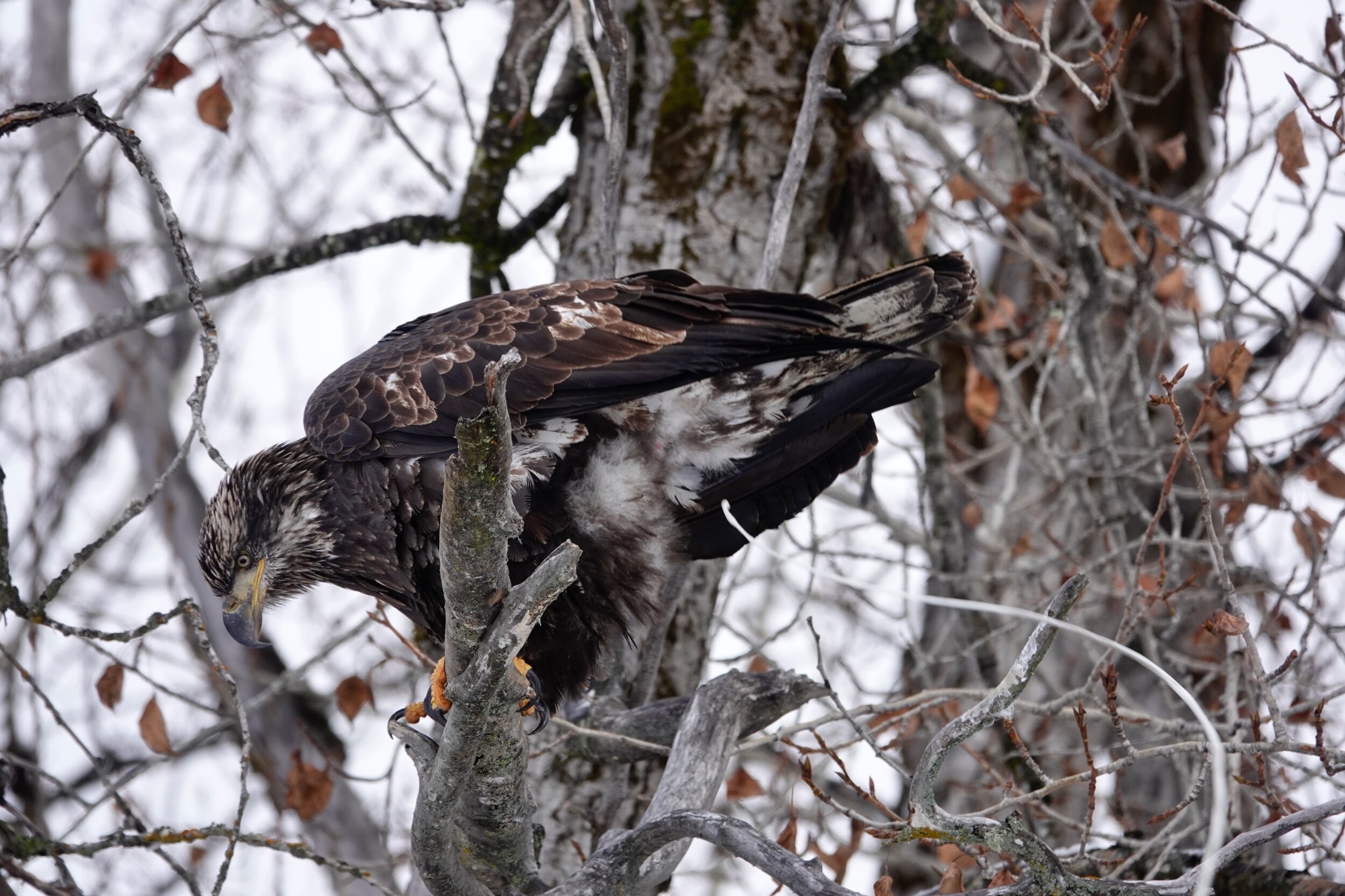
It saves on toilet paper. It’s called a slice when a raptor propels its droppings out and away from a nest or perch as this young Bald Eagle is doing.

It saves on toilet paper. It’s called a slice when a raptor propels its droppings out and away from a nest or perch as this young Bald Eagle is doing.

“Rats!” Said the rat. “I’m in Alberta!”

Naturally
 A house sparrow missing his tail was in the yard. If Jim Rockford were still around, I'd have him put a tail on the bird. Dark-eyed juncos are snowbirds. Old Man Winter gave them a lot of responsibility, but they came through with 8 inches of the white stuff in the recent storm. Some red-bellied woodpeckers take their red bellies everywhere. Others, not so much. The red belly isn't always easily noticed. A friend from Maine brought up the chestnut colors on the south end of a northbound white-breasted nuthatch. A nervous rooster pheasant in the yard behaved hawkwardly. Its presence made a nice birthday pheasant for my wife. A cat sat on a warm rock I'd placed into a heated dog dish I've convinced the birds is a birdbath. 
 Squirrels left footprints in the snow with their larger hind feet appearing in front of the smaller front feet. Rabbit tracks resemble those of squirrels except the front feet aren't paired with hind feet and form a triangular shape. I can tell where rabbits have fed as twigs and shrubs show clean diagonal cuts. 

Alberta rats

 Norway rats are destructive — they can carry disease and eat crops. For over 70 years Alberta has been determined to stop rats from calling Alberta home, concentrating efforts along the Saskatchewan border, banning the animals as pets, and investigating any hint of a rat inside the province. Out of 481 rat reports in 2020, 26 were actual rats. About half of the sightings were muskrats. Rats ride into Alberta on vehicles. 
Q&A
 Barb Lamson of Mankato asked where squirrels live in the winter. Do they stay in their tree nests? How do they stay warm? Squirrels live in two types of structures: Dens, which are holes in trees and dreys, which are densely packed masses of sticks and leaves typically located high in the forked branches of large trees. Dens, insulated with dried leaves and other materials, are preferred for winter and brood chambers, but dreys are sturdy and weather-resistant. Dreys require more maintenance. Squirrels fatten up as much as possible, grow a thicker coat that helps keep them warm, and use shivering to generate body heat. In cold weather, squirrels might share a nest in order to share body heat, but this can lead to disputes. 
 "Are birds at feeders more likely to fall victim to predators?" According to a Cornell Laboratory of Ornithology study, avian predators are attracted to busy feeders, but cats aren't more active at feeding sites. Evidence suggested feeders may provide safe havens from predation. There are more birds to sound alarms. Feeders may reduce foraging time and exposure to predators.
 "Why do beavers build dams?" A dam, made of trees and mud, blocks or slows water flow in a river or stream, creating a pond. They build lodges in those ponds, which provide protection from predators like wolves, coyotes or mountain lions. They offer warm places to sleep and raise young. Lodges are built of sticks, grasses and mud, and have underwater entrances. Ponds are important habitats for other wetland animals.
 "What's the white covering on trees called?" If it's not snow, it could be rime ice that happens in areas of dense fog when fog droplets come in contact with surfaces below freezing. Or hoarfrost, which is similar to dew and occurs on cold, clear, calm nights when water vapor freezes onto below-freezing surfaces. Hoar refers to the frosty coating, coming from the word hoary, which means white or gray with age.
 Diane Norvell of Owatonna asked if it's unusual to see robins in Minnesota in January. The great poet Anonymous wrote, "The north wind doth blow, and we shall have snow, and what will the robin do then, poor thing? He’ll sit in a barn, and keep himself warm, and hide his head under his wing, poor thing!" A small percentage of our robins spend the winter in Minnesota. And why not? It's a winter wonderland. Wintering robins become gregarious, finding security in flock numbers and sleeping in conifers to stay warm at night. They frequent areas with open water. Robins can survive cold weather if they find enough food to stoke their furnaces. They feed on fruits and berries of hackberry, crabapple, hawthorn, juniper, sumac, mountain ash and buckthorn. Robins that migrated south wander north into areas when and where the temperatures average about 37° and earthworms are emerging. Our wintering emotional support robins follow the food. They move around in search of food and shelter.
Thanks for stopping by
 "This is one time where television really fails to capture the true excitement of a large squirrel predicting the weather." — Phil Connors (played by Bill Murray) in "Groundhog Day."
 "In the depth of winter, I finally learned that within me there lay an invincible summer." — Albert Camus
 Do good.

©Al Batt 2021


A red-bellied woodpecker with a red belly. Photo by Al Batt

A red-bellied woodpecker with a red belly. Photo by Al Batt

This is how squirrels find acorns under the snow. They use a dowsing or divining rod.

This is how squirrels find acorns under the snow. They use a dowsing or divining rod.

For some reason, this House Finch couldn’t look me in the eye.

For some reason, this House Finch couldn’t look me in the eye.