
Naturally
I went for a walk and scared up countless birds who were holed up in an arborvitae until the coast was clear and an accipiter had concluded its hunting. I found the hawk. It was a sharp-shinned male, about the size of a blue jay. I found him because blue jays had found him in a spruce tree and they made a fuss. The raptor was seriously outnumbered. There was a good crop of acorns this year, which will provide a reliable winter food crop for the blue jays.
Talking to people from around the state, I’m reminded that deer have never been uniformly distributed across Minnesota. I see many of them in my neighborhood.
I marveled at the beauty of a tiny eastern screech-owl. It was a red one. This species comes in three color morphs: red, gray and brown. I’ve heard it called a shivering owl because of the trembling cry it makes. For years, a few times each week, I saw a red owl. It was an important part of a building. Red Owl was a grocery store chain that opened its first store in Rochester and operated 441 stores in Michigan, Wisconsin, Minnesota, Iowa, North Dakota and South Dakota. In 1988, the rights to the Red Owl name were secured by the grocery wholesaler SuperValu. The title sequence of “The Mary Tyler Moore Show” featured the lead character in a Red Owl meat department.
I love honey. It makes my tastebuds buzz and dance. Bees in France made honey in shades of blue and green, alarming beekeepers and inspiring scientists to discover the reason was the bees had developed a taste preference for the residue from containers of the candy M&M’s processed at a nearby plant.
In another bee story, I learned elephants are terrified of bees. Bees tend to sting elephants around the eyes, behind the ears, in the mouth and inside the trunk. That would scare anyone. Live beehives are being used as fences to protect farm crops from foraging elephants in some African and Asian countries and the experiment has had substantial success.
Why did the crow cross the road? To find the chicken that tried to cross the road but was hit by a car.
Q&A
“What’s the difference between pigeons and doves?” The general opinion is doves are beautiful, fragile birds and symbols of love and peace, while pigeons are considered feral birds often thought of as vermin generally found in gray, brown and blue colors. Others might describe doves as pigeons lacking street smarts. Doves and pigeons are in the same taxonomic family of birds known as Columbidae. There are at least 310 species in that family. Doves are generally smaller than a pigeon, but that’s not always the case. The common name of our common barn or city pigeons is rock pigeon, which was previously called rock dove.
“Circumstances prevent me from having a feeder, but I’d love to see the birds at one. Any suggestions?” You could visit a park, a nature center or kind neighbors with bird feeders. If you’d like to do it without leaving your home, you could make a virtual visit to the Cornell Lab of Ornithology at https://www.allaboutbirds.org/cams/. It features live streams of feeders in New York, Ontario and Texas as well as many other bird cams.
“Who tops the pecking order at a bird feeder?” I watched wild turkeys feed at the Hormel Nature Center’s platform feeders. They were the ruling class and the champion of displacement behavior. Work at the Cornell Lab of Ornithology found the top five feeder regulars in descending order are American crow, common grackle, red-bellied woodpecker, European starling and blue jay. The chickadee sits at the bottom of the dominance hierarchy. The downy woodpecker rates higher than one would expect from its size and the pileated woodpecker falls lower than its size would indicate. As I watched birds vying for prime positions on the feeders in my yard, I must add that squirrels have teeth and will depredate some birds, so they have a great impact on feeders.
Susan Wegner of Maine asked why a nuthatch male raised its head, spread its tail, drooped its wings, swayed back and forth, and bowed deeply. A surge of testosterone sometimes hits birds in the fall. It provides brief urges.
“What preys on turkeys?” Wild turkeys aren’t easy prey, they’re large, can run up to 18 mph, fly 50 mph and are capable of swimming. Great horned owls, golden eagles, coyotes, foxes, bobcats and raccoons are possible predators on the turkeys stuffed with acorns.
Thanks for stopping by
“Nothing is more honorable than a grateful heart.”―Lucius Annaeus Seneca.
“We can only be said to be alive in those moments when our hearts are conscious of our treasures.”―Thornton Wilder.
Do good.
©Al Batt 2021

An Eastern Screech-owl has prominent ear (feather) tufts and white “eyebrows.” Photo by Al Batt

Minnesota State defeated Augustana 91-86 behind Joey Batt’s (left in photo) 22 points and five assists, and 14 points each by Maddy Olson (at right in photo), Taylor Theusch and Emily Russo.
Nature talk on the radio. Do birds smell or has my deodorant gone bad? Why do I smell dirty socks when I’m around highbush cranberries?
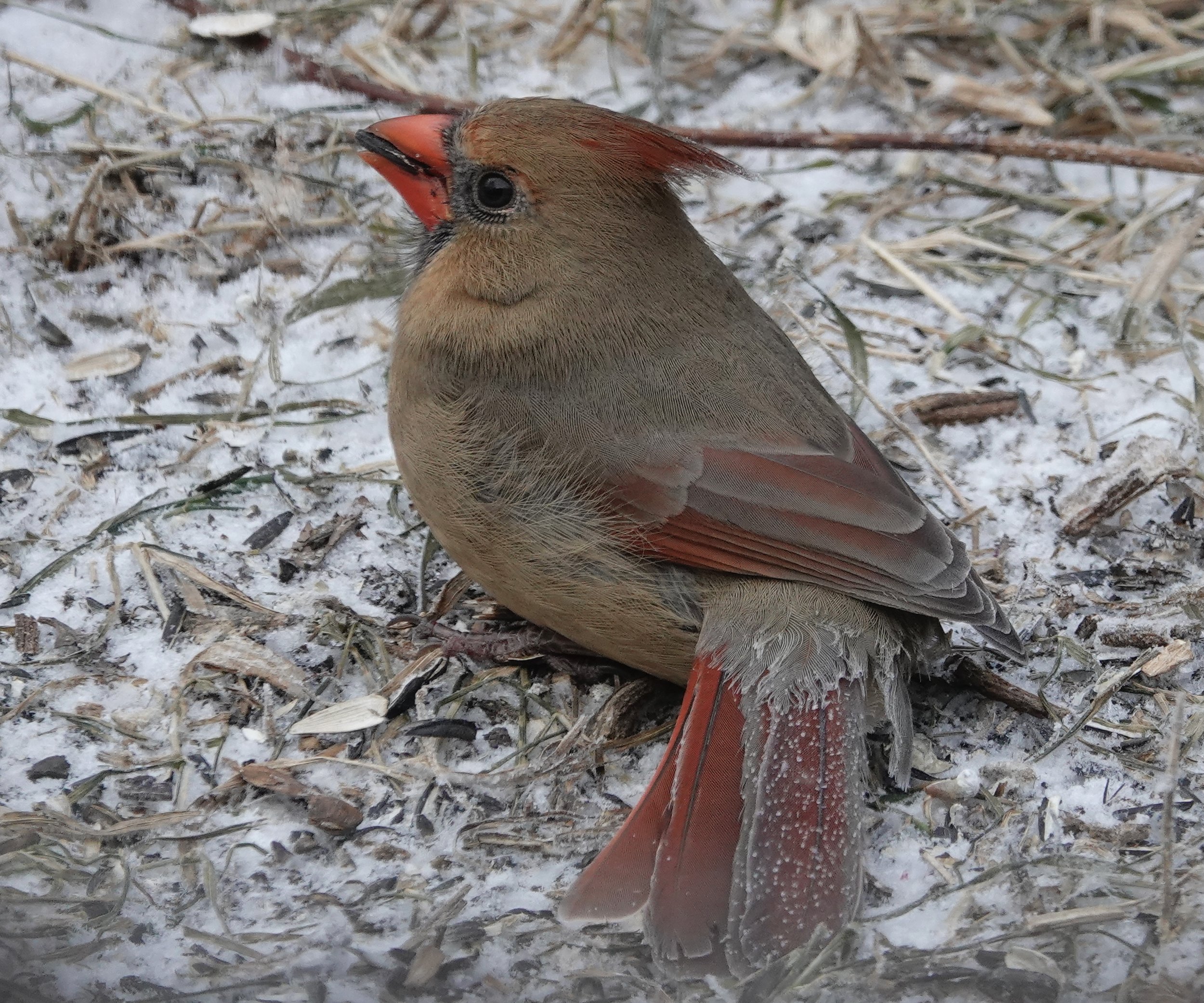
The superstition is that sprinkling salt on a bird's tail will render the bird temporarily unable to fly, enabling its capture. This female Northern Cardinal flew away flawlessly, so her tail must have been sprinkled with snowflakes.

Trying weather can be artistic as evidenced on this hawthorn tree palette.
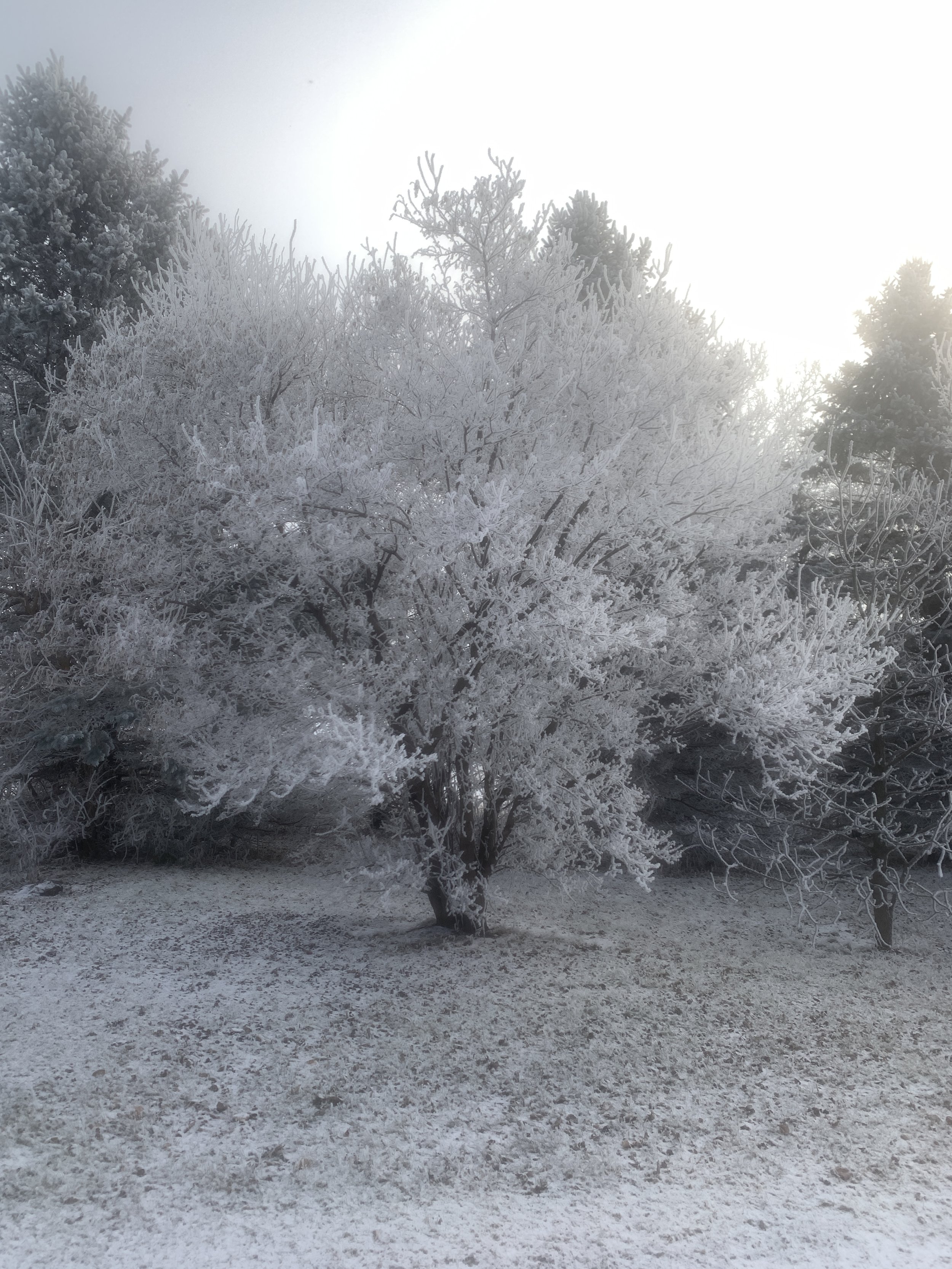
The trees had an early white Christmas.

The tornado has passed and it took the snow with it, but the deer remains.