
Naturally
Eastern bluebirds were in my yard. Their peak migration is from late September to late October.
The 2026 Minnesota Governor's Pheasant Hunting Opener
As part of the Opener in Northfield, I attended a public land celebration of the Circle Lake Wildlife Management Area (WMA) in Rice County. It’s 262 acres with a 101-acre island in the middle of it. In the 1920s, the island was a golf course. The lake has a total area of 837 acres. The WMA includes brushlands, forest, wetlands, and grasslands. After 75 years of the DNR’s WMA program, the DNR manages over 1500 WMAs which cover almost 1,400,000 acres of public land. A WMA protects wildlife habitat for future generations, provides opportunities for hunting, trapping, fishing and wildlife viewing, and promotes important wildlife-based tourism in the state. Acquisition of these WMA lands was funded by the Outdoor Heritage Fund as recommended by the Lessard-Sams Outdoor Heritage Council. This fund must be used to restore, protect and enhance habitat for fish, game and wildlife.
Q&A
Jerry Viktora of Ellendale asked when the bats flying around his yard begin to hibernate and what they are eating in October. The big brown bats that hibernate in buildings are typically the last bats to hibernate, beginning in October or November, when the nighttime temperatures drop into the 30s. Beetles are their primary food in October. They don’t eat multicolored Asian lady beetles, as they would find them unappetizing due to the foul-smelling chemical secretion from the beetles’ leg joints that makes them distasteful. Besides, they work different shifts–the beetles are diurnal, and the bats are typically nocturnal. Big brown bats can reduce their breathing rate to one breath every two hours during hibernation.
A KEYC viewer asked if yellowjackets nest in the ground. Yellowjackets commonly nest in the ground. Yellowjackets build multi-tiered nests in voids like hollows in trees, structural walls, abandoned animal burrows, rotting tree stumps, compost heaps or hollow logs. Science classifies the bald-faced hornet as a type of yellowjacket. Unlike standard yellowjackets that are black and yellow, bald-faced hornets are black with ivory-white markings on their face, thorax, legs and abdomen. They build large, gray, football-shaped, papery nests in trees and bushes. Yellowjackets can sting repeatedly, but only females have stingers. Male wasps are among the last raised in a nest, and function only to mate with the new queens. The Schmidt Sting Pain Index describes a yellowjacket sting this way, “Imagine W. C. Fields extinguishing a cigar on your tongue,” and a bald-faced hornet’s sting as “Similar to getting your hand mashed in a revolving door."
Jim Muyres of Mankato is feeding millet to the juncos and asked, “Why do some stay here... or migrate from the north to here... or go all the way to Mexico?” Females and young birds often migrate south earlier and travel farther than adult males. Adult males travel the least distance possible to allow a shorter return journey in the spring to claim prime breeding territory. Juncos migrate just far enough south to find reliable food and tolerable winter conditions. They are ground-foraging birds that prefer specific micro-habitats: wooded edges, brush piles, forest borders, parks and feeding stations offering spilled seed or millet scattered on the ground or on tray feeders. Juncos are creatures of habit, and flocks tend to stick to a tight home range all winter. Site fidelity is important to juncos, and many return to the same backyard or neighborhood year after year. They nest in northeastern Minnesota. Those that fly all the way to northern Mexico must be fussy, or partial to the land and food there.
“Why do birds migrate?” They need to get to a meeting. Migration is a long and perilous journey. The reason they migrate is opportunity. There is a spring explosion of insect and plant life here when the land emerges from the freezer. To migrating birds, this means abundant food for them and their nestlings. The migrants find less competition for favorable nesting sites in the north than they might have encountered in their wintering grounds in the south. The winter bird population in the north was reduced because of the lack of food availability, and fewer bird species are well-adapted to survive here in harsh weather conditions. Many birds move when their primary food sources (insects, seeds or nectar) become scarce. They migrate to warmer areas where food is abundant year-round. There they take up a new life and await the spring migration when unrest causes them to partake on a journey north.
Thanks for stopping by
“An experience of the beautiful can change the heart. A thank you note. A sunrise. A poem. A violin sonata. A student remembering a childhood hurt, and letting it go: there is a beauty in that moment. A cantata.”–Dr. Robert Allan Hill.
"I firmly believe that nature brings solace in all troubles."–Anne Frank.
Do good.
©️Al Batt 2026
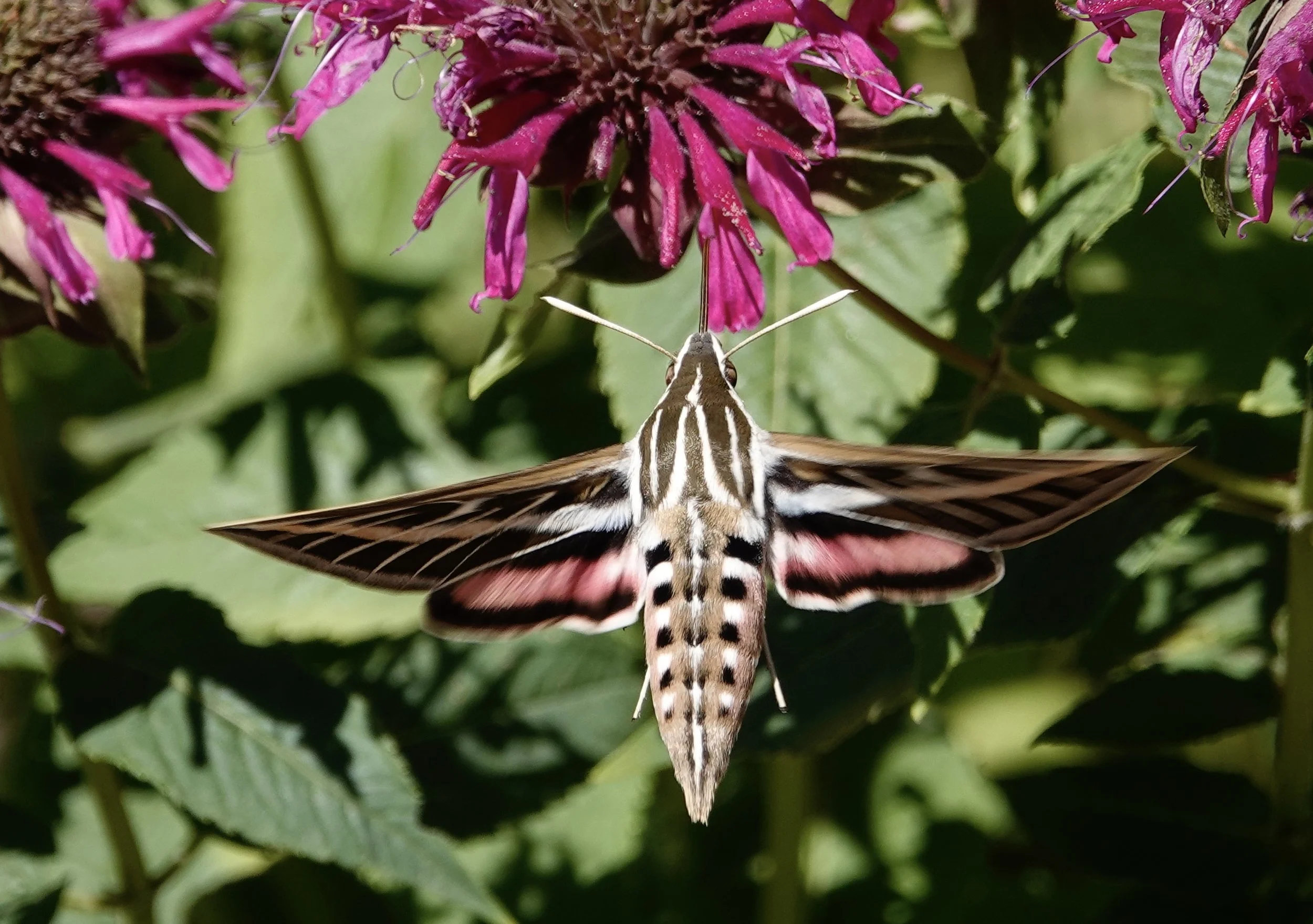
The white-lined sphinx moth, has a bird-like body and uses its 3.5-inch wingspan to hover, which causes it to be mistaken for a hummingbird. It’s called a hummingbird or hawk moth. The caterpillar is called a hornworm and has a yellow or orange horn at its back end. Its host plants include apple, evening primrose, four-o’clocks, tomato and grape. The adults nectar on cardinal flower, columbine, evening primrose, honeysuckle, hosta, phlox and petunia. Photo by Al Batt.