
Naturally
Painted lady butterfly and bumblebee welcomed the morning.
I saw no chickadees in the yard. I saw none at my feeders all winter. I miss these tiny ambassadors of avian ambrosia.
“Who’s awake? Me too!” had heralded the night’s darkness. A series of five rhythmic, muffled hoots from the woods surrounding the house. It was a great horned owl.
When I was a boy, I heard someone described as not worth a hoot in a hailstorm. When I heard all the reports of damaging hail, I’m glad I got the hoot instead.
I went for a leisurely meander where I was verbally assaulted by a goose, intent on beginning a nest. I admired the beauty of hepatica, bloodroot, Virginia bluebells and Dutchman's breeches. These early flowers depend upon ants for seed dispersal. The leaves of Virginia waterleaf (which appeared water-stained) provided more entertainment for my eyes.
A song sparrow serenaded my stroll. The bird is recognized by a song beginning with three short notes followed by a longer, lower note, closely mimicking the iconic "da-da-da-dum" opening of Beethoven’s Fifth Symphony.
An eastern cottontail rabbit built a nest in a flower bed near the house. It’s a shallow cup scraped into the soil, lined with fur and dried vegetation. Rabbits nest in unusual locations—the middle of a lawn, along a sidewalk, on a playground or in a garden. To avoid attracting predators, the mother visits her kits only briefly at dawn and dusk for quick feedings. She conceals the nest with dried vegetation between feedings.
The Feather Wars
I enjoyed reading “The Feather Wars: And the Great Crusade to Save America's Birds” by James H. McCommons. It’s an expansive account of bird conservation that chronicles the sky-darkening flights of passenger pigeons in the 19th century that were so overwhelming that they caused people to drop to their knees in prayer. The pigeons created a continuous sound of thunder and buffeting winds from their wings, turning day into dusk. Descriptions noted that the flocks brought a startling power that felt like a "great wind, the rumble of a tsunami, or the tremor of an earthquake." Then the bird became extinct.
Birds of many species gave their lives so that feathers might adorn women’s garments.
The book related the story of Charles Bendire, a 19th-century US Army officer, known for his work in oology (the study of birds' eggs). While collecting eggs, Bendire had a delicate egg in his mouth for safekeeping while he climbed, and it became stuck. In his efforts to pry his mouth open to free the egg, he broke one of his teeth. The egg, identified as belonging to a zone-tailed hawk, survived and is preserved at the Smithsonian.
I found the book wonderfully worthy and absorbing.
Q&A
Mike Bonner of Courtland asked if grape jelly is OK to feed orioles. Grape jelly isn’t likely harmful in small amounts but doesn’t provide the nutrients orioles need. Think of it as a snack or dessert, not an entree. It’s OK to provide in a shallow dish about 1 inch deep during peak spring migration. Smaller amounts are less probable to spoil in hot weather or get sticky residue on feathers. Organic, natural or bird feeding store grape jelly is better for orioles because it avoids high-fructose corn syrup. Orioles enjoy sliced oranges and drink nectar made of one part granulated white sugar to four parts non-distilled drinking water. Heat the water if necessary to dissolve the sugar.
“Why do I see so many deer in my residential neighborhood?” Deer are found in such areas because the landscapes provide an ideal habitat with abundant food, limited hunting and few natural predators. Safety and high-nutrition resources are attractive to deer. Wooded areas and parks provide cover, resting places and travel corridors.
“How much can a wild turkey eat?” A single adult wild turkey is an opportunistic omnivore that can eat up to one pound of food per day, with consumption rates varying by age, sex and season. Hens typically consume about one-third of a pound daily, while toms can eat between half a pound and a pound, increasing intake to build fat reserves during fall. Insects, such as grasshoppers and beetles, make up a significant portion of a poult’s diet in summer. Wild turkeys generally travel 1 to 2 miles per day foraging for food, though they can travel up to 5 miles in a single day depending on habitat and food availability.
Ken Nelson of Clarks Grove wondered if there was a way to discourage common grackles from feeders. Switch to safflower or striped sunflower seed, or use caged feeders with small openings to restrict access. Use weight-sensitive feeders that close under a grackle’s weight.
Thanks for stopping by
“The world is mud-luscious and puddle-wonderful.”–E.E. Cummings.
“Sunshine is delicious, rain is refreshing, wind braces us up, snow is exhilarating; there is really no such thing as bad weather, only different kinds of good weather. —John Ruskin.
Do good.
©️Al Batt 2026
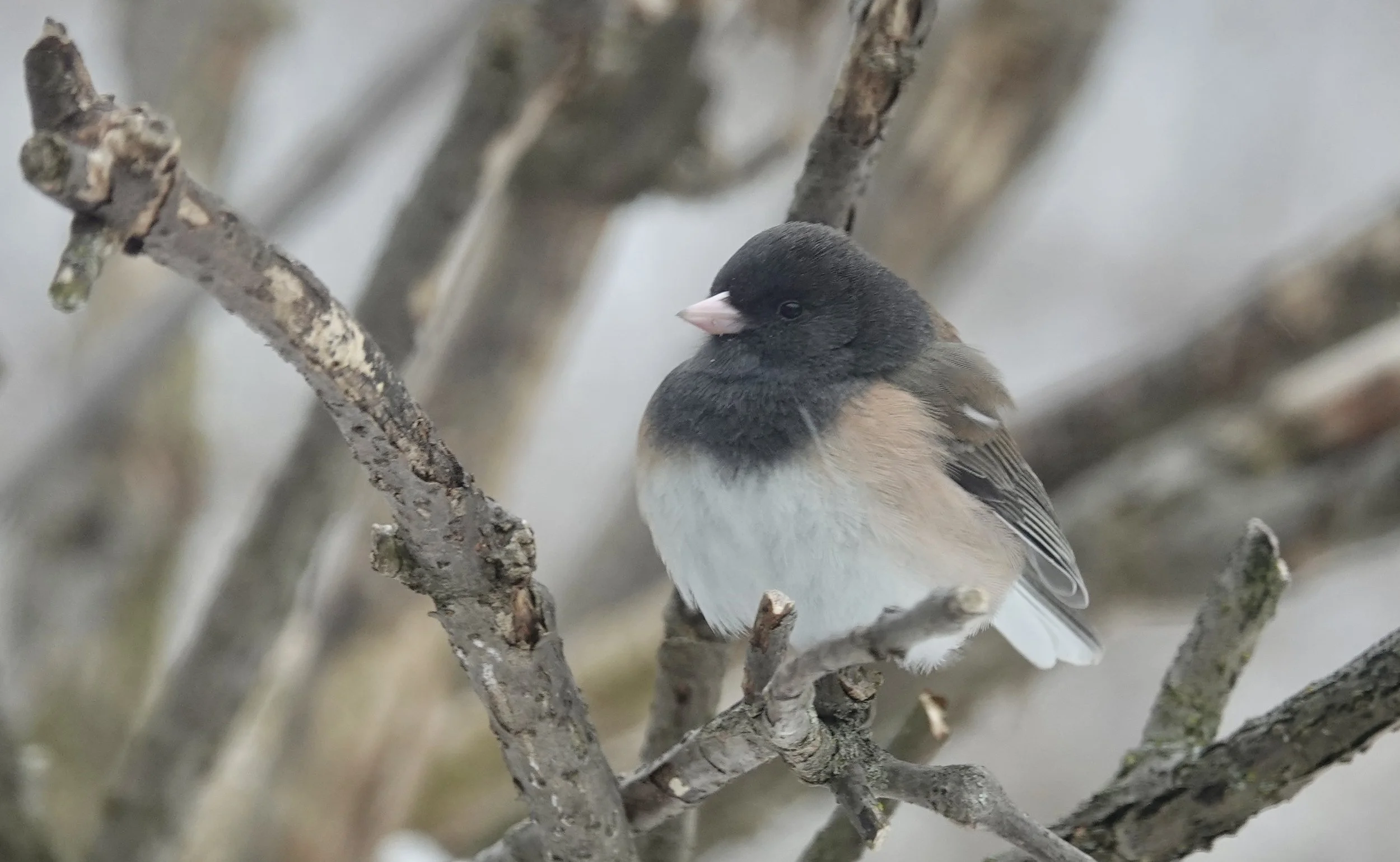
The name junco has Latin origins, meaning "rush" or "reed." It derives from the Latin word "juncus," referring to various types of reed-like plants—an odd name for a bird not partial to that habitat. The scientific name for the dark-eyed junco is Junco hyemalis, which translates to "winter rush" or "winter bunting." Many here call it a snowbird. Photo by Al Batt.