
Naturally
I did a Christmas Bird Count (CBC) and a Christmas Multicolored Asian Lady Beetle Count (CMALBC) on the same day. The latter Count was done in our house. The number of beetles indoors was impressive, as was the density of the fog outdoors.
Fog eats snow. While fog doesn't literally eat snow (I’ve never heard any sounds of a fog’s munching) or make it vanish before my eyes like David Copperfield might, but the fog does make the snow melt faster. The above-freezing air temperature contributes to snowmelt, but when fog forms, condensation occurs. The process of condensation releases energy as heat, which is released into the air. This added heat increases the rate at which the snow melts. The water droplets from the fog itself will melt snow.
I slipped and slid as I walked through the mud, snow, rain, wind, mist, ice, slush, water and fog. No treadmill could offer all that. Several deciduous trees were stubbornly hanging onto their leaves as they watched my silly stumbles—the red oak, ironwood and buckthorn.
I filled the feeders before I ventured off to ring the bells for the Salvation Army. When I returned home, there were footprints galore underneath those feeders. The squirrels and the rabbits had been busy. When a squirrel hops and lands, its larger back feet land parallel, just in front of its smaller front feet, which land side by side. The resulting shape is square-ish. Rabbits land with one forefoot in front of the other. This paints a picture of two fore-footprints behind the two larger hind-footprints resembling the letter Y. SQuirrels leave SQuare tracks, while Ys are the mark of a bunnY. Because squirrels live in trees, one of the best ways to identify their tracks is to follow them. It doesn’t take long before squirrel trails lead directly to and end at the base of a tree. Rabbits must go around the trees. Rabbits frequently leave droppings that look like Cocoa Puffs along their trails. My apologies to those who enjoy a fine bowl of Cocoa Puffs. I rarely find any squirrel scat, which is smaller than rabbit poop. That’s because squirrels prefer using porta-potties. I base that statement on a staggering lack of evidence.
Q&A
“Do birds eat snow to stay hydrated?” They do, but it uses energy to convert snow and ice to water. I watched a chickadee during a Christmas Bird Count getting water from a dripping icicle.
“What do opossums and raccoons do during the winter?” The Christmas opossum showed up in my yard this year as it does each year. A marsupial miracle. The weather was warm enough that a couple of raccoons were out for a walk to find food. Raccoons don’t hibernate during the winter. They enter a state of lowered activity called torpor, which doesn’t last as long as hibernation. Raccoons wake up to forage during this time. A warm day encourages that activity. Raccoons seek shelter in hollow trees or logs, rock crevices, woodchuck burrows, brush piles, chimneys, under buildings and in abandoned buildings. Opossums don’t have raccoon coats, so winter is a struggle. I watched one using its tail and its mouth to carry dry leaves and grass to insulate its bed. They don’t hibernate but also enter a state of torpor. Torpor may be our 51st state as many men enter into it while watching football games on TV. Opossums den up in rock piles, woodpiles, squirrel nests, tree hollows, brush piles, abandoned burrows and buildings.
“How long does a loon need to run on the water before becoming airborne and what is a loonie?” Loons need 30 yards to a quarter mile (depending on the wind) to flap their wings and run across the water to gain enough speed for liftoff. Finnish folklore says that when the creator (Nature) made the first loon, the creator accidentally forgot to give it legs. As the legless bird flew away, Nature realized the oversight and threw a pair of legs and feet at it. The legs struck the back of the flying bird’s body and they stuck there. The legs became attached far back on the bird's torso, facilitating its exceptional diving and swimming abilities while leaving it awkward on dry ground. A loonie is a colloquial term for the Canadian $1 coin or Canadian dollar, introduced in 1987. The name comes from the coin’s reverse design featuring a loon.
“Do pine siskins look like goldfinches?” Pine siskins and American goldfinches are related. The siskins can appear to be goldfinches wearing streaked pajamas. The goldfinches are slightly larger and lack streaking on their breasts.
Thanks for stopping by
"Blessed is the season which engages the whole world in a conspiracy of love."—Hamilton Wright Mabie.
“Blessed are those who can give without remembering and take without forgetting."—Elizabeth Bibesco.
Do good.
©️Al Batt 2025
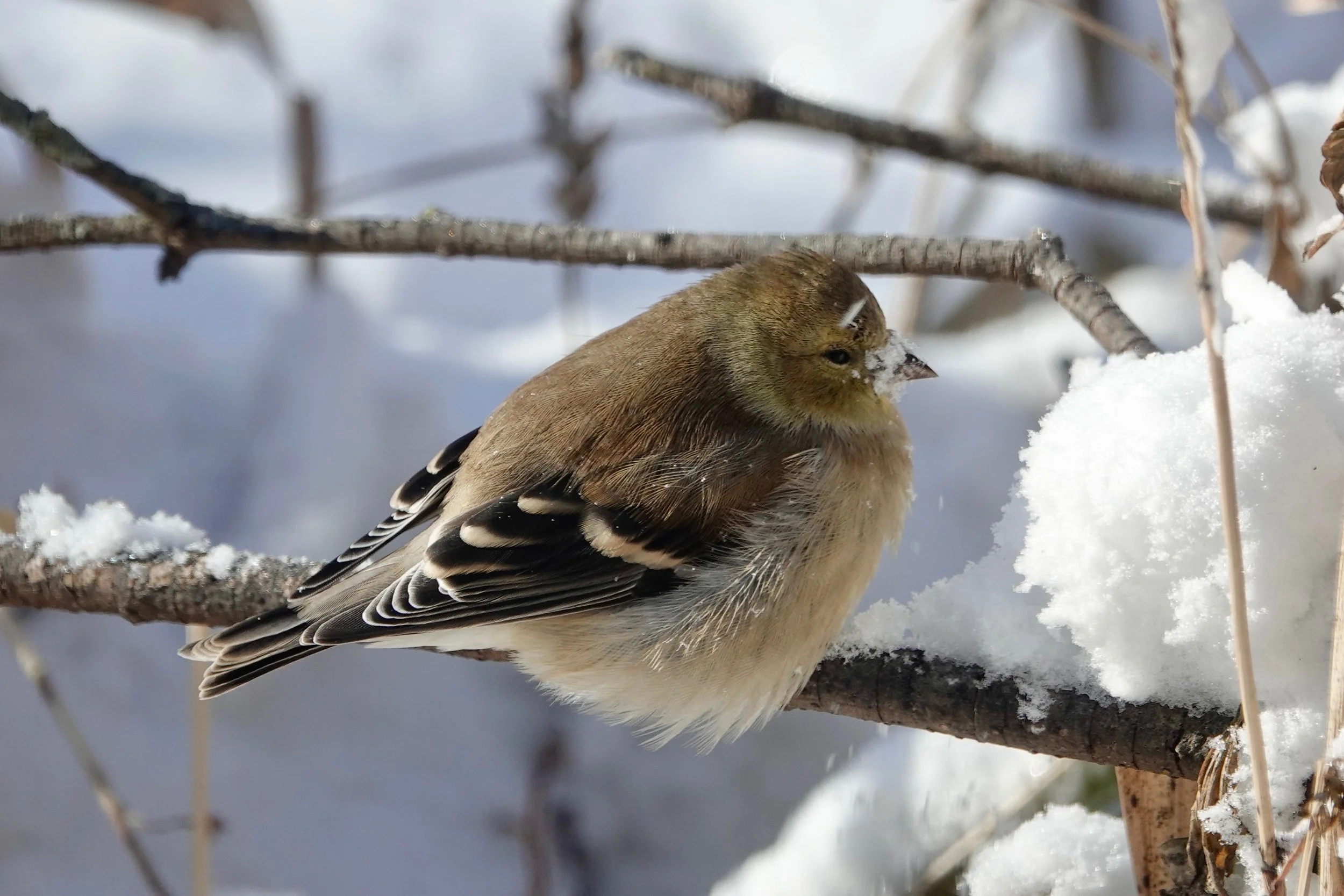
American goldfinches are now in winter (also known as nonbreeding or definitive basic) plumage. Nicknamed the “wild canary,” the male’s spiffy breeding attire fades from his vibrant colors to the duller look of the less conspicuous females. Both sexes are drab olive, with the male showing hints of yellow on the throat and shoulders. Photo of American goldfinch by Al Batt.