Naturally
We talk about the weather because it is a social lubricant that provides a safe and neutral territory, and offers an instant common ground. The weather is not controversial. Few people get into heated arguments about the weather. Weather is a great equalizer. A peasant and a king share the weather. This is an El Niño year, and it’s supposed to be a warmer and wetter winter. The exceptional meteorologist Paul Douglas wrote we could expect “an October-like November and a November-like December. A white Christmas may come down to the wire. Best chance of snow: January into March.”
The red maple in the yard had a couple of introverted leaves, refusing to join the crowd on the ground. Maybe the leaves are saying, “Why the mad rush? There is somuch to look at from up here.”
A crow clan kicked up a fuss in the yard. An American tree sparrow was hanging around with the juncos. Early European settlers named it the "tree sparrow" because it reminded them of the Eurasian tree sparrows of their homeland. American tree sparrows are ground birds. They forage on the ground, nest on the ground, and breed primarily in scrubby areas at or above the tree line.
There have been many reports of crossbills this fall. The tips of their upper and lower mandibles cross past one another rather than meeting straight on. This acts like a specialized pair of pliers. A crossbill grips a pine, spruce or fir cone, inserts its crossed bill between the woody scales, and twists its head to pry the scales apart. It then uses a long, flexible tongue to scoop out the hidden seed.
Niagara Cave (Harmony, Minnesota) is a place where I could be certain the trickle-down theory works. Stalagmites and stalactites are some of the best-known cave formations. They are icicle shaped deposits formed when water dissolves overlying limestone and then re-deposits calcium carbonate along the ceilings or floors of underlying caves. Stalactites form on ceilings and hang downward. You can remember this with the phrase “Stalactites hang TIGHT to the ceiling.” When stalactites are actively forming, they drip water. Where that water hits the floor, a mound-shaped stalagmite will form. You can remember this with the phrase “Stalagmites push up with all of their MIGHT.”
Did you know?
Arctic terns migrate from pole to pole to chase the endless summer’s sunlight, ensuring they experience two summers each year and maximize access to food. The total annual round trip is 25,000 to 50,000 miles. By following the sun, they experience more daylight than any other animal, which helps them see prey on the ocean surface.
Our national tree is the oak.
The Wisconsin Federation of Women’s Clubs sponsored a bird study and conservation program in public schools. As part of the project, schoolchildren voted for their favorite bird in 1926. The American robin received twice as many votes as any other, easily winning the popularity contest. Children chose it largely because it was common, beloved and strongly associated with spring’s arrival. On June 4, 1949, the robin was officially designated as the state bird of Wisconsin, which shares the American robin as a state bird with two other states: Connecticut and Michigan.
Deer Rock (also known as G̱uwakaan Teiyí or Peace Rock) is a historic Tlingit landmark located on the right bank of the Chilkoot River in Haines Borough, in Southeast Alaska. Its signage reads: “Deer are seen by the Tlingit as the most peaceful animals. When a conflict arose among clans or groups, the most peaceful person was chosen as The Deer to act as peacemaker and mediator between the disputing parties.”
Synanthropic wild plants or animals live near humans and benefit from human environments without being domesticated.
Q&A
“Why don’t turkeys fly more often?” It’s too expensive. You might remember an episode of the TV show “WKRP in Cincinnati,” where a radio station decides to give away live turkeys by dropping them from a helicopter. What could go wrong? When station manager Arthur Carlson returned from the disastrous promotion, he said, “As God is my witness, I thought turkeys could fly!” Wild turkeys weigh more than bald eagles but have shorter wings that don’t provide enough lift for sustained flying. They can fly up to 55 mph. Selective breeding of domestic turkeys gave the birds a low power-to-mass ratio, which makes flying nearly impossible
“When do raccoons disappear in the fall?” Raccoons don’t truly hibernate. They begin regular denning around late October. Throughout the fall, raccoons forage heavily to build up a thick layer of body fat to survive the cold. Their winter dens can be tree hollows, rock crevices or warm human spaces like attics and chimneys. They enter a state called torpor, where their metabolism slows and they sleep for days or weeks at a time. They wake occasionally and emerge during milder winter days, warmer nights, or when driven out by hunger or thirst.
“What are some common nonnative birds?” The European starling was brought to New York's Central Park in the late 19th century. The house sparrow was introduced from Europe. The rock pigeon was brought to North America in 1606 by European colonists. Eurasian collared-doves were accidentally introduced to Florida in the 1980s and have rapidly expanded their territory. Mute swans were brought to America in the late 1800s when parks and wealthy estates wanted them for aesthetics. Monk parakeets were escaped or released pets. The western cattle egret was first documented in the U.S. in the 1940s, after the birds had naturally expanded their range. Ring-necked pheasants were successfully imported from China to the United States in 1881 as game birds. Their first successful release in Minnesota came in 1916.
Thanks for stopping by
“For most of history, man has had to fight nature to survive; in this century he is beginning to realize that, in order to survive, he must protect it.”—Jacques-Yves Cousteau.
“Many eyes go through the meadow, but few see the flowers in it.”—Ralph Waldo Emerson.
Do good.
©️Al Batt 2026
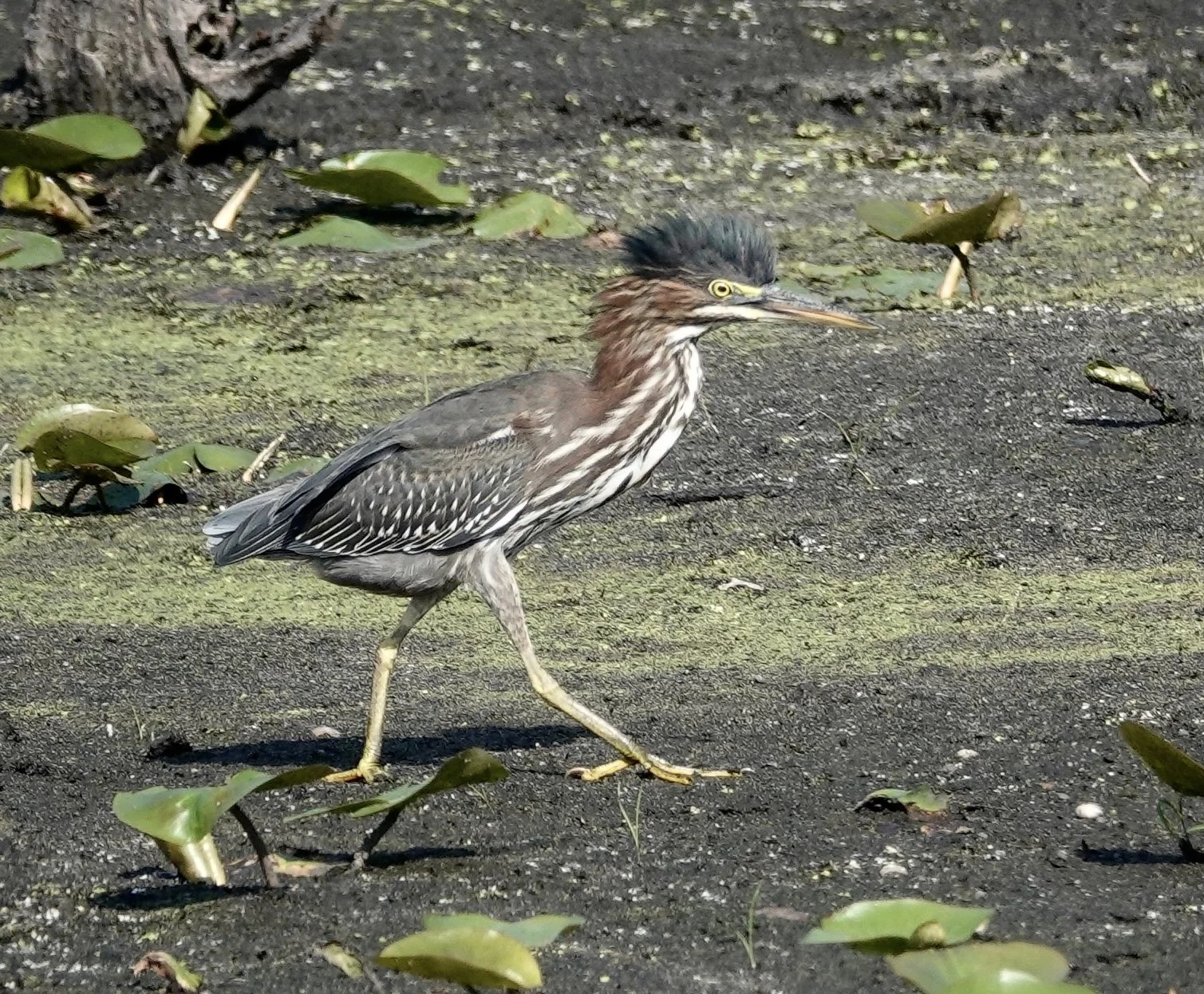
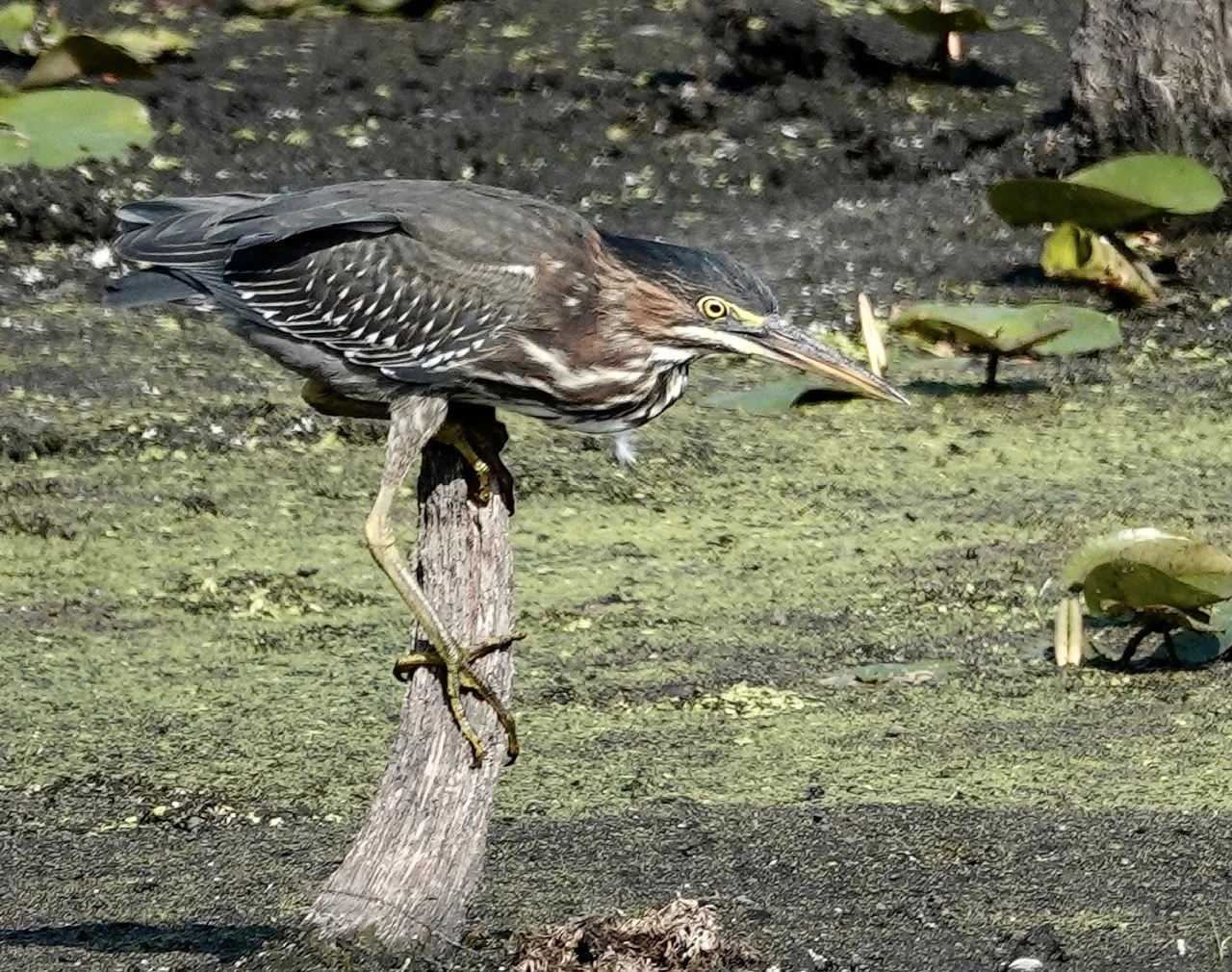
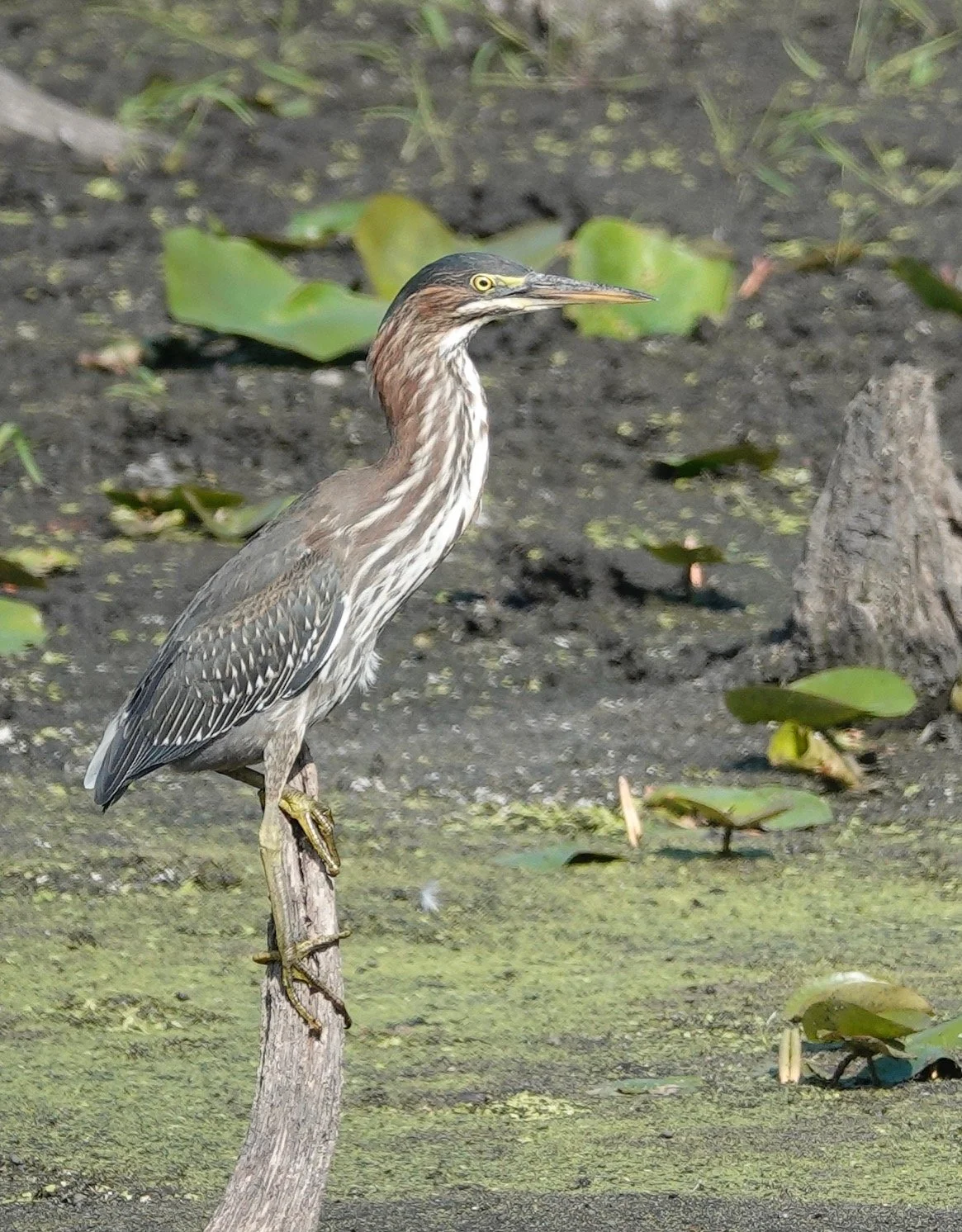
The crow-sized green heron eats mostly fish. It drops insects, feathers or twigs onto the water’s surface to act as bait to lure small fish within striking distance. This heron is an angler that makes all its own lures. Its call is a sharp “skeow!” One of the green heron’s nicknames is fly-up-the-creek because of its habit of flying low and fast up a stream or ditch when startled. Another is chucklehead. Photos by Al Batt.