
Naturally
My walk exited the leafy part of the driveway.
Fall was stretching its legs along with me. The median last spring frost in Freeborn County, Minnesota, is April 15. The median first fall frost is October 19, giving a typical growing season of 187 days.
Flickers, juncos, flocks of robins and blackbirds, and silent crickets heralded fall. But the flock stars of the day were the members of a small flock of eastern bluebirds that landed on the utility wires I walked under. A lot goes over my head. In this case, I was happy it was a flock of beautiful bluebirds.
Birds fly south because migration helps ensure the survival of their species. And they do it all without a travel agent or a frequent flyer membership.
I’d like to invite everyone to watch a bird. Chickadees, nuthatches and blue jays picked up takeout food at the feeders. Those species cache food for convenience and in case of lean times. It saves them from having to go shopping when harsh weather hits.
I never miss putting in a plug for the chickadee. It’s my favorite bird. It pays me for that honor by keeping me company. Florence Nightingale would have been even greater as Florence Chickadee.
At the end of October, I heard from a resident of the Quad Cities area in Iowa, who reported that a ruby-throated hummingbird was hanging around there. That hummingbird will never get a job working for a cuckoo clock. That position requires a bird to be punctual.
Birds are a marker of place. Bobolinks spend the summer on their breeding range in the northern U.S., including Minnesota. In the fall, they fly south through the eastern U.S., across the Gulf of Mexico, and travel all the way to the southern grasslands of Argentina, Paraguay and Bolivia for the southern summer. The round-trip spans roughly 12,500 miles.
Did you know?
California almonds depend on honeybees and require 1.7 million colonies of honey bees at the end of February when almonds bloom. That’s 80 billion bees.
Red pine needles are in clusters of two. White pines have five needles per bundle—equaling the number of letters in "white."
Q&A
“Is a flock of grackles really called a plague?” Yes, a group of common grackles is commonly called a “plague.” Other collective nouns for grackles include annoyance, cackle, cloud, colony, flock and quarrel.
“One tree in my yard had all green leaves except for one branch that held yellow leaves. Why did that happen?” When yellow leaves appear on only a single branch (or a specific section) of a tree while the rest of the canopy stays green, it typically means a localized issue is affecting the tree’s vascular system. Damage to roots directly beneath or connected to one side of the tree can cut off water and nutrient flow to a specific branch. A fungal or mechanical canker (injury) on a specific limb can choke off the branch's supply of sap and chlorophyll. Verticillium wilt is a soil-borne fungus that clogs the water-conducting vessels of specific limbs first, causing leaves to yellow, wilt and drop on one branch of a tree. Wood-boring insects or bark beetles can attack a single branch, disrupting nutrient transport.
Micah of Mankato sent me a photo for identification. It was a chukar. Micah asked why it was there. Chukar partridges are not native to Minnesota and do not have an established wild or feral population in the state. Native to Eurasia (Eastern Europe and Central Asia), chukars were imported to the U.S. in the 1930s and established wild populations mostly in the mountainous western states. When chukars show up in yards or suburban neighborhoods in Minnesota, they are nearly always escaped birds. Game farms and hunting clubs raise chukars for dog training and hunting preserves, from which individual birds occasionally escape. If it seems calm, it’s because it was raised in captivity.
“How many birds eat insects?” According to the American Bird Conservancy, 96% of all terrestrial North American bird species rely on insects for at least part of their diets at some point in their lives.
Meeting adjourned
"People need wild places. Whether or not we think we do, we do. We need to be able to taste grace and know once again that we desire it. We need to experience a landscape that is timeless, whose agenda moves at the pace of speciation and glaciers. To be surrounded by the singing, mating, howling commotion of other species, all of which love their lives as much as we do ours, and none of which could possibly care less about our economic status or our running day calendar. Wildness puts us in our place.”—Barbara Kingsolver.
“I spent the summer traveling; I got halfway across my back yard.”—Louis Agassiz.
Do good.
©️Al Batt 2026
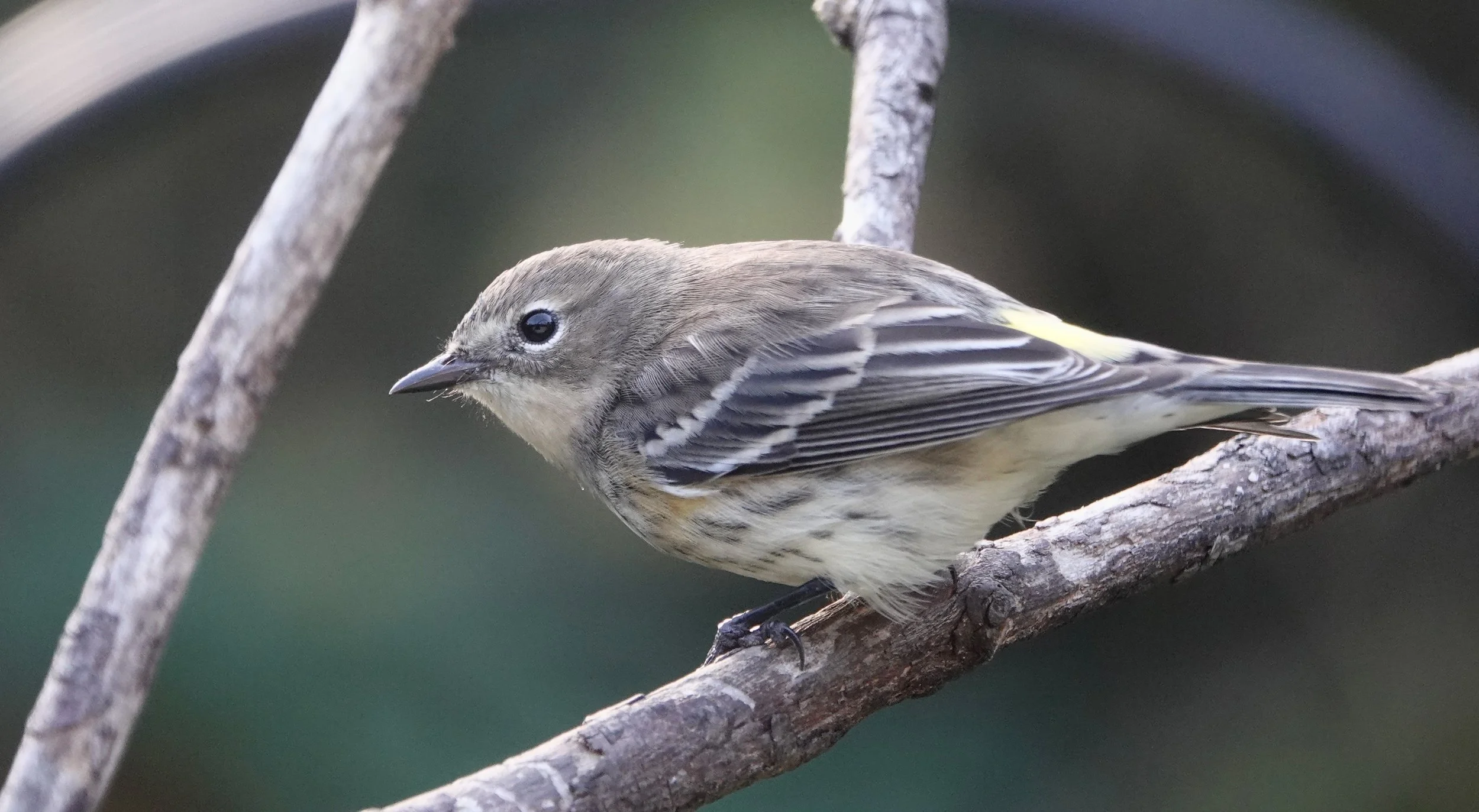
The yellow-rumped warbler is nicknamed butterbutt because of its yellow rump patch. It also has a yellow cap and yellow armpits, but is not called the yellow-capped warbler or the yellow-armpitted warbler. This warbler doesn’t go far to overwinter, traveling to the southern United States, Mexico and the Caribbean. In the fall, they are among the last songbirds to migrate south. Photo of this warbler’s fall edition by Al Batt.