
Naturally
The weather was tolerable. Some might have called it barely tolerable, but the onslaught of winter had paused. That meant bad weather was on the way.
What do we do when severe weather looms? We go to the store and stock up on the necessities like Twinkies and Bugles. Birds do something similar. They find food and eat a lot of it. Because most birds can’t go to the grocery store (I see an occasional house sparrow in one), I top off the bird feeders, while waving my pom-poms. I’ve found the simple act of filling a feeder gives me a sense of place.
As I did that cheering chore, I nearly stepped on a tiny shrew. It had been eating sunflower seeds spilled on the ground. The northern short-tailed shrew is the largest shrew species in Minnesota, at 4 to 5 inches long including the tail, and weighing up to 3/4 ounce. It has smaller eyes than a mouse, no visible ear flaps, and an elongated, pointed snout. Mice, voles, rats, squirrels, chipmunks, woodchucks and beavers are rodents. Shrews and moles are not rodents. They belong to the order Eulipotyphla, a group of small mammals that specialize in eating insects. Shrews will eat grubs, worms, snails, slugs, spiders, other small animals and plant materials like sunflower seeds. The heart of a short-tailed shrew beats between 800 and 1000 times per minute. Bats aren't the only mammals to use echolocation. Shrews use it to help them navigate in dark environments. The short-tailed (northern and southern) shrew is the only venomous mammal in North America. This shrew’s saliva contains a neurotoxin that kills or paralyzes its prey. One well-placed bite helps to subdue or kill larger prey such as mice and voles. It holds medical potential with a component being studied as a possible treatment for ovarian cancer. Shrews have an exceptionally high metabolism rate, and these opportunistic omnivores have a voracious appetite that serves their need to consume the equivalent of their body weight each day.
“The Taming of the Shrew” is a comedy written by William Shakespeare. The word "shrew" comes from the Old English, "shrewe" and means the animal or an "ill-tempered, scolding person."
Q&A
“I saw a mouse in a tree. Is that normal?” In Minnesota, the mice in trees are typically deer mice or white-footed mice, both of which are adept climbers that use trees for nesting in cavities, abandoned bird nests, or for foraging. They use their long tails for balance. They are highly active in wooded areas and can be found in trees year-round, including during winter. These arboreal mice do not hibernate and can be seen around and in homes.
“How do turkeys survive winter?” Wild turkeys spend their hibernal time looking for food and roosting in trees. Winter is hard on turkeys. It’s hard on us. Turkeys are tough and made to survive severe weather. They reduce movement to conserve energy and heat. Conifers make reliable roosting trees because they shelter the birds from the wind. Trees on southern-facing slopes offer more sunlight. Turkeys switch to a diet of acorns, waste grains, seeds and fruit (apples, cherries, etc.) and scratch for food where the wind has swept the snow away. The males sometimes practice strutting because a male can never look too cool.
“Are rabbits and bats rodents?” No, neither rabbits nor bats are rodents. Rodents are in the order Rodentia, while rabbits are in Lagomorpha and bats are in Chiroptera. Chiroptera means "hand-wing." Bats are more closely related to primates (like humans) and cats than to rodents. They are the only mammals capable of true flight.
“Where might I see a seahawk other than in Seattle?” There is no such thing as an avian seahawk. No ornithologist would refer to a raptor as a seahawk, but some people might consider “sea hawk” to be a nickname for ospreys or skuas. A skua isn’t a hawk. Skuas are predatory, gull-like seabirds known for their aggressiveness and kleptoparasitism (pirating food from other birds). The term "jaeger" is used in North America for the three smaller species, while "skua" refers to the larger species. The bird that leads the football team onto the field is an augur hawk, native to Africa. It’s not a sea hawk.
Thanks for stopping by
“I, not events, have the power to make me happy or unhappy today. I can choose which it shall be. Yesterday is dead, tomorrow hasn't arrived yet. I have just one day, today, and I'm going to be happy in it.”―Groucho Marx.
"People need wild places. Whether or not we think we do, we do. We need to be able to taste grace and know once again that we desire it. We need to experience a landscape that is timeless, whose agenda moves at the pace of speciation and glaciers. To be surrounded by the singing, mating, howling commotion of other species, all of which love their lives as much as we do ours, and none of which could possibly care less about our economic status or our running day calendar. Wildness puts us in our place."—Barbara Kingsolver.
Do good.
©️Al Batt 2026
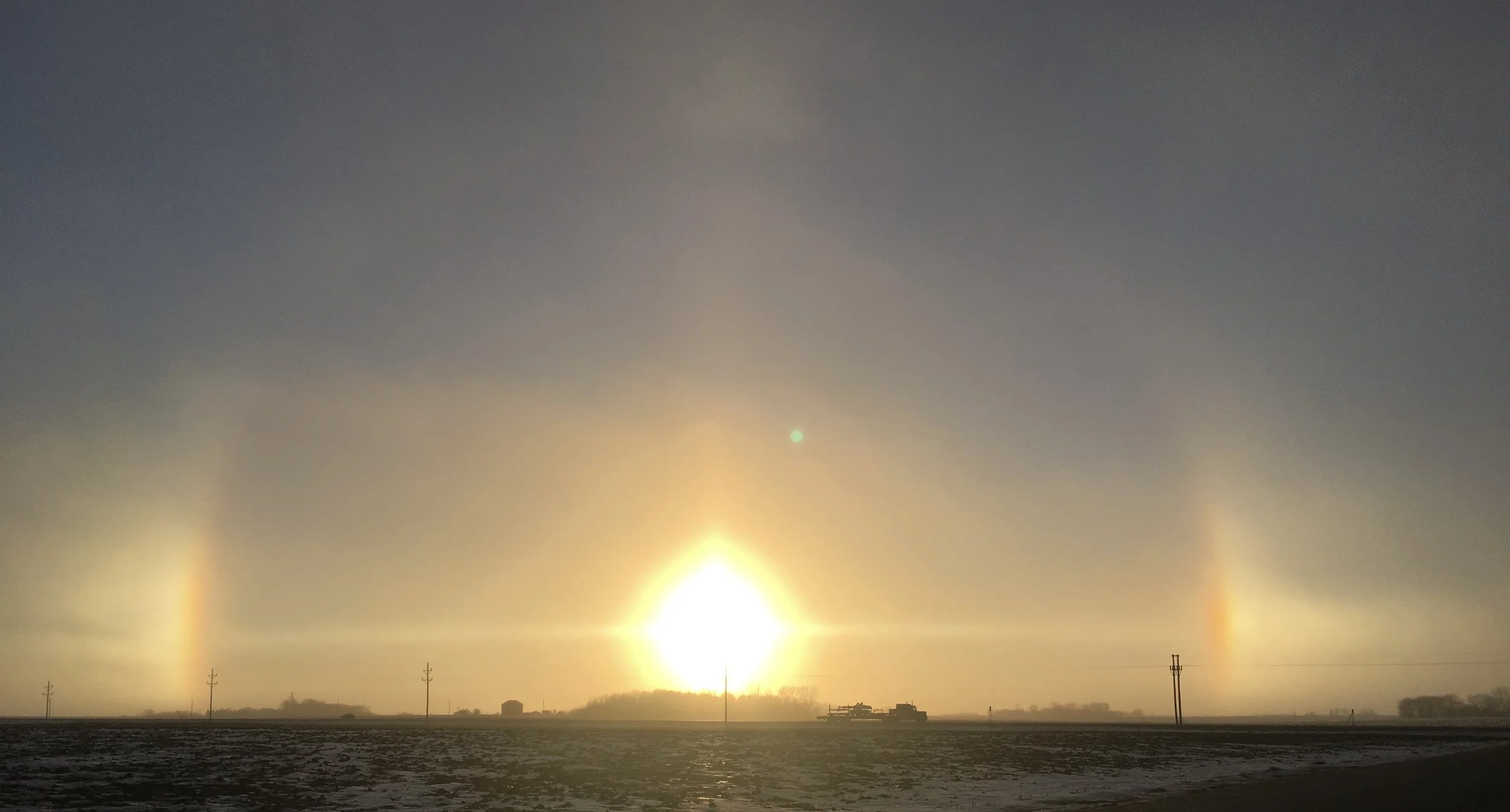
They were barking. Sundogs or parhelia, are bright, colorful patches of light that appear roughly 22 degrees to one or both sides of the sun. They are created when sunlight bends (refracts) through ice crystals acting as a prism. They display color dispersion similar to rainbows, with red closest to the sun and blue on the outside. Photo by Al Batt.