
Naturally
It was a bodacious day. There was no need for me to hide, as there was little or no wind to find me. Strong winds had left dirty snowmen in their paths, if any snowmen were still standing, in rural locations. That’s what happens when you wear white when the soil takes to the air.
The day grew sunnier. Merle Hall was kind enough to send me a book titled, “How to Tell the Birds from the Flowers and Other Woodcuts” by Robert Williams Wood. The book’s verses and illustrations provide lighthearted flornithology, which is described as a blend of flora and ornithology. Here are a couple of examples of the writings from that book: “Who is there who has never heard, About the Burdock and the Bird? And yet how very very few, Discriminate between the two, While even Mr. Burbank can’t, Transform a Bird into a Plant.” And “Upon this cake of ice is perched, The paddle-footed puffin: To find his double I have searched. But have discovered—Nuffin.”
The birds in my yard headed for their hideouts. That was for good reason. I saw a hunting Cooper’s hawk. It was a female, significantly larger than the male. According to the Cornell Lab of Ornithology, small birds are safer around Cooper’s hawks than are medium-sized birds. Starlings, mourning doves, rock pigeons, robins, jays, flickers, quail, pheasants, grouse and chickens should be on a constant vigil when a Coop’s is near. Cooper’s hawks also prey on mice, voles, chipmunks, squirrels, small rabbits and bats. Even though this hawk displays incredible agility, a study showed that 23% of the Cooper’s hawks examined had healed fractures in the bones of their chest. Their wishbones had taken a battering. They had likely flown into windows and other things while in pursuit of a meal.
Book report
I saw a Christmas hawk, a rough-legged hawk, which I see regularly on Christmas Bird Counts. Falconers infrequently use rough-legged hawks. I haven’t taken up falconry, but I did get around to reading “H is for Hawk” by Helen Macdonald. I’d been fixin’ to do that for years. In T. H. White's “The Sword in the Stone,” the wizard Merlin transforms Arthur into a small falcon known as the merlin. White was a frustrated falconer with a goshawk. Goshawks are mysterious creatures in both White’s and Macdonald's books. The name goshawk comes from the Old English words for "goose" and "hawk." Attila the Hun chose the fierce goshawk as the emblem on his helmet. When Macdonald’s father died, she was devastated. Driven by grief, she found the goshawk's temperament mirrored her own. The book is an account of bereavement, natural history, biography and a memoir of a life with a goshawk named Mabel. In the end, it’s a triumph over adversity.
Q&A
“Do fish have eyelids?” Eyelids help moisten eyes, so they don’t dry out. Eyelids protect eyes from things in the air, like dirt and dust. Most fish don’t have eyelids because they live in water, which keeps their eyes moist and protected with no need to blink. Fish don’t close their eyes to sleep; instead entering a resting state while staying alert. Some species, including sharks and certain mackerel, have an "adipose eyelid," which is a transparent, fixed covering, or, in some sharks, a nictitating membrane.
“A neighbor uses coyote urine to keep deer away. Its effectiveness is questionable, but where do you get coyote urine?” From coyotes. Sorry about that. Coyote urine is purported to discourage deer from loitering where they aren’t wanted (not everyone falls for the irresistible charm of deer), and fox urine is supposed to keep rabbits out of a garden. Research is mixed regarding the results. If you’re asking where to buy it, big box stores and online. I’m sure your favorite local garden center could get it for you. If you’re asking where those who supply the retail channel get the urine, the recycled urine is collected at facilities housing the animals by use of specialized floor drain systems that collect the liquid into storage containers. If you use coyote urine to deter deer and it attracts too many coyotes, you’ll need to buy wolf urine to keep Wile E. away.
“Do red-tailed hawks migrate?” Many red-tailed hawks in Minnesota do migrate south for the winter, beginning their journey in the fall. Many of these hawks move to southern states, with juveniles often migrating farther south than the adults. Others endure our lovely winters and are found in open fields near cities or farmland. The red-tailed hawk is a winter resident in the southern half of the Gopher State.
Thanks for stopping by
“If you can’t be in awe of Mother Nature, there’s something wrong with you.”–Alex Trebek.
“Where flowers bloom, so does hope.”–Lady Bird Johnson.
Do good.
©️Al Batt 2026
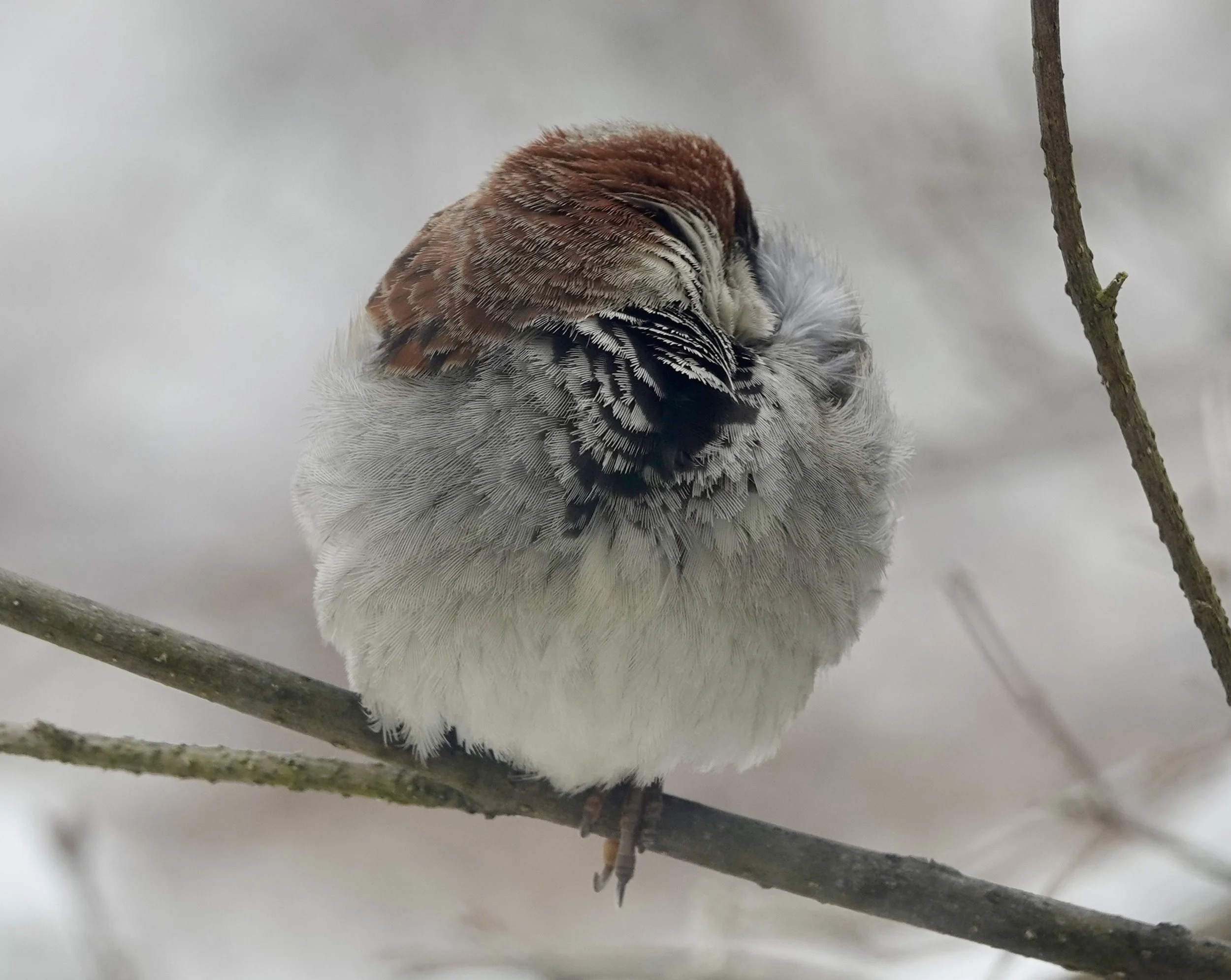
What do you do if you left home without your puffy jacket, even though your mother told you to never leave home without your puffy jacket? What do you do? If you are a bird, like this house sparrow, you fluff your feathers to trap air close to your body. This acts as insulation. And you poke your beak under shoulder feathers to keep it warm on a beak-chilling day. Photo by Al Batt.