
Naturally
I love seeing birds. On a day in our second winter when the wind was angry enough to blow the whiskers from my face and the blowing snow had a bite; I discovered once again that I’m happy to watch house sparrows. Not everyone enjoys their company, but the bird once known as an English sparrow is a beautiful, interesting creature that is doing what it needs to do to get by. The sparrows chirped away happily on a day when a human had to look hard to find a smile.
I put peanuts in the shell in a feeder. The blue jays were busy casing another joint, but the radar of the white-breasted nuthatch worked, and the nuthatch enjoyed the peanuts. It got exercise as it hammered the legume shells to get to the nut meats. The nuthatch enjoyed a few before the peanut-early warning system of the blue jays kicked in.
Trumpeter swans are checking out nesting sites and will claim the perfect spots for raising their cygnets. More beautiful birds. Trumpeters build their nests on top of muskrat or beaver lodges, or they pile sedges and cattail tubers into a mound on sites surrounded by water. The swans warm the eggs by covering them with their webbed feet.
Chickadees are cute. Black-capped chickadees cache food items to ease their way through winter. Not only do chickadees remember their seed cache sites, they also remember which seeds had been eaten by them or by thieves. Researchers at Columbia University discovered that chickadees create neural barcodes, providing them with a system for managing their larders. During peak hoarding, a chickadee can store as many as 1,000 food items in a day. A study of a related species showed that as many as 80,000 seeds and insects were stored by one chickadee each fall. Work at the University of Toronto revealed that black-capped chickadees can accurately relocate caches for as long as 28 days. Chickadees spend most of their precious time near the caches where they had hoarded the most nutritious food. Chickadees remove cached items and hide them again in a new place, moving them repeatedly until they are eaten. It’s a meaningful game of hide-and-seek. The hippocampus is critical to the formation of these types of memories. Avian researchers found that the hippocampus in chickadee brains expands as the tiny birds gather and store seeds each fall. To support that incredible memory, chickadees grow 30% more neurons to add to their memory center in the fall when caching behavior peaks.
Q&A
Casey McGill asked why Albert Lea Lake was noisy in February. It was caused by the ice expanding and contracting. The singing of a nice ice ballad is due to temperature fluctuations, which create booming, cracking, groaning or growling sounds that travel across the frozen surface. This phenomenon is common during rapid temperature changes when ice shifts, cracks or forms pressure ridges that act like a drum skin. Sounds are most pronounced when there’s little to no snow cover on the ice that might muffle the sounds.
“I found a seashell in my grandmother’s house. I held it to my ear and heard the ocean. Why does that happen?” The seashell acts as a resonator, amplifying ambient environmental noise. The shell's hard, hollow and curved cavity captures surrounding sound waves, bouncing them around to create a low-frequency, echoing hum that resembles ocean waves. The shell acts as a filter, enhancing specific frequencies while dampening others. The sound is normal background noise—traffic, wind or distant conversations, which our brains interpret as the white noise of waves lapping a shore. You could get the same effect by cupping your hand over your ear, but it’s not as interesting when done by a snowbank or while shopping for peanut butter.
“Are hummingbirds found anywhere else other than in the Americas?” No, hummingbirds are found only in the New World (the Americas), ranging from Alaska to Tierra del Fuego. They live in North, Central, and South America, and in the Caribbean. Fossil evidence shows they were once present in Europe during their early evolutionary history. Attempts to introduce them to Europe in the 19th century failed, as they aren’t native to those ecosystems.
Thanks for stopping by
"Between every two pine trees there is a door leading to a new way of life."—John Muir.
“Somewhere, always, the sun is rising, and somewhere, always, the birds are singing. As spring and summer oscillate between the Northern and Southern Hemispheres, so, too, does this singing planet pour forth song, like a giant player piano, in the north, then the south, and back again, as it has now for the 150 million years since the first birds appeared.”—From the book, “The Singing Life of Birds: The Art and Science of Listening to Birdsong” by Dr. Donald Kroodsma.
Do good.
©️Al Batt 2026
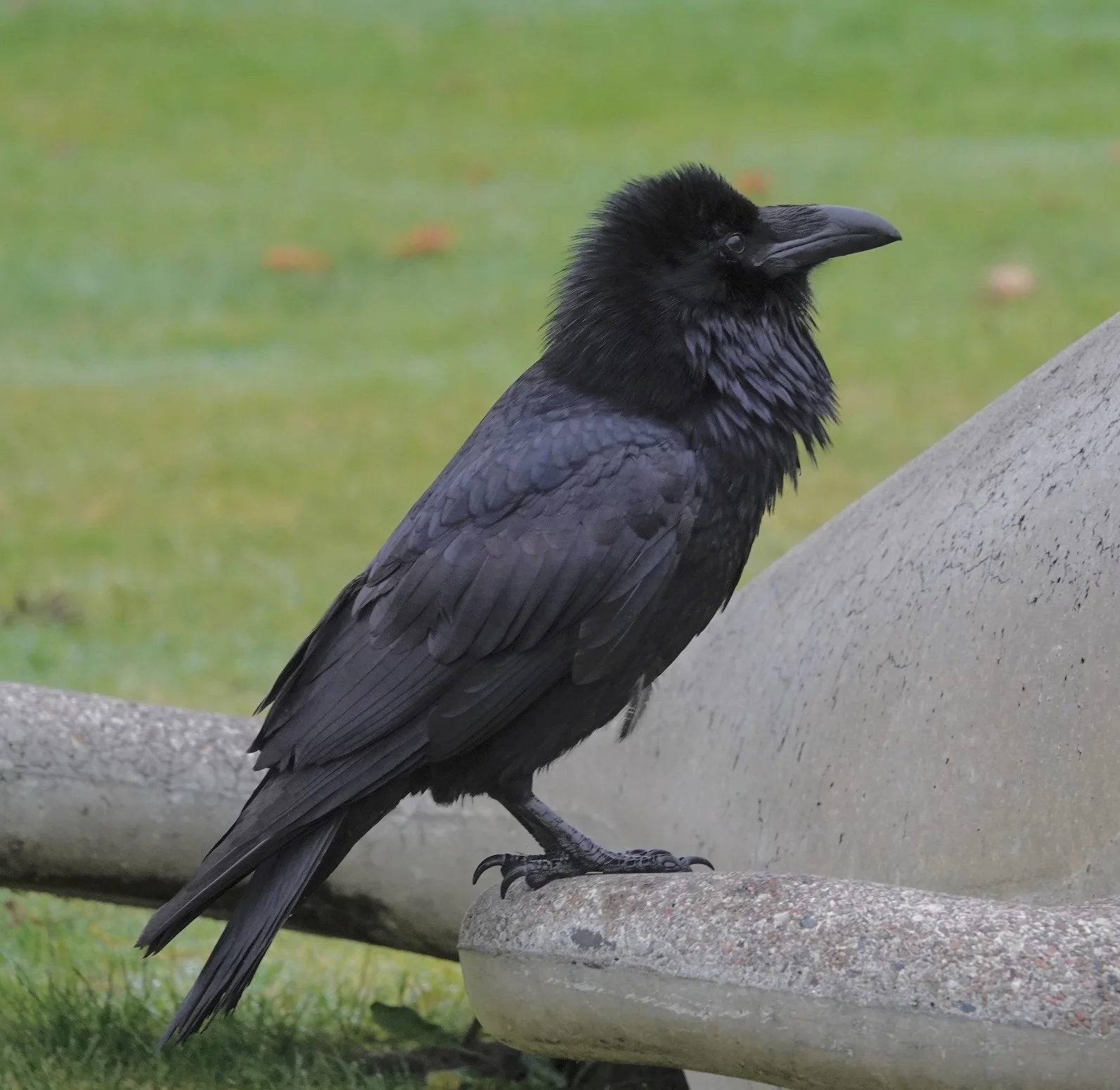
Common ravens are the largest species of Passeriformes in the world, an order commonly known as perching birds or songbirds. Ravens have wedge-shaped tails, shaggy throat feathers and deep croaking calls. They have a heavier bill than crows, which are smaller with fan shaped-tails. The raven is an opportunistic omnivore immortalized by "Quoth the Raven, 'Nevermore,'" a famous refrain from Edgar Allan Poe's poem, "The Raven." Photo by Al Batt.