
Naturally
The temperature hit the high 40s in February, and a chipmunk bopped out of its burrow to have lunch and do some grocery shopping. When cold weather hits, a chipmunk enters a state of torpor, which is a period of reduced activity and restless hibernation, in its burrow, where it can avoid the harsh elements and predators. It wakes regularly to eat from its cache of nuts and seeds.
Shakespeare wrote, “The earth has music for those who listen.” I listened to the white-breasted nuthatch, nicknamed a "tree mouse" or an “upside-down bird” that moves headfirst down trees. It commonly produces a nasal "yank-yank" call that pairs exchange while foraging. But what I heard was a male nuthatch singing a rapid, nasal, fairly low-pitched wha, wha, wha that is sometimes described as “hey, hey, hey,” “why, why, why,” “what, what, what,” or “ha, ha, ha.” Males sing these songs in late winter and spring. I take it as a welcome sign of an approaching spring or the presence of a false spring. The bird was probably wondering what sort of critter I am and if I’m a big goofy bird, perhaps an odd duck, why I can’t fly. Then it laughed at me.
A swishing shot in basketball can be called “string music.” A nuthatch can provide “spring music.”
From The Raptor Center (edited for brevity)
Male great horned owls attract mates with hoots. If the female is interested, she gives a hoot. This leads to a courtship dance of bowing, cooing and beak touching. The male might share his food with the female, a big deal for a solo predator. A mouse might be the owl equivalent of flowers, chocolates and a steak dinner. At the end of January through February, the female lays eggs (generally 1-3) in an abandoned crow, hawk or squirrel nest. Why nest so early? It's theorized that since young great horned owls require a long period to learn survival skills (6-7 months), the parents need an early start. The chicks begin exploring the branches around the nest at around 6 weeks old and are fully flighted at 8 weeks. The Raptor Center anticipates its first owlet patients will arrive in early March.
Q&A
Jennifer, Lily, Duncan and Derek of Pipestone asked if a chicken could survive in the wild. Chickens can survive in the wild, particularly if the wild is in a warm, tropical area. Think Hawaii. They do best in places that offer ample foraging and few predators. Chickens are adaptable, capable of flying to tree roosts, and can establish feral populations. They struggle in cold climates. Smaller, camouflaged or gamefowl breeds survive better than large commercial chickens. The bigger cluckers are walking billboards for hungry predators.
“Do wild turkeys and domestic turkeys interbreed?” Yes, wild turkeys can and do hybridize with domestic turkeys because they are the same species. Hybrid offspring often have lower survival rates due to abnormal plumage or reduced physical abilities compared to pure wild birds. Authorities often prohibit the release of pen-raised turkeys because they can introduce diseases and threaten the genetic purity of wild flocks. If you see a white turkey in a gang of wild turkeys, does that mean it’s a hybrid? That could be the case, but it’s more likely because of genetic variation or a mutation. The color could make them a target for predators.
“Does the early bird get the worm?” The saying “The early bird catches the worm” appeared in a collection of proverbs published in 1636, titled “Remaines Concerning Britaine” by William Camden. It suggests that being proactive and timely provides a competitive advantage. Modern behavioral ecology confirms that early-morning foraging confers measurable benefits. A 2021 analysis published in Behavioral Ecology and Sociobiology reviewed 87 field studies across 32 passerine species. It was found that birds initiating foraging within 30 minutes of sunrise consumed, on average, 22% more caloric intake per hour than those starting after 7:30 a.m. During a drought, worms burrow deeper. This means the early birds might expend more energy searching with diminishing returns. In urban environments, artificial light extends nocturnal insect activity, making dusk feeding more productive. Socially dominant birds may stay lean and agile during the day, and eat later, before a cold night. If you’re a bird stuck in a low position in the pecking order, you’ll likely need to look whenever, wherever and however possible for food, be it a juicy worm or not.
Thanks for stopping by
“There’s a whole world out there, right outside your window. You’d be a fool to miss it.”—Charlotte Eriksson.
“You cannot get through a single day without having an impact on the world around you. What you do makes a difference and you have to decide what kind of a difference you want to make.”—Jane Goodall.
Do good.
©️Al Batt 2026
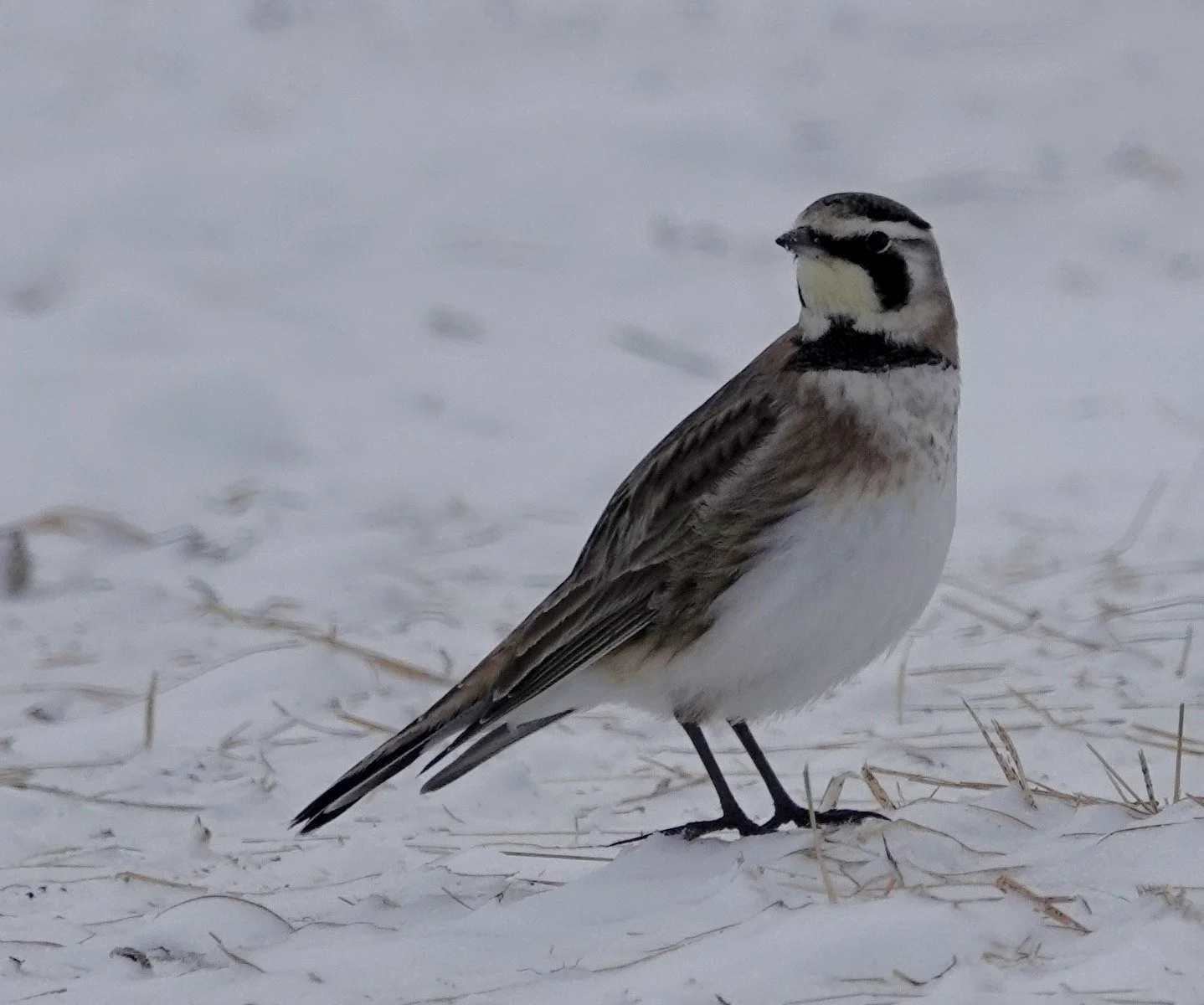
I saw this horned lark in February. The horned lark is the only lark native to North America. It prefers open spaces—the bare ground with sparse vegetation found in empty places like tundra, heavily grazed pastures, prairies, shores, airports and fields. The horned lark’s song is a high-pitched tinkling. Collective nouns for a group of larks include an ascension, chattering, exaltation and happiness. Photo by Al Batt.