
Naturally
March provides us with varied weather, most of which would be considered a brutal winter day in much of the world. It brings us hope and warm thoughts.
A south wind brought birds—red-winged blackbirds and common grackles. New avian arrivals are lovely bringers of a new day. Canada geese honked while flying overhead. I’ve been told spring generally moves northward at an average speed of about 15 to 16 miles per day. Some say it’s 20 miles per day. Spring travels 100 feet uphill per day.
I watched rock pigeons lift off from a grain storage unit. Often called barn pigeons, a flying pigeon’s heart beats can reach 600 per minute. The wind helped carry them away. The birds wore no puffy jackets.
On a frigid day with a blistering wind. A shivering friend said he wished he had an eiderdown jacket. I’ve heard of eiderdown jackets often, but I’m not sure that I’ve ever seen one in person. I know they represent the pinnacle of luxury, warmth and rarity in insulating outerwear. They feature ethically harvested, ultra-light down from Icelandic or Canadian eider ducks. Top brands offering genuine, high-end eiderdown products include Vollebak, Härkila and Paul & Shark. None of those brands are available at the local Put It Back! Store. I asked my friend why he didn’t get himself an eiderdown jacket. He told me he’d checked the prices, and they were $4,000–$6,000. He added that they could last decades. They should.
The down used is that of the common eider, a large migratory sea duck with a range along the northern coasts of eastern Siberia, Europe and North America.
One species of eider is native to the Arctic coasts of Alaska and eastern Siberia. It’s the spectacled eider, a sea duck with bold white rings around its eyes that look like goggles. Before 1995, the winter location of this threatened species was a great ornithological mystery. That site was confirmed during aerial surveys in March 1995 and further documented in 1997. The entire world population of spectacled eiders was found huddled in small patches of open water surrounded by sea ice in the Bering Sea south of St. Lawrence Island. They dive to feed on clams and mollusks, equipped with a thick plumage meant to withstand harsh conditions.
Back to the common eider, eiderdown is a type of down feather, a soft and fine layer of feathers found on the breast of the female eider duck. When the nesting season begins, she plucks the down feathers and uses them as nesting material to keep the eggs warm. People harvest the down when the young and adult birds abandon the nests in the summer. The ducks aren’t disturbed or harmed. The collected down is cleaned and used to produce filling for bedding and clothing. Approximately 85-90% of the world’s eiderdown comes from Iceland, and 10-15% comes from Canada. This down is exceptionally soft and has insulating properties superior to goose down, wool, cotton or synthetic fills. In the eiderdown business, profits are down.
A 2026 Canadian study reported by New Scientist found that expert birdwatchers have greater brain tissue density in regions responsible for attention, perception and working memory compared to novices. Birding reshapes the brain in much the same way as learning a language or mastering a musical instrument does. Athletes exhibit similar adaptations in motor areas. These structural differences, likely driven by neuroplasticity, enhance bird identification skills and may help build cognitive reserve, potentially protecting against age-related decline.
Q&A
“I watched dragonflies hunt one day last year. They never seemed to miss. How successful are they?” Harvard University researchers found dragonflies capture prey in 90 to 97% of their attempts.
“How do I tell an immature bald eagle from a golden eagle?” Young bald eagles have a dark brown plumage mottled with white with large, heavy beaks and bare legs. They take 4 to 5 years to reach plumage with a white head and tail. Young golden eagles have more uniform, dark chocolate plumage, a golden nape, smaller beaks, legs feathered down to the feet, and a distinct, broad white band at the base of the tail and white patches under the wings, most visible in flight. An adult golden eagle is mostly dark brown with a golden wash on the back of the head and nape. An adult has a faintly banded tail. A young bald eagle’s beak is a dark brown/black and gradually transitions to yellow over 4-5 years. A golden eagle has a consistent tri-colored beak (dark tip, greyish-blue middle, yellow base) throughout its life.
Thanks for stopping by
“I took a walk in the woods and came out taller than the trees.”—Henry David Thoreau.
“Each species is a masterpiece, a creation assembled with extreme care and genius.”—Edward O. Wilson.
Do good.
©️Al Batt 2026
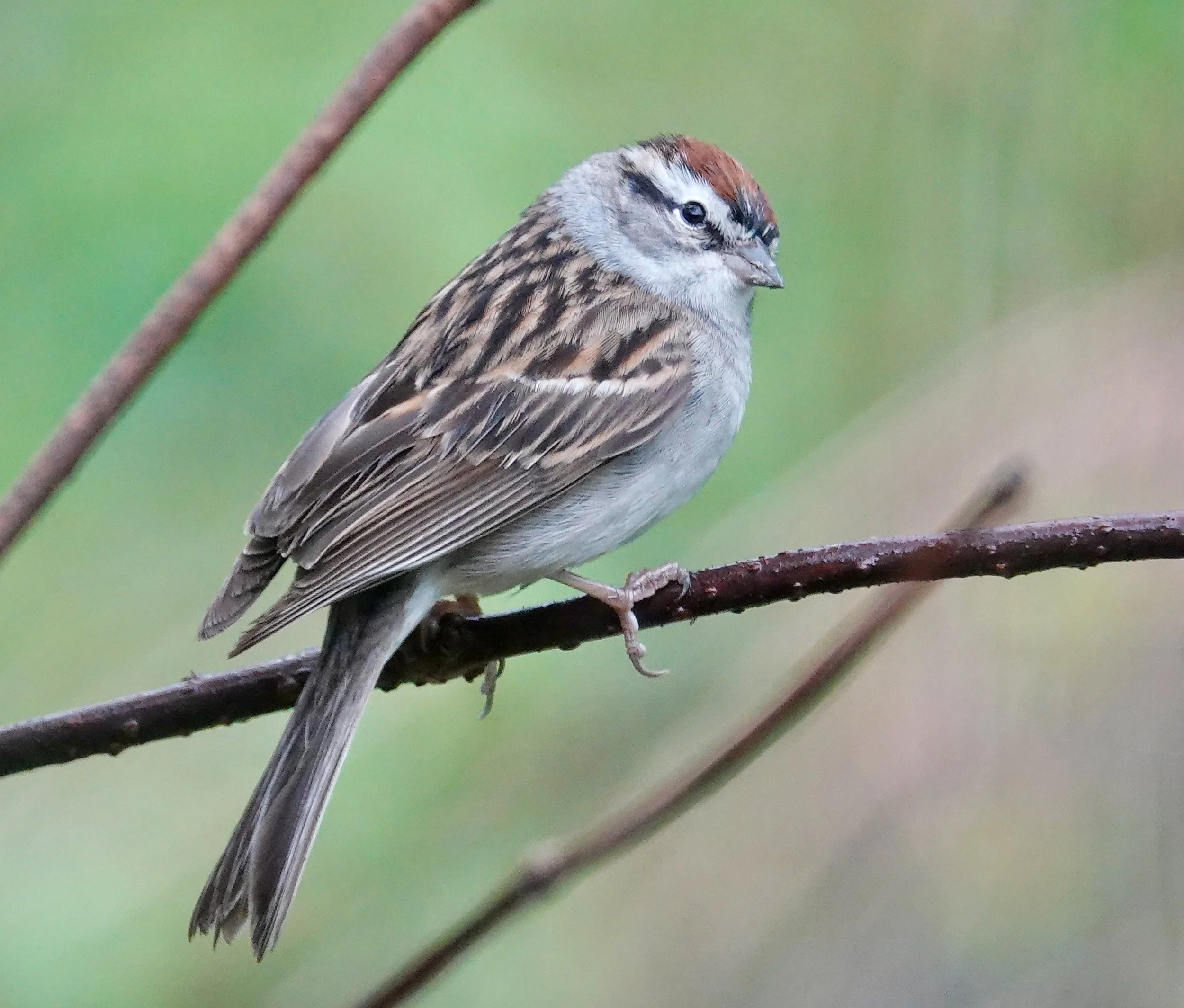
The American tree sparrow (winter) and chipping sparrow (summer) are similar small birds with rusty caps. The tree sparrow has a central breast spot (sometimes hidden), bicolored yellow/black bill, dark legs, and rusty eyeline. A chipping sparrow has an unspotted breast, black bill, light-colored legs, and black eyeline. Edward Forbush nicknamed the chippy the "little brown-capped pensioner" because it foraged for crumbs around farmhouses. Photo of a chipping sparrow by Al Batt.