
Naturally
Winter casts a giant shadow, and we can never be certain when winter will storm out of the room, but we can find hope in signs of spring. Red-winged blackbirds return—the males before the females—and post themselves on territory, where they call “look-at-me.” It’s said that American robins need three snows on their tails before it is truly spring. The robins that went south return in the spring to follow their food sources—earthworms and insects—as the ground thaws. They track a 37-degree Fahrenheit isotherm (a line connecting areas with similar temperatures) to find areas where soil warms enough for worms to surface. Their northward journey is driven by food availability and the need for nesting, rather than by temperature, although they travel according to that 37-degree isotherm. Spring brings the need to stake out breeding territories, often before the snow has disappeared. Robins sing "cheerily, cheer up, cheer up, cheerily, cheer up" to establish these territories. Look for eastern bluebirds, killdeer and common grackles. Common mergansers, buffleheads, ring-necked ducks and wood ducks find open water. Cardinals offer their spring songs. They are clear, high-pitched whistles that sound like "what-cheer," "cheer-cheer-cheer" or "birdie-birdie-birdie." The spring song of the white-breasted nuthatch is a rapid, nasal, low-pitched series of notes described as "what-what-what" or "why-why-why." Black-capped chickadees shift from their "chick-a-dee-dee" call to a clear, two-note "fee-bee" whistle; a song that says, “Spring’s here.” The bugling calls of sandhill cranes are heard. Woodpeckers are like that junior high kid who wanted to be Ringo Starr and drummed on anything that made a resonant sound. Woodpeckers drum on trees or metal chimneys. Tiny snow fleas (springtails) appear on top of melting snow on warm, sunny days. Ground cover, like creeping Charlie and weeds, starts turning green. It becomes nearly impossible not to notice the red osier dogwood (redstem or red-twig dogwood). Its vibrant colors are evident in moist, sunny areas. There are little green buds on willows—pussy willows. Red-tailed hawks are generally solitary, but they perch side-by-side as mated pairs, reflecting bonding, hunting coordination or territorial behavior. The females are larger. Package delivery people wear shorts. March 15 is officially celebrated as Buzzard Day in Hinckley, Ohio, marking the annual return of turkey vultures (incorrectly called buzzards) to the Cleveland Metroparks' Hinckley Reservation. The annual return of the cliff swallows to Mission San Juan Capistrano (California) is celebrated on March 19, marking their arrival from South America. Some people believe spring begins when the Blue Jays return to Minneapolis. The Toronto Blue Jays are scheduled to play the Minnesota Twins at Target Field in Minneapolis on April 30.
Q&A
Cheryl McRoberts of Haines, Alaska, spotted a flock of crows gathered around a dead crow and wondered if it was a crow funeral. It appears to be an organized respect for the dead, but it’s thought that crows don’t hold funerals to grieve in a human sense but gather in a large (not restricted to family members) chaotic, noisy and highly social "wake" to investigate the death of a fellow crow. It might be a fact-finding mission meant to identify the cause of death, potential predators or environmental dangers to avoid in the future. Death becomes data used to stay safe. Crows are social and extremely intelligent. Is it a recognition of loss? It looks like it. The crows know.
Jennifer, Lily, Duncan and Derek of Pipestone asked how animals know when to change their coats. Maybe their mothers tell them as ours do. The primary trigger is a change in the photoperiod (length of daylight), which generates hormonal responses. As days shorten in the fall, hormones direct the body to grow thicker, often differently colored fur. Longer daylight hours in the spring cause the body to shed the winter coat. Temperatures and food availability play secondary roles in signaling. Warmer temperatures and delayed snowfall can cause mismatches, where animals (like weasels or hares) turn white and little snow falls. This causes the animals to be obvious, which makes them vulnerable to predators or unable to hunt effectively.
Marlyss Johnson of Wells saw over 100 bald eagles gathered on a small lake named Penny Lake and wondered why they were holding a convention there. Bald eagles congregate on small lakes primarily due to an abundance of accessible food, such as winter-killed fish or fish concentrated in shallow areas. They might assemble there because of the open water for fishing or for socializing. The eagles could also be attracted to tall roosting trees near water, which are essential for resting and hunting.
Thanks for stopping by
“Orbiting Earth in the spaceship, I saw how beautiful our planet is. People, let us preserve and increase this beauty, not destroy it!”—Yuri Gagarin, first human in space.
“We are not an endangered species ourselves yet, but this is not for lack of trying.”—Douglas Adams.
Do good.
©️Al Batt 2026
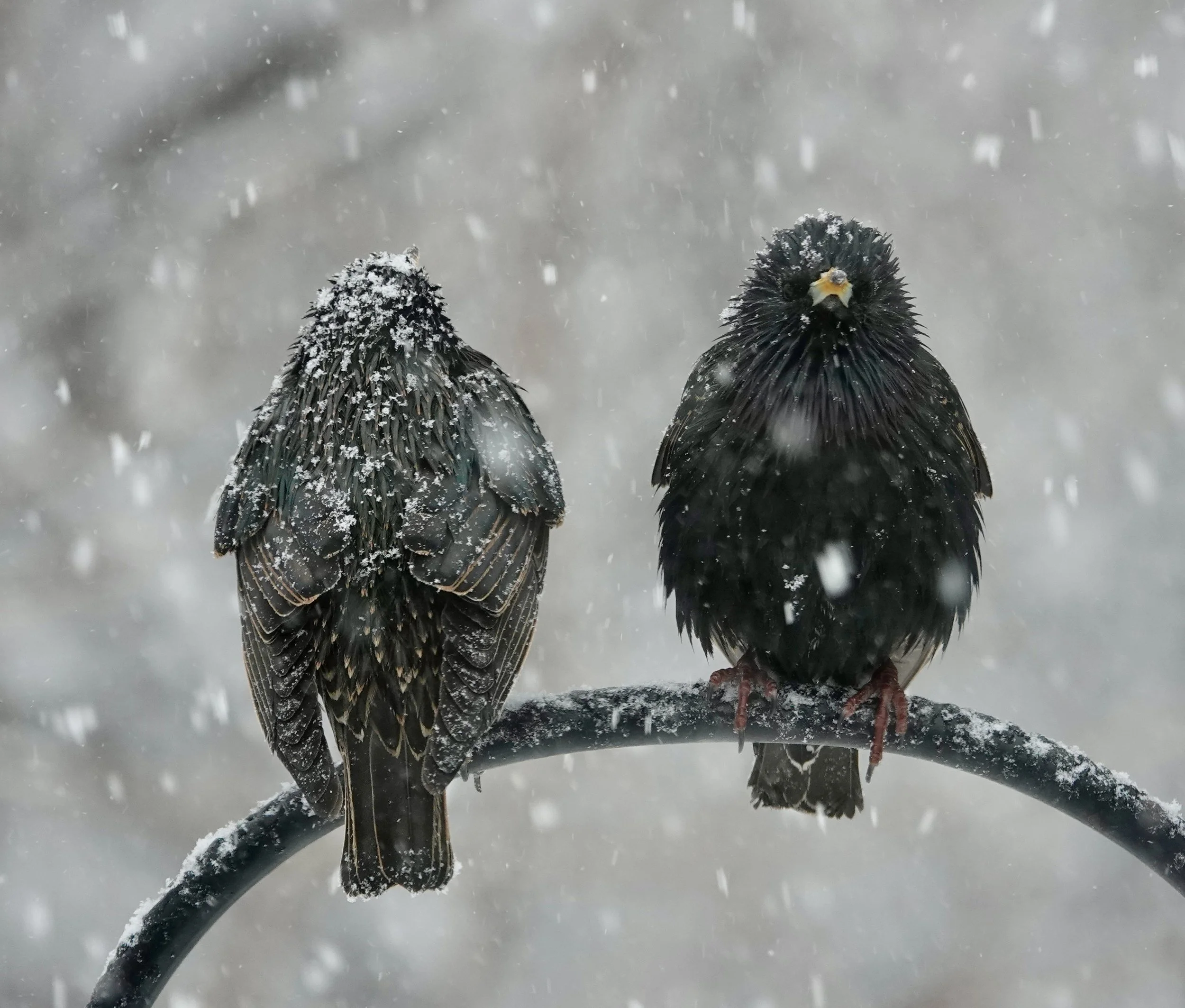
Robert Louis Stevenson wrote, “A birdie with a yellow bill Hopped upon my window sill, Cocked his shining eye and said: ‘Ain't you 'shamed, you sleepy-head!’"
These European starlings with yellow bills appeared to be somewhat less than enamored with the blizzard. Photo by Al Batt.