
Naturally
It’s spring when the first dandelion is a thrill and sneezing is a sign of spring to many.
Near a wetland, I listened hard to a marshing band, but I couldn’t tell how far a frog can jump by its croak.
April Fool’s Day brought the full, Pink Moon, named for the early spring bloom of a native wildflower of eastern North America, commonly called creeping phlox or moss phlox.
Sidewalk anthills appear in early spring, shortly after the ground thaws, as pavement ants repair tunnels and expand colonies, pushing sand and soil to the surface. The small, volcano-shaped piles are routinely seen in concrete cracks.
Pinfeather leaves appear on trees while Dr. Killdeer calls out his name and Frasier Crane (a sandhill crane) flies overhead. Flying V’s join the crane in the sky—turkey vultures.
I watched a brown creeper spiral up a tree trunk, using its stiff tail feathers for balance. The small bird with a streaked brown back is an insectivore probing bark crevices for spiders, insects, pupae and eggs. It completed its spiral, then flew down to the base of another tree to climb. They rarely come to feeders.
Michigan Bluebird Society
I had the pleasure of speaking at the MBS Bluebird Festival at a college in Ann Arbor. Speakers offered helpful hints for bluebird landlords. Barnyards where livestock is fed aren’t recommended sites for bluebird boxes because those areas are attractive to house sparrows. To reduce competition from house wrens, locate boxes at least 100 feet from treelines and shrubs. Because bluebirds are territorial and won’t allow other bluebirds to nest close to them, locate nest boxes at least 100 yards apart. If tree swallows use the boxes, put up boxes in pairs 15 to 25 feet apart. The swallows will defend both boxes from other swallows but will tolerate the presence of bluebirds in the second box. Bluebird houses can be mounted on a metal pipe/pole using pipe clamps—materials found in the plumbing section of a local hardware store. The pipe clamps should be attached above and below the nesting chamber of the house. A smooth, round pipe is the best and simplest mounting system. An ideal pole is a 1/2-inch electrical conduit. Metal poles can be polished with steel wool and coated with carnauba wax. The easiest and best type of predator guard to put on the pole is a cylindrical metal stovepipe-shaped baffle with a metal top with a hole in the middle, through which the pole goes. The metal baffle rests on a collar clamped onto the pole. The baffle should be made of galvanized steel or heavy-duty aluminum. This prevents squirrels or raccoons from chewing it and making it easier to climb. The cylinder should be a pipe baffle between 6 and 8 inches in diameter for maximum effectiveness. The top of the baffle needs to be solid with minimal gaps between the baffle and the pole. This is to prevent chipmunks or snakes from squeezing through the gap. Place the boxes at least 50 feet from bird feeders and houses. Raccoons are the biggest concern for many bluebird landlords, although cats and squirrels can be problems. Hawk attacks cannot be prevented. Deterring cats is difficult, because they leap at the adult bluebirds as they leave or enter the box. Cats can jump over 5 feet high. A cone-shaped baffle of at least a 30" diameter put on top of the cylinder baffle could help. Mealworms should be used as a supplemental treat, not a diet staple, and fed in limited quantities (100/day per pair) to avoid nutritional imbalances. They’re best used during the winter or in harsh weather. Bluebird boxes should face away from large bodies of water to prevent fledglings from flying directly into the water and drowning on their first flight.
Q&A
“Where do flying squirrels nest?” They glide up to 80 yards using a special skin membrane and nest in tree cavities or large dreys built high in trees. Dreys are balls of twigs and leaves that keep the squirrels safe, dry and cozy. Moss serves as insulation. As winter approaches, squirrels move from dreys into tree holes.
Kathryn Sloan of Mankato asked what else sounds like a mourning dove. A common mnemonic of the Eurasian collared-dove is a persistent, fast "Col-LARRRED-dove" or "who-WHOO-who," unlike the slow, mournful "Huu-lah, hoop-hoop-hoop" of a mourning dove.
“Why are tree swallow populations declining?” It’s a combination of reduced food availability (aerial insects), pesticide exposure, climate-driven habitat changes, and challenging weather, resulting in a roughly 30% decline from 1966 to 2019.
Thanks for stopping by
“I step outside each day with the intention of being blown away by something ordinary.”—Rachel Wolchin.
“In this life we cannot always do great things. But, we can do small things with great love.”—Mother Teresa.
Do good.
©️Al Batt 2026
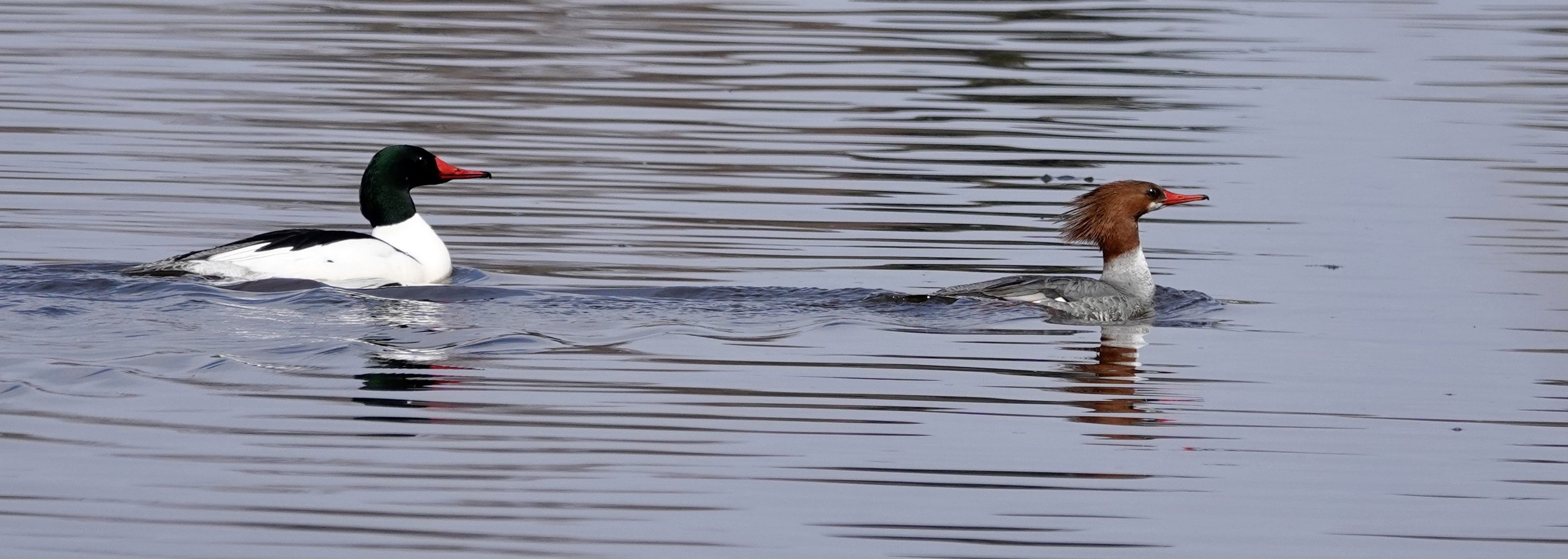
Common mergansers are large, fish-eating, diving ducks nicknamed "sawbills." Because they’re primarily piscivorous, they are sometimes called “fish ducks.” A male has a dark green head, a white body and a black back. A female has a gray body and a reddish-brown head. They have slender red bills with serrated edges, and nest in tree cavities. “Merganser” comes from the Latin and translates to “plunging goose.” Photo by Al Batt.