
Naturally
A melodious whistling came from a male cardinal wearing his Sunday best.
The robins were noisy; the chorus frogs were noisier. A flock of red-winged blackbirds, common grackles and brown-headed cowbirds swept from tree to tree. It was a giant reunion of birds.
An owl made a personal appearance in my yard. Being an owl is what owls do for a living. A great horned owl's eyes are so enormous relative to its head that if human eyes were of similar proportion, they would be the size of oranges. Owl eyes make up as much as 5% of these birds' total body weight. That may not sound like a lot, but for comparison, my eyeballs are about 0.0003% of my total weight. The grip strength in the great horned owl’s feet is 200 to 500 pounds per square inch. An average man’s handshake is 80-100 PSI.
Q&A
Jack May of Mankato asked if the red-winged blackbirds covering the lawns in March are finding anything to eat or just passing the time practicing. The red-winged blackbirds on our lawns are likely foraging for leftover seeds and early-season insects. They visit farm fields to consume seeds from grasses, weeds like ragweed and cocklebur, and waste grains like corn. As the weather warms, they begin hunting for protein-rich insects such as beetles, caterpillars and spiders. They’re good at finding food. They have to be. At feeders, they are drawn to cracked corn, millet and sunflower seeds scattered on the ground.
“What bird makes the biggest nest?” There are a few contenders. The southern Africa region is inhabited by a small bird (5.5 inches long and weighing an ounce) called the sociable weaver, which builds community nests. The social weaver is known for its elaborate nests built on trees and other tall structures like utility poles. The birds weave the nest branch by branch and twig by twig to construct huge nests that have separate chambers. A nest can reach 23 feet wide, weigh as much as 2,000 pounds, and have over 100 chambers housing 100 families or more. White stork nests are massive structures measuring 3 to 7 feet in diameter and 3 to 10 feet in height. These nests are built from branches, twigs, straw, grasses, rags and paper, and because they are reused and added to annually, they can weigh over one ton. Each spring, returning pairs across Europe add new layers of material to the existing structure. Because of the size and weight of their nests, storks choose sturdy platforms such as rooftops, chimneys, electricity pylons and large trees. Golden eagles build large nests 2 feet deep and 5 to 6 feet wide. The largest golden eagle nest on record was 20 feet tall and 8.5 feet wide. A typical bald eagle nest is 4 to 5 feet in diameter and 2 to 4 feet deep. A nest could weigh 1,000 to 2,000 pounds. The largest bird nest ever recorded was a bald eagle nest found in St. Petersburg, Florida, in 1963, measuring 9.5 feet in diameter, 20 feet deep, and weighing over 4,400 pounds (over 2 tons). Bald eagles are known to build the largest, heaviest nests of any individual bird pair, and expand the structure over many years.
“I was in your group tour in Kansas and saw black-bellied whistling ducks there. Are they common?” Black-bellied whistling ducks have rapidly expanded northward from their core range in Mexico and South Texas since the 1970s, establishing populations as far north as Wisconsin and Nebraska. They are becoming more common during warmer months in Kansas. These tropical, long-legged ducks with pink bills and whistling calls, frequently nest in Kansas, using tree cavities and artificial boxes. The ones we saw were near Ellinwood, between Cheyenne Bottoms and Quivira NWR. They typically migrate south to Mexico or the Gulf Coast for the winter.
“What do flying squirrels eat?” The southern flying squirrel is a native, nocturnal species found throughout Iowa, generally inhabiting mature oak-hickory forests. Minnesota has the northern flying squirrel, which finds the northeastern Arrowhead region a suitable habitat, with a mix of coniferous and deciduous trees. Southern flying squirrels are most common in Minnesota’s eastern counties—wherever there are sufficiently large numbers of hardwood trees like oak, maple and hickory. Their populations do overlap. The chipmunk-sized squirrels eat nuts, seeds, berries, fruit, fungi, buds, beetles, moths, insect larvae, spiders, bird eggs and nestlings, baby mice, shrews, lichens and carrion. They don’t hibernate, so they cache food for winter.
Thanks for stopping by
“He who laughs most, learns best.”―John Cleese.
“There is a quiet light that shines in every heart. It draws no attention to itself, though it is always secretly there. It is what illuminates our minds to see beauty, our desire to seek possibility, and our hearts to love life.”–John O’Donohue.
Do good.
©️Al Batt 2026
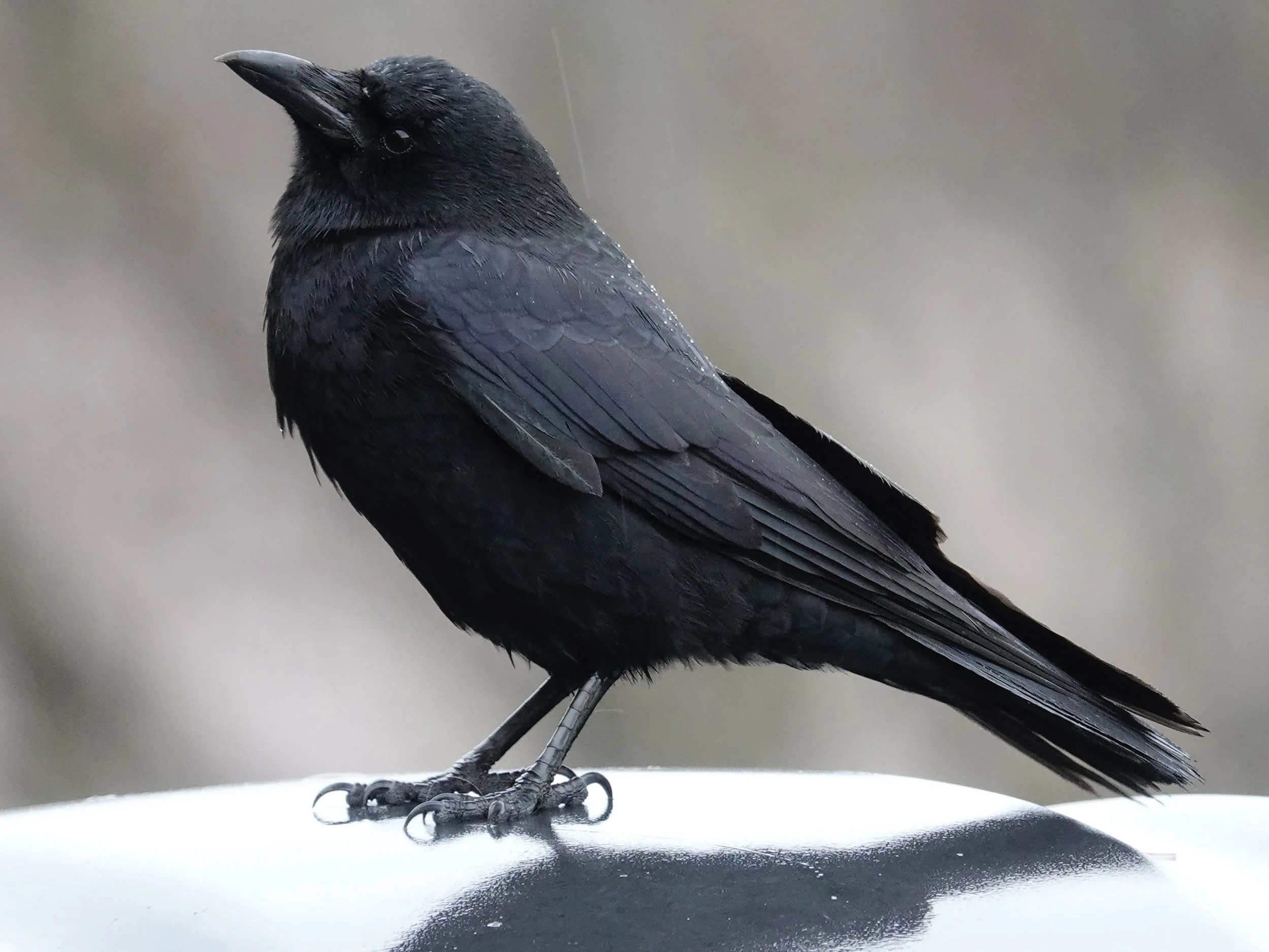
In American crow populations, older offspring help their parents raise new chicks for a few years, and this could include as many as 15 individuals, with offspring from five different years pitching in. They feed the young, defend the territory and the nest, stand guard while other family members forage, and feed their mother while she’s sleeping on the nest. American crows lay a clutch of 3 to 9 eggs, with 4 to 6 being most common. Photo by Al Batt.