
Naturally
I walked a familiar path. I didn’t need a dog to walk with me. I’d enjoy the company, but we’d be doubling up on some duties, because I am easily distracted by squirrels too.
Eastern bluebird males perch on nest boxes to survey a territory, attract mates and to guard against competitors and predators. I saw one perched on a little free library box. He was looking for a mate who was a reader.
Male goldfinches were golden rays of sunshine. Their chattering was nice to hear. The birds were in prime form, but it was as quiet as cotton on a cottontail when an eastern cottontail doe gave birth to young rabbits in a flowerbed in our yard. Cottontail rabbits typically have 3 to 8 kits per litter, with up to 4 litters in Minnesota and as many as 6 in Iowa. Rabbits are hairless, sightless and helpless at birth. They weigh about an ounce when they join this world and are no bigger than a person's thumb. To keep them warm, the mother digs a shallow saucer-shaped nest in the ground and lines it with vegetation and her own belly hair. Baby cottontails leave the nest after three weeks. I’d rather have a dozen rabbits in my yard than a single stray cat. The range of one cottontail is no more than five acres (about the size of four football fields).
I heard the harsh sounds of grackles while I watched a couple of ring-billed gulls squabbling over a french fry. They are french fry gulls that patronize the parking lots of fast-food joints offering fries.
I have been seeing ground squirrels on the sides of roads. The Minnesota Golden Gophers have a mascot named "Goldy Gopher," a character modeled after this 13-lined ground squirrel. This ground squirrel is also called a striped gopher or a squinny. Goldy is definitely not a pocket gopher, but many people think he looks more like a chipmunk than a 13-lined ground squirrel.
This and that and the other
A rose-breasted grosbeak sings like a lovesick robin.
I watched a small lake this spring. There were many ducks. It was the Duck Ages.
A Canada jay, known as a camp robber, once stole my tent. It was in a dream.
He landed close to the deck. He cawed, a bit arrogantly to my ear. I called him Russell Crow. That’s probably not his real name. “Oh, crow up!” I yelled his way. He pretended he didn’t hear me.
Mary Oliver wrote, “Around me the trees stir in their leaves and call out, ‘Stay awhile.’ The light flows from their branches. And they call again, ‘It’s simple,’ they say, ‘and you too have come into the world to do this, to go easy, to be filled with light, and to shine.’”
Q&A
“What’s the difference between a pigeon and a dove?” There is no formal distinction between a pigeon and a dove. They are all part of the family Columbidae. Which birds are called doves and which are called pigeons is decided by those who name them. They are all close relatives of chunky, small-headed birds that feed mostly on seeds and fruit. Historically, people have used dove to refer to smaller species in this family, and pigeon to refer to larger species.
“What do great blue herons eat?” Birds are survivors. A great blue heron (nicknamed shite poke, long John, big cranky, blue crane, GBH and poor Joe) eats what is within its reach, which includes fish, amphibians, reptiles, small mammals, insects and other birds. I have seen a great blue heron eat ground squirrels, chipmunks and muskrats. A GBH is 3 to 4.5 feet tall and weighs 5-6 pounds.
“Is it a millipede or a centipede?” Millipedes have two pairs of short legs on each body segment, a rounded body, and a hard external skeleton. Their legs are tucked under the body and are difficult to see. The number of body segments varies with the species, but the number of pairs of legs ranges between 40 and 400. Centipedes have only one pair of legs per body segment, which are easily spotted protruding from their flattened bodies. Centipedes have an odd number of pairs of legs that vary from 15 to 191. Millipedes have short antennae and move slowly, eating their way through moist leaf litter, fungi and decayed plant material on the ground. Centipedes are fast, have long antennae and back legs nearly as long as their antennae. Centipedes eat spiders, insects, worms and other arthropods.
Thanks for stopping by
“When you learn a thing a day you store up smart.”—Festus Haggen on “Gunsmoke.”
“If you can find a path with no obstacles, it probably doesn’t lead anywhere.”—Frank A. Clark.
“To walk into nature is to witness a thousand miracles.”—Mary Davis.
Do good.
©️Al Batt 2026
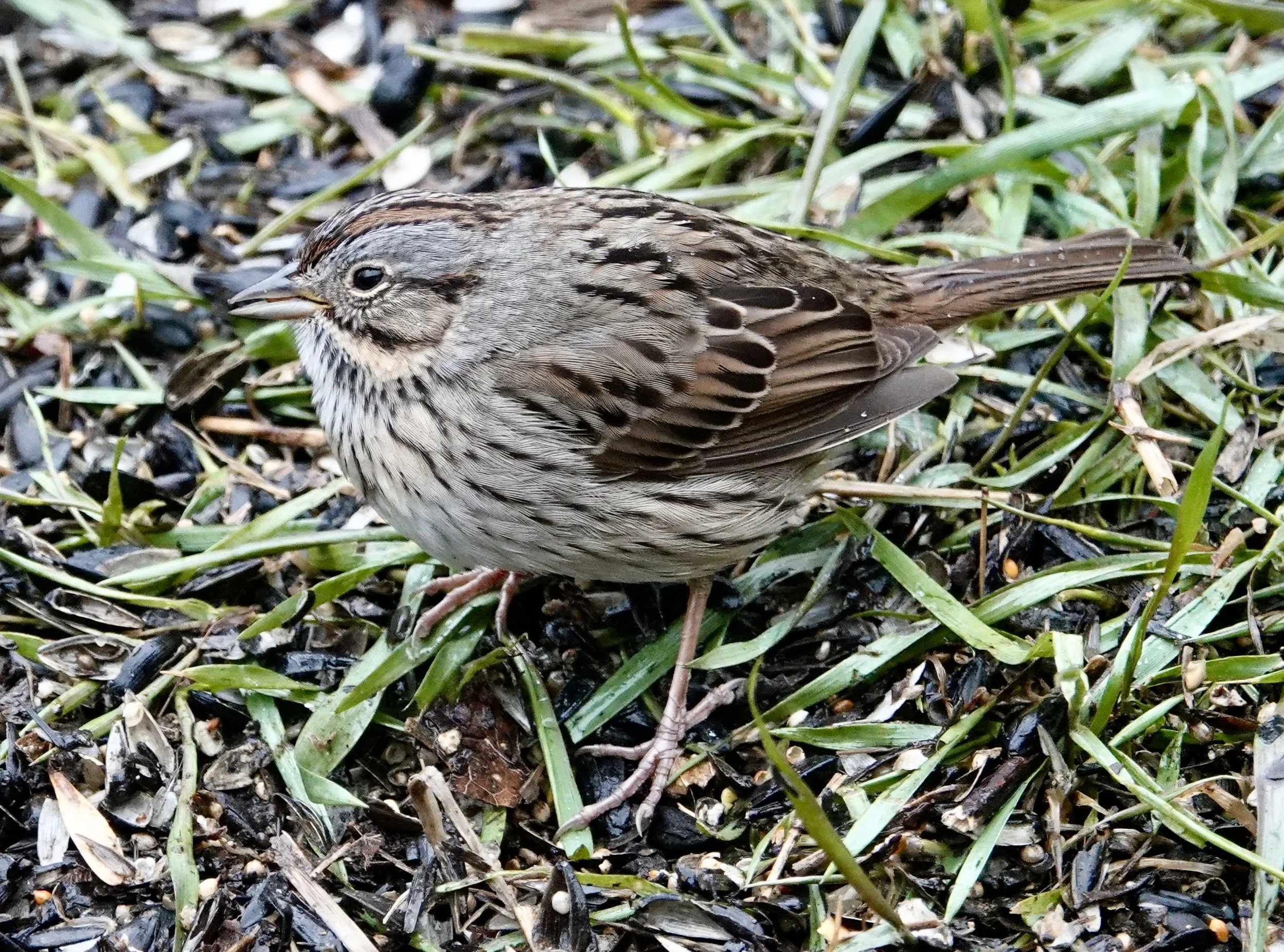
A field guide doesn’t always work. Sometimes birds defy description. One day, that LBJ (Little Brown Job) becomes a Lincoln’s sparrow. That’s a good day when that happens. No field guide, no matter how incredible it is, does a bird justice. John James Audubon named this cute, secretive, tiny sparrow after his companion, Thomas Lincoln. Photo by Al Batt.