
Naturally
“Cow-CAT!”
That’s what I heard. Ring-necked pheasant roosters crow loudly most often in spring and summer, especially at dawn and dusk. A rooster's crow is often followed by a loud, rapid beating of the wings that can be heard only from relatively close distances. Roosters frequently cackle when they fly. Ring-necked pheasants were first successfully imported from China to the United States in 1881. Their first successful release in Minnesota came in 1916. Pheasants were introduced to Iowa in 1900 or 1901, originating from an accidental release when a windstorm destroyed a game farm in Cedar Falls.
I celebrated Earth Day at Meadowlark Prairies Outdoor Lab in St. James. We don’t have a spare Earth. We need to take care of this one.
Common grackles picked at things on the ground as gulls flew overhead, getting a sky view of the world. Baltimore orioles return to Minnesota right around the time plum trees blossom.
Ants are primary seed dispersers for wild violets. The dispersal of seeds by ants is called myrmecochory. Wild ginger, with its brownish–purple flowers, depends upon ants both for pollination and seed dispersal.
A dashing male house finch found the sunflower seeds to his liking. A jaunty looking male goldfinch joined it at the platform feeder. The word "finch" originates from Old English finc (related to German fink), referring to a small, colorful songbird, and was a nickname for a cheerful or lively person. That fink is not to be confused with “rat fink," a slang term for a contemptible, treacherous or undesirable person, specifically an informer, stool pigeon, narc, squealer or snitch. “Rat fink” was famous as a grotesque counterculture mascot created by Ed "Big Daddy" Roth as an anti-hero to Mickey Mouse.
My yard hosted many purple finches this spring. The male is a handsome fellow often described as a sparrow dipped in raspberry juice. The breeding range for this species includes northwestern Minnesota, Canada, the northeastern U.S., the Great Lakes region, and the Pacific coast.
A male robin battles with a bedroom window here in the Batt Cave. He is attacking his own reflection, mistaken for a rival. This behavior is best curtailed by breaking up the reflection on the outside of the glass. The robin is persistent and robust. He is the energizer birdy.
Dandelion seeds develop apomictically , which means without fertilization. Each dandelion plant produces as many as 20,000 viable seeds, according to the University of Wisconsin. Seeds are spread by the wind. Each seed has a pappus , a feathery white structure that acts like a parachute. Their long taproots can sprout two to five shoots when damaged, which is a reason it seems as if every time we pull a dandelion, several take its place.
Q&A
“What state has the most trumpeters?” I think Louisiana has produced the most trumpet players, but California and Tennessee have had so many musicians, that their numbers of trumpeters must be high. If you’re talking about the trumpeter swans, I’d guess Alaska would have the most, and Minnesota the second highest population. A trumpeter swans has 25,000 to 35,000 feathers. A standard queen-size feather pillow may contain 2,500 feathers in a single pillow. Feather pillows consist of 51% or more feathers (often from ducks or geese) and might be blended with down for comfort.
“Where do the multicolored Asian lady beetles go after leaving our homes in the spring?” After leaving homes in the spring, multicolored Asian lady beetles (MALBs) disperse to find food, primarily feeding on aphids in trees, shrubs, and early vegetation before major crops are available. They are voracious predators, they feed on mites, scale insects and aphids on ornamental plants and early-spring flowers before moving to field crops like soybeans.
“Can birds shut down half their brains?” Yes, it’s called unihemispheric slow-wave sleep, which will never be an answer on a crossword puzzle. A brain that can function while half-asleep is important to survival. Ask any man trying to stay awake through two televised NFL games in one day. Birds can shut down one hemisphere of their brain while the other hemisphere stays alert. This adaptation allows birds to rest during long flights or remain vigilant at the edge of a flock or roost, with one eye open to watch for threats. This ability allows some migrating birds to get shuteye on the wing. Another good reason to be a birdbrain.
“What do robins eat in the spring?” Robins are omnivorous, so in addition to earthworms, they eat beetles, spiders, caterpillars, grasshoppers, grubs, crickets, snails, and the berries of chokecherries, hawthorn, dogwood, staghorn sumac, crabapples, hackberries, eastern red cedar, holly and juniper.
Thanks for stopping by
“Wherever there are birds, there is hope.”―Mehmet Murat ildan.
“What sunshine is to flowers, smiles are to humanity. They are but trifles, to be sure, but scattered along life’s pathway the good they do is inconceivable.”—Joseph Addison.
Do good.
©️Al Batt 2026
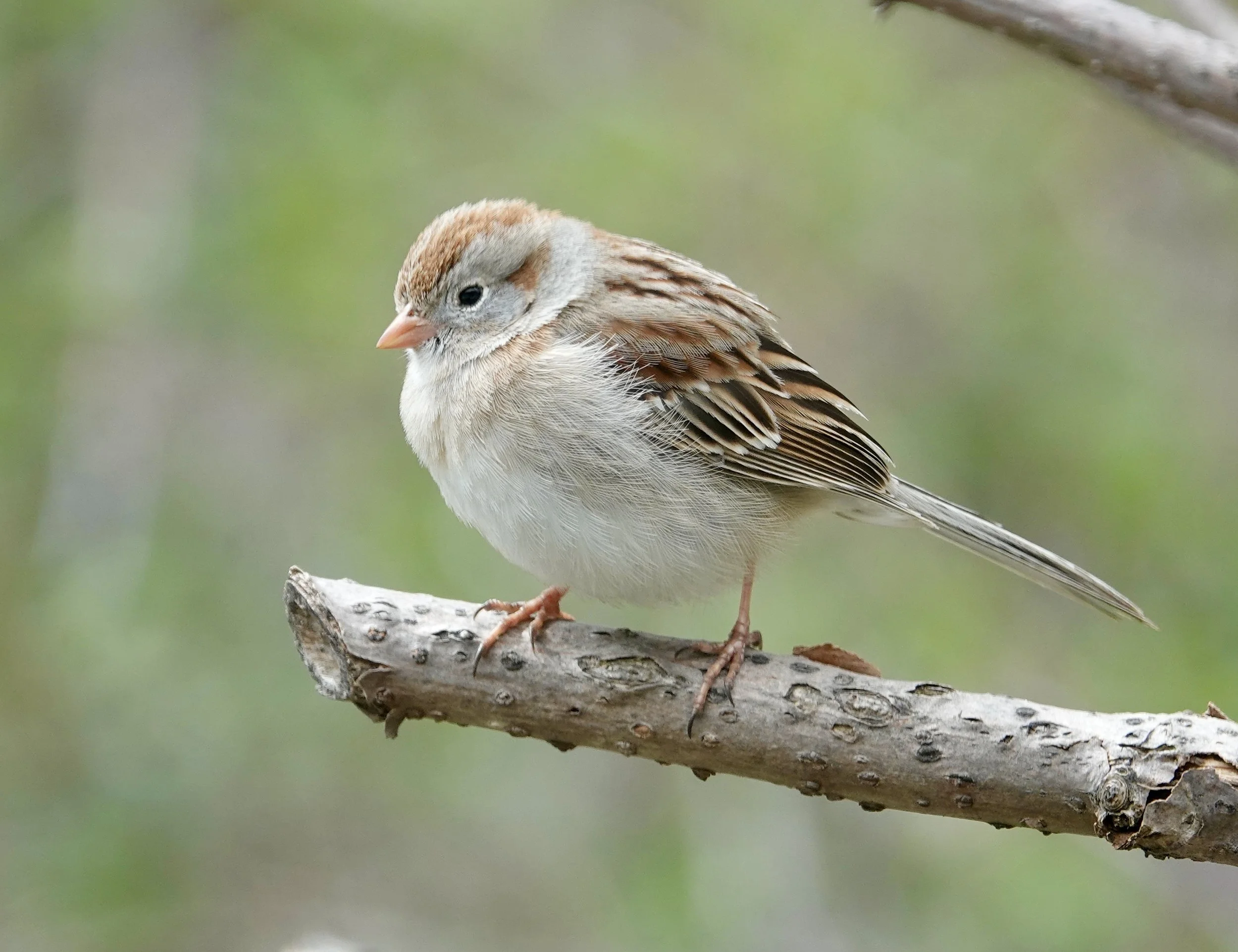
I led a walk on Earth Day. The birds we encountered most often were field sparrows. The field sparrow is a small, pink-billed songbird of open, shrubby habitats, pastures, dry fields and wooded edges. It prefers areas of grass interspersed with shrubs or small trees. Its song is a series of sweet, clear whistles that accelerate into a dropped-ping-pong-ball trill before coming to a rest. Photo by Al Batt.