
Naturally
The robin is an impressive bird. Its daytime caroling begins in the early morning. The Blackfeet viewed the robin as a symbol of peace, and a camp location was considered to be safe and secure if it had robins. On average, only 40% of robins’ nests successfully produce young, and only 25% of the fledglings survive until November. From then on, about half of the robins will live to the next year.
A rose-breasted grosbeak sang. Some describe its song as that of a robin that has had singing lessons. A robin that sings opera. This grosbeak sings while incubating eggs. Birds are typically quiet on the nests, not wanting to attract predators. Perhaps grosbeaks use reverse psychology.
I walked a group of folks around a forest in Bemidji. I stopped and invited them all to listen to an odd sound. I asked if anybody knew what it was. No one did. A good share of the people were from that area, but most guessed it was a bird of some kind. A porcupine had produced the whines, grunts, groans and squeals.
I’m seeing little concentrations of sticky, frothy bubbles on various plants. The white foam blobs are produced by the nymphs of spittlebugs, small insects related to aphids and other true bugs. They get the name from the blobs of foamy “spit” they create. Spittlebugs produce the frothy mixture by mixing air with fluid excretions, but not from their mouths. We can call it spit, but it really isn’t. Thank goodness spittlebugs don’t chew tobacco.
Researchers at Tel Aviv University found that the concentration of sugar in the nectar of evening primrose temporarily increased within minutes of sensing vibrations from pollinators’ wings.
Q&A
“Is merlin, the falcon, named after the wizard, or is the wizard named after the falcon?” The wizard gets his name from the Welsh mythological figure Myrddin Wyllt. Geoffrey of Monmouth translated it into Latin as Merlin around the year 1130. The small falcon derives its name from esmerillon, an Old French word for falcon. The merlin is sometimes called a pigeon hawk.
“Is the boxelder tree invasive?” The USDA’s definition of an invasive species is: non-native to the ecosystem under consideration, and a species whose introduction causes or is likely to cause economic harm, environmental harm, or harm to human health. A boxelder is native. Not all nonnative plants are considered invasive. Corn and potatoes are a couple of examples.
Jeff of Janesville asked what birds can sing two songs at once. Certain songbirds (like the wood thrush, veery and gray catbird) can sing two completely independent melodies at once. The vocal organ of these birds, the syrinx (located where the windpipe divides into the lungs), has two separate airways, each controlled by an independent set of muscles and nerves. A single bird can sing in harmony with itself, seamlessly switching between vocalizations without pausing to breathe. While the human voice box can produce only one sound at a time, a bird’s syrinx is a paired structure that allows birds to sing complex, fast-paced songs. Located where the bronchial tubes from each lung come together, both sides can produce sound. They can be used in concert to sing two different notes simultaneously and to complete broad sweeps in pitch quickly. Brown thrasher, northern cardinal, Swainson’s thrush, varied thrush and European starling are said to be able to perform such vocal magic. Some people claim the American robin is capable of a two-voice complexity that creates two notes at once. There is a difference of opinion as to the abilities of the various bird species to produce two sounds at once, but I will say the song of the wood thrush is definitely a gift to the ears.
“Why are robin’s eggs blue?” The source of the blue is the pigment biliverdin. One theory is that blue acts as a sunblock, striking a balance between being dark enough to protect eggs from damaging UV rays and being light enough not to overheat the eggs.
“Do purple martins nest in natural cavities?” Purple martins are secondary cavity nesters—they don’t excavate their own cavities. They use cavities that are already created, either by other animals (like humans) or in natural cavities of cliffs and rock formations. Martins traditionally inhabited forest edges or beaver dam backwaters where woodpeckers had drilled holes into dead snags. Purple martins can still be found using natural cavities in the western United States, but in the east, they depend on human-maintained nesting structures like gourds and martin houses. In the Southwest, purple martins sometimes use secondary cavities in saguaro cacti.
Thanks for stopping by
"On every vernal morning a wave of Robin song rises on the Atlantic coast to hail the coming day, and so, preceding the rising sun, rolls across the land until at last it breaks and dies away upon the distant shores of the Pacific Ocean."—Edward Forbush.
“I know he’d be a poor man if he never saw an eagle fly.”—John Denver.
Do good.
©️Al Batt 2026
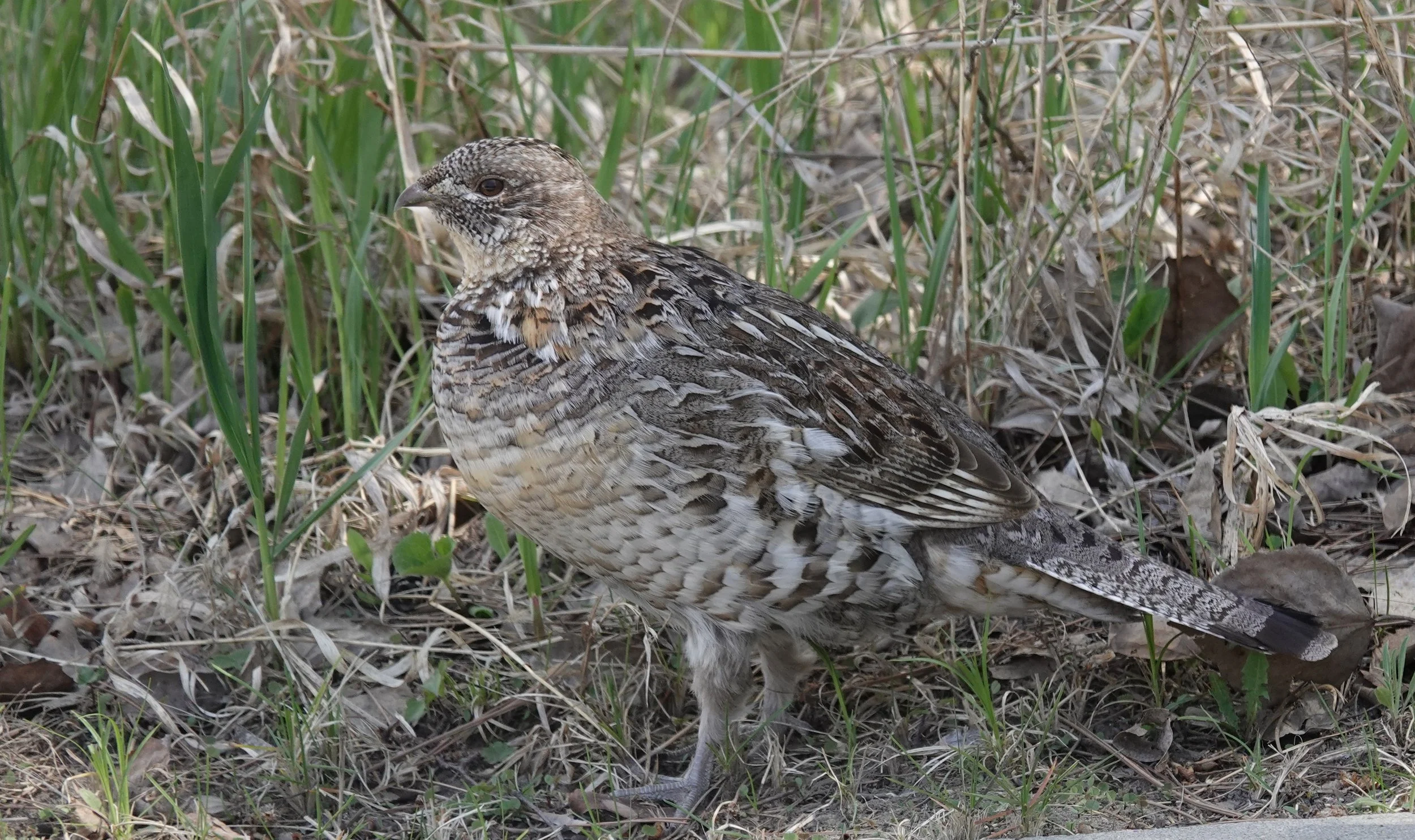
Ruffed grouse males have a concealed neck ruff that they display during courtship. Their toes grow projections on the sides in winter that act as snowshoes to help the grouse walk across snow. The grouse buries itself in soft snow to roost. As a drumming male rotates its wings forward and backward, air rushes in beneath his wings, creating a vacuum that generates a deep, thumping sound wave that carries a quarter of a mile. Photo by Al Batt.