
Naturally
Yipes! It’s winter when the weather is not nothing, but it shouldn’t need to be a contest either. Winter will win.
When I was a boy, someone gave me a ceramic bird whistle. A gift to the senses. I added water to it and then blew into the bird whistle’s mouthpiece, which produced crisp and sweet bird sounds of the warbling variety. The generic bird had a large crest and was of a solid brown color. I couldn’t identify the species by sight or sound, but it was delightful to hear, especially in January.
This reporter of avian wonders is happy to see every bird, but some more than others. A nuthatch makes me smile. A white-breasted nuthatch picked up a sunflower seed from a platform feeder and then put it down. It picked up another and put it back. It was like a grocery shopper searching for the perfect peach. Or a bowler trying to find the perfect ball to roll a 300 game. The bird picked up a third one, secured the seed’s position in its bill, and flew away. Food to go. Is it all about the thrill of the chase to a nuthatch? Are they picky, picky, picky? Is seed art a favorite hobby of nuthatches? No, it’s evaluating each sunflower seed, looking for one that had proper heft to it. It chooses one of superior quality that would make for fine eating. The white-breasted nuthatch is sometimes called the “upside-down bird” from the way it finds food.
I paid a visit to someone living in an ancient home. Aged abodes are often welcoming to critters. There was a carpenter ant walking on the floor of the house. I told the homeowner not to worry about it. Carpenter ants are busy just like human carpenters. There was no telling when it would be back.
I’ve been keeping company with a dense January fog, which is a typical Minnesota weather pattern, often linked to warm, moist air meeting cold surfaces, causing the low-visibility and mild, damp conditions. It’s the weather that grandmothers could feel in their bones. Advection fog forms when that warm, moist air moves over a cold surface, cooling the air to its dew point and condensing moisture into fog, which adds to the varied weather of our genial winters.
Q&A
“Do great horned owls bring in nesting materials?” Great horned owls don't build their own nests. They take over existing stick nests from animals like hawks (a red-tailed hawk nest is commonly used), crows, ravens, herons, eagles and squirrels, or use tree cavities, ledges, witches’ brooms or deserted buildings and deer stands, and occasionally on the ground. I saw one owl nest amid a great blue heron rookery. Great horned owls might add lining, such as shredded bark, leaves, feathers and fur from prey, or their own downy feathers plucked from their breasts to make it more comfortable and homier. Sometimes they add nothing. The nests deteriorate quickly, making it impossible for the owls to obtain insurance, and they are forced to abandon the nests.
“I saw a robin in January. Is that a rare sighting?” If you have never seen a robin before in January, it would be rare. In “Mary Poppins,” the beloved robin Mary (Julie Andrews) sang with in "A Spoonful of Sugar" was an American robin, not the European robin, which would be common in a London setting. American robins are members of the thrush family, while European robins are smaller and members of the Old World flycatcher family. The American robin was named after the European robin due to a superficial similarity—an orange breast. I know, the birds are called robin redbreasts, but they are orange—maybe a rusty-orange. The robin became the iconic bird of Christmas in the Victorian era, when postmen were nicknamed robins because of their red waistcoats. Robins appeared on Christmas cards to represent the postmen who delivered them. The European robin is the unofficial national bird of the United Kingdom. How often is the American robin seen in London? I know one was spotted in London in 2006, and others have been seen in the U.K., but rarely. So, if you live in Minnesota or Iowa and not in London, it’s not rare to see an American robin in winter. The charming robins that remain here change their diets in winter from worms and insects to fruit and berries. Robins gather in crabapple, red cedar, highbush cranberry, hawthorn and hackberry trees to chow down. The rockin’ robins can winter here because of that diet change, they are tough, they form flocks (since they lack social media), and they maintain a positive attitude.
Thanks for stopping by
“Nature is one of the most underutilized treasures in life. It has the power to unburden hearts and reconnect to that inner place of peace.”–Janice Anderson.
“Being able to smell the fresh air and disconnect from the news and your phone—there’s nothing like it.”—Jason Ward.
Do good.
©️Al Batt 2026
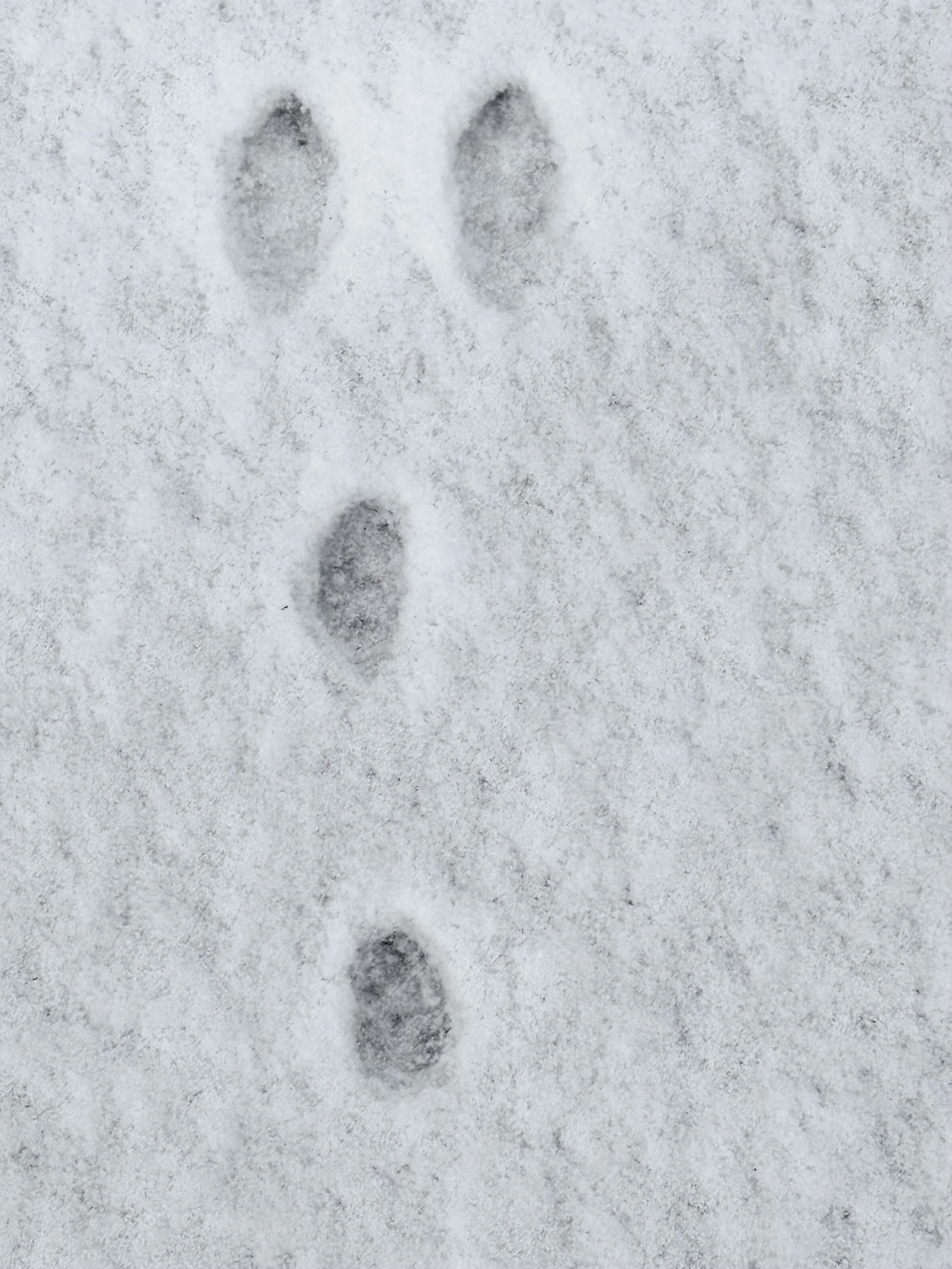
These are the tracks of an eastern cottontail rabbit. When a rabbit hops, its hind feet land in front of its smaller front feet, creating a Y shape (Y for bunnY)—the large hind prints at the top of the Y and the smaller, staggered front prints below. Squirrel tracks are side-by-side in a W shape. If the trail stops at a tree, it’s a squirrel. If it goes into the brush, it’s a rabbit. Photo by Al Batt.