
Naturally
I took a walk on the wild side.
The five-petaled, white flowers of Canada anemone are one of my favorites. It’s a lovely native that grows well in medium to moist soils.
The sweet music of birds thrills me to no end. A catbird sang its mysterious and varied song. It was obviously a mass communications major. If a human had produced the sounds, it would be called jazz scat, a vocal improvisation technique using wordless vocables, nonsense syllables and rhythmic sounds. Human singers aspire to using their voices like musical instruments or catbirds.
Fireflies (lightning bugs) used their blinkers and candle bats (moths) circled the yard light. Muggy June and July days welcome fireflies. There was a hit song in 1952 called "The Glow-Worm" by The Mills Brothers, who warbled, “Shine little glow worm, glimmer, glimmer.” Glowworms are firefly larvae. They glow to warn predators that they are toxic. Glowworms are predators of snails, slugs, worms and other insects. Adult fireflies eat insects, pollen and vegetation, but some have no mouthparts and don’t eat.
I saw some blond mallards—hybrids between mallards and domestic ducks. A female and her young family floated nearby. I was afraid the mallard hen might quack under pressure, but her ducklings were obedient and well-mannered.
A friend found a lone duckling in her yard. She had no photo, but it was likely a mallard. They are common yard waterfowl. A mallard duckling has a distinct black eyeline that runs from the bill through the eye to the back of the head. On a wood duck duckling, the eyeline begins at the back of the eye and stretches backward. A young wood duck is sleeker.
I was a co-leader of a birding bus in Detroit Lakes. Detroit Lakes has a population that doubles in the summer and triples on the weekends. I advised the participants that they should keep looking at a tree until it turned into a bird. I love seeing synchronized binocular usage. My binoculars were focused on a lovely raptor perched in a tree. It was like staring at a beautiful mountain, but the mountain was a broad-winged hawk that flew down, caught a vole, flew back to its hunting perch, and ate its prey whole. It was quite impressive.
Q&A
“Have you ever seen a moose charge?” No, but I did see one in the Juneau (Alaska) Costco once. OK, it was in the parking lot. I don’t know if it entered the store and charged any purchases. I know a guy who broke in his new Toyota by hitting a moose near Fairbanks, Alaska. In that case, the car charged the moose.
“Did you play Pokémon when you were a boy?” No, I played poke things with a stick. I turned over rocks and fallen logs. I never knew what I’d find on a nature hunt. I knew my search was done when my pockets were full of finds. I didn’t look for my ancestors from Iowa and Utah. As far as I know, none of them had ever lived under rocks. I’m the first in the family to do that. My kin moved to wherever the light was.
“What do swallows eat?” Tree swallows eat trees; cliff swallows eat cliffs; bank swallows (called sand martin in the UK, Europe and Asia) eat banks; and barn swallows eat barns. That’s not true, although there are fewer barns than there used to be. Makes you wonder, doesn’t it? I don’t think barn swallows are the culprits. Swallows are primarily insectivores, catching flying insects on the wing. Tree swallows also consume berries and seeds—especially bayberries and wax myrtle berries. Being capable of digesting the waxy coating on bayberries helps tree swallows survive when flying insects are unavailable.
“How fast can a peregrine falcon fly?” I watched Mayo Clinic’s 2026 falcon chicks, which were banded and named on May 22. The female chicks were named: Belle, for the 100th anniversary of the Mayo Clinic Carillon on the Rochester campus, and Vega, after a bright star, evoking strength. The males are Mylo, meaning a soldier or gracious, and Zephyr, meaning a west wind or a gentle breeze. According to Guinness World Records, a dive by Frightful, a peregrine falcon owned by an aviator and a falconer named Ken Franklin of Friday Harbor, Washington, was clocked at 242 mph in 1999. The falcons pay no attention to speed limit signs.
Thanks for stopping by
“Because all creatures are connected, each must be cherished with love and respect, for all of us as living creatures are dependent on one another.”—Pope Francis.
“That′s life. That′s what all the people say. You're riding high in April, shot down in May. But I know I'm gonna change that tune. When I′m back on top, back on top in June.” As sung by Frank Sinatra.
Do good.
©️Al Batt 2026
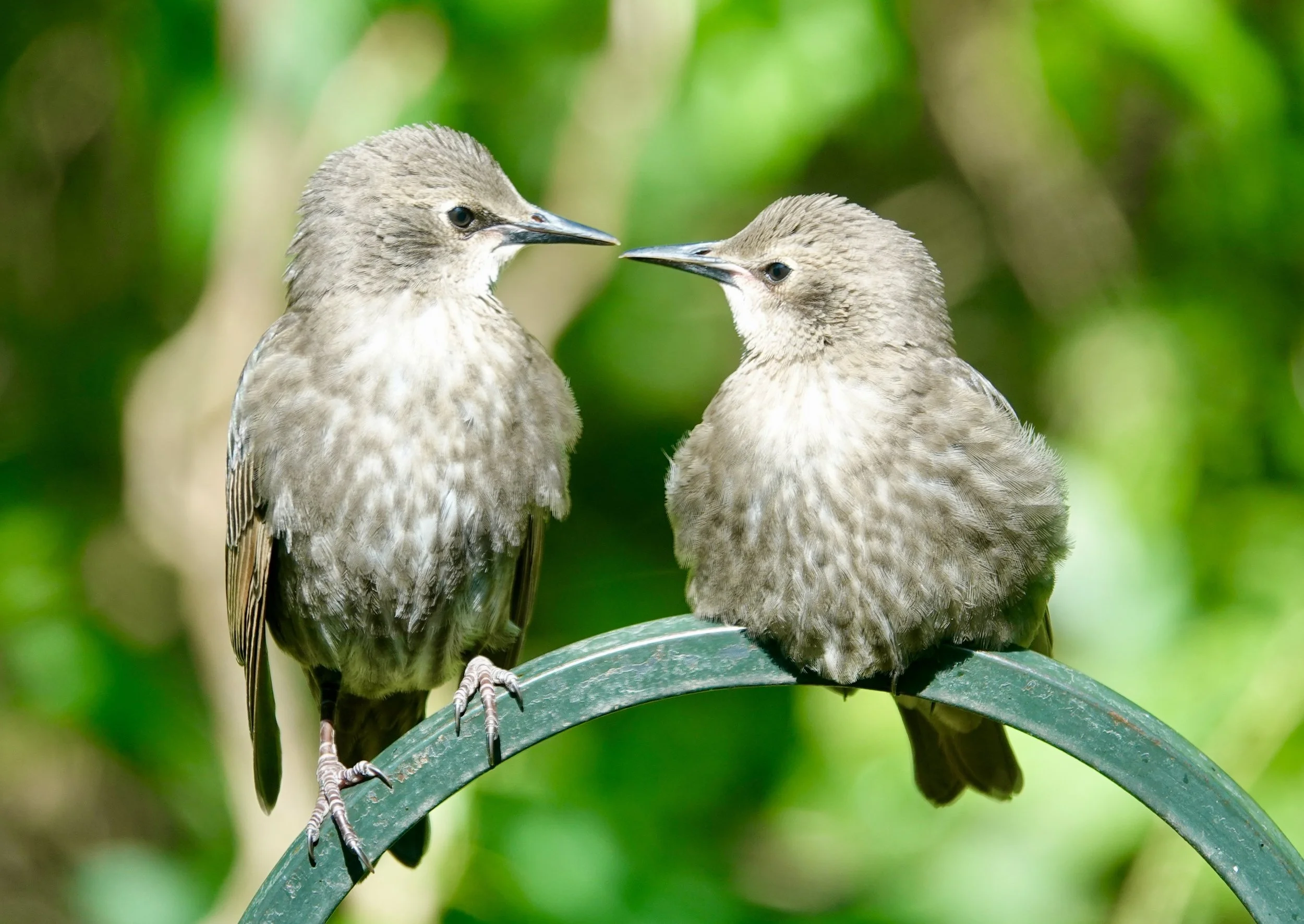
Juvenile European starlings are drably dressed in dusty gray-brown coveralls. They lack the adult’s iridescence. They soon join a flock of other starlings, called a murmuration. It’s a starling college where they can work on their vocal mimicry and other essential life skills. Photo by Al Batt.