
Naturally
A Baltimore oriole male shadowboxed with his image in a window. It was a heated rivalry. Monarchs fluttered by and barn swallows catapulted through the air. A red-eyed vireo called persistently. It sounded as if it were asking a question and then answering it.
Tamarac National Wildlife Refuge
I walked with cohorts at Tamarac NWR. We saw golden-winged warblers. Roughly half of the population of that warbler breeds in Minnesota.
Cotton Lake, near Rochert, Minnesota, is known for a unique geological feature: An island in an island. A large island within the lake that contains its own small, enclosed island. The north shore of Cotton Lake directly borders the 43,000-acre Tamarac National Wildlife Refuge.
One in our esteemed flock of birders had taught environmental philosophy at Southwest Minnesota State University in Marshall. He used the writings of Aldo Leopold, widely considered the father of wildlife ecology. His seminal contribution to environmental philosophy was the "Land Ethic," which expanded our moral community to include soils, waters, plants, animals and the biosphere. Leopold’s environmental philosophy is summarized in his 1949 book, “A Sand County Almanac.” Leopold argued that human beings aren’t conquerors of the Earth, but members and citizens of the biotic community. His definitive philosophy is captured by the principle: "A thing is right when it tends to preserve the integrity, stability and beauty of the biotic community. It is wrong when it tends otherwise.” Leopold maintained that true conservation goes beyond mere economic self-interest or government regulation. It requires an ecological conscience driven by individual responsibility and a deep emotional respect for nature.
In memoriam
Lori Naumann, a devoted wildlife conservationist and long-time employee of the Minnesota DNR, died recently. She was a team member of the DNR’s Nongame Wildlife Program. Lori was known for her passionate leadership of the DNR EagleCam, DNR FalconCam, Nongame Wildlife Program’s tax donation campaigns, and the Minnesota Loon Restoration Project. According to Lori, research has shown that the sense of isolation and loneliness is reduced when people watch birds outside their windows. When we watch birds at the feeders, it helps to improve and maintain brain function and memory. Lori left a lasting legacy and will be missed. She was a joy to work with.
Q&A
“Where do barn swallows nest?” Look for barn swallows near human habitation. They nest nearly exclusively on or in buildings that offer overhead protection. Preferred locations include the rafters and eaves of barns, sheds, stables, garages, bridges, docks and culverts. Their distinctive forked tails and bright colors are a delight to watch.
“When is the rice harvest in Minnesota?” Harvesters may take ripe wild rice during the harvesting season that runs from August 15 through September 30.
“I saw orchard orioles and scarlet tanagers at my jelly feeders. Where do these birds nest?” Orchard orioles construct hanging, basket-like pouches woven from grass and plant fibers, suspended 10 to 20 feet high in deciduous trees in open woodlands, forest edges and riparian groves near water. They nest throughout Iowa in shade trees near farmlands, along the edges of marshes and lakes, and are concentrated in river floodplains and corridors, and in the southern and west-central parts of Minnesota. River valleys are popular places for orchard orioles. They frequently nest close to eastern kingbirds, an aggressive bird that chases off predators and cowbirds. Breeding populations of orchard orioles depart on their southward migration by mid-to-late July. Scarlet tanagers nest in mature deciduous forests and undisturbed woodlands, favoring large, unfragmented canopies often dominated by oaks. In Minnesota, they primarily nest in the central and southeastern mixed woodlands. In Iowa, they are sparsely distributed, mostly nesting in mature timber along major river valleys and slopes in the eastern and western parts of the state.
“I walked with you at the Detroit Lakes Festival of Birds when you said what the western meadowlark was saying. What was it again?” The western meadowlark’s beautiful song is a series of clear, flute-like whistles that descend in pitch, followed by a bubbling gurgle. There are several mnemonics used to remember the melody. "I was here a year ago." "Gosh darn my feet are cold." "Please give me some squid." The nearly identical eastern meadowlark has a simpler, two-part whistle remembered as "but-I-DO-love-you," or "spring-of-the-year."
“What are baby porcupines called?” Porcupettes. The collective noun for porcupines is a prickle, but porcupines are rarely seen in groups. Porcupines cannot throw or shoot their quills. For a quill to embed, the porcupine must physically press or swing its tail into the attacker. I petted one in Red Deer, Alberta. I started at the head and went in the direction of the quills.
Thanks for stopping by
“Bugs are not going to inherit the earth. They own it now. So we might as well make peace with the landlord.”—Thomas Eisner.
“The secret to life is finding joy in ordinary things.”—Ruth Reichl.
Do good.
©️Al Batt 2026
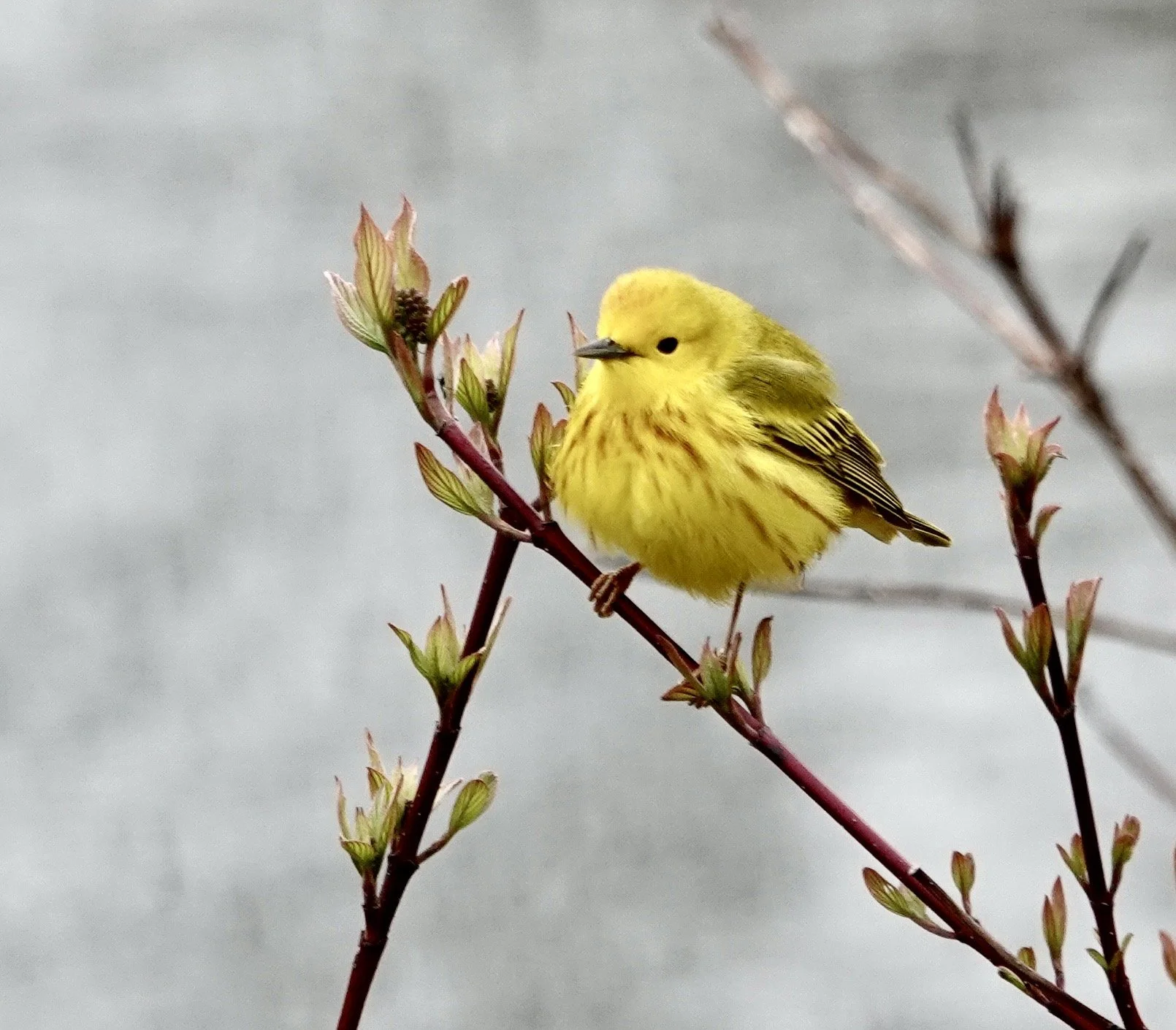
My father called it the summer warbler. That made sense as we had summer cows—summer black and summer brown, or was it some are black and some are brown? The northern yellow warbler’s song is so sweet that people use the mnemonic “Sweet-sweet-sweet-I’m so sweet” to remember it. Photo of a somewhere between buttery-yellow and lemony-yellow male northern yellow warbler by Al Batt.