
Naturally
One shadow segued into another. I paused in my walk across a parking lot to watch a flock of circling pelicans that were creating the shadows dancing past me on the pavement. I stared up and then down in wonder and gratitude for the shared moment.
It’s the season of the yellow. Yellow sunflowers, goldenrods and sulphur butterflies. The fields yellow and tree leaves flash yellow. I see the yellow sulphur butterflies in hay fields (especially alfalfa and clover), prairies, and on roadsides near those habitats. This species has multiple (2-3) broods from May to late October.
Dragonflies cruised the yard—meadowhawks and green darners. The meadowhawks are the smaller ones, and the darners migrate.
It’s that time of the year. When no matter how many hummingbirds you have at your feeders, someone else will have considerably more.
Large flocks of blackbirds gather during September as they prepare to migrate south for the winter. The flocks might include red-winged blackbirds, grackles, starlings and cowbirds.
Keep an eye out for Bonaparte’s gulls. Bonaparte’s gull is named after the French emperor Napoleon Bonaparte’s nephew, Charles Lucien Bonaparte, a famous ornithologist. The Bonaparte's gull is the only gull species that regularly nests in trees. They breed in Canada and Alaska. At this time of the year, the Bonaparte’s is delicate-looking with a thin black bill and a black smudge behind the eye.
Q&A
“When do young coyotes become vocal?” Pups are born in dens across Minnesota in April and May. Pups start exploring outside the den in June and July, and begin whining, barking and yipping. Young coyotes develop higher-pitched, adult-like calls and yips from July to October. Young coyotes disperse from their family territory in October to January, leading to vocal activity as they travel and look for new areas.
Jennifer, Lily, Duncan and Derek of Pipestone asked how birds drink. Birds don’t have lips, so they cannot suck water up as mammals do. They use different methods. Most common songbirds scoop water with their lower beaks, toss or tilt their heads back, and swallow. They find water in the morning dew on leaves and petals, icicles and snow, and raindrops. Doves and pigeons submerge their bills and use their tongues like a piston to suck water continuously without lifting their heads. Swallows and swifts fly low over a pond or lake, opening their mouths to scoop water on the fly. Hummingbirds get most of their liquid from flower nectar. Birds of prey get most of their water from their meaty meals. Nestlings of many species usually get all their water from their food—chewed up insects or worms, or bits of prey or seeds. The parents sometimes dunk the nestlings’ food in water for extra hydration. Pigeons and doves feed their babies “crop milk,” a wet, lumpy secretion from their digestive system. Some birds drink little water. Sandgrouse, not native to North America, nest in dry places, often miles from water. Sandgrouse fathers have sponge-like belly feathers. They travel to water, soak their feathers, and then fly back home—sometimes 30 miles away—carting up to 15% of their body weight in water. Their babies milk the water from those belly feathers.
“What is a cobra chicken?” It’s a nickname for the Canada goose, given because of its long neck, fierce hiss and belligerent attitude.
Jim Muyres of Mankato asked if birds have taste buds. There is more research to be done, but birds have fewer taste buds than we do. While humans have about 9,000 to 10,000 taste buds, most birds have between 20 and 500. Chickens have about 24, pigeons have around 50, and parrots have 300 to 400. The European starling has a phenomenal sense of taste. They can taste salt, sugar, tannins and even citric acid. They can distinguish between table sugar and other kinds of sugars. Penguins can taste only salty and sour flavors. Hummingbirds thrive on nectar, can identify sweet flavors, and detect and measure sugar concentration using specialized taste receptors on their tongues. Vision is significant to songbirds, and they prefer foods that have a notable contrast. Because many birds swallow food whole rather than chewing it, they rely on vision rather than taste to find and choose what they eat. Instead of being clustered on the tongue like in humans, most avian taste buds sit on the roof of the mouth, the floor of the oral cavity, and the back of the throat. A small percentage of a bird's taste buds are on its tongue, and they are found at the back.
Young birds watch and copy adult flock members to discover safe food sources. They also learn by trial and error. If a bird tastes something foul or toxic—like a noxious caterpillar—it quickly learns to reject or spit it out and avoid similar items in the future.
Thanks for stopping by
“From one thing, know ten thousand things.”―Miyamoto Musashi.
“When the last tree is cut, the last fish is caught, and the last river is polluted; when to breathe the air is sickening, you will realize, too late, that wealth is not in bank accounts and that you can't eat money.”—Alanis Obomsawin.
Do good.
©️Al Batt 2026
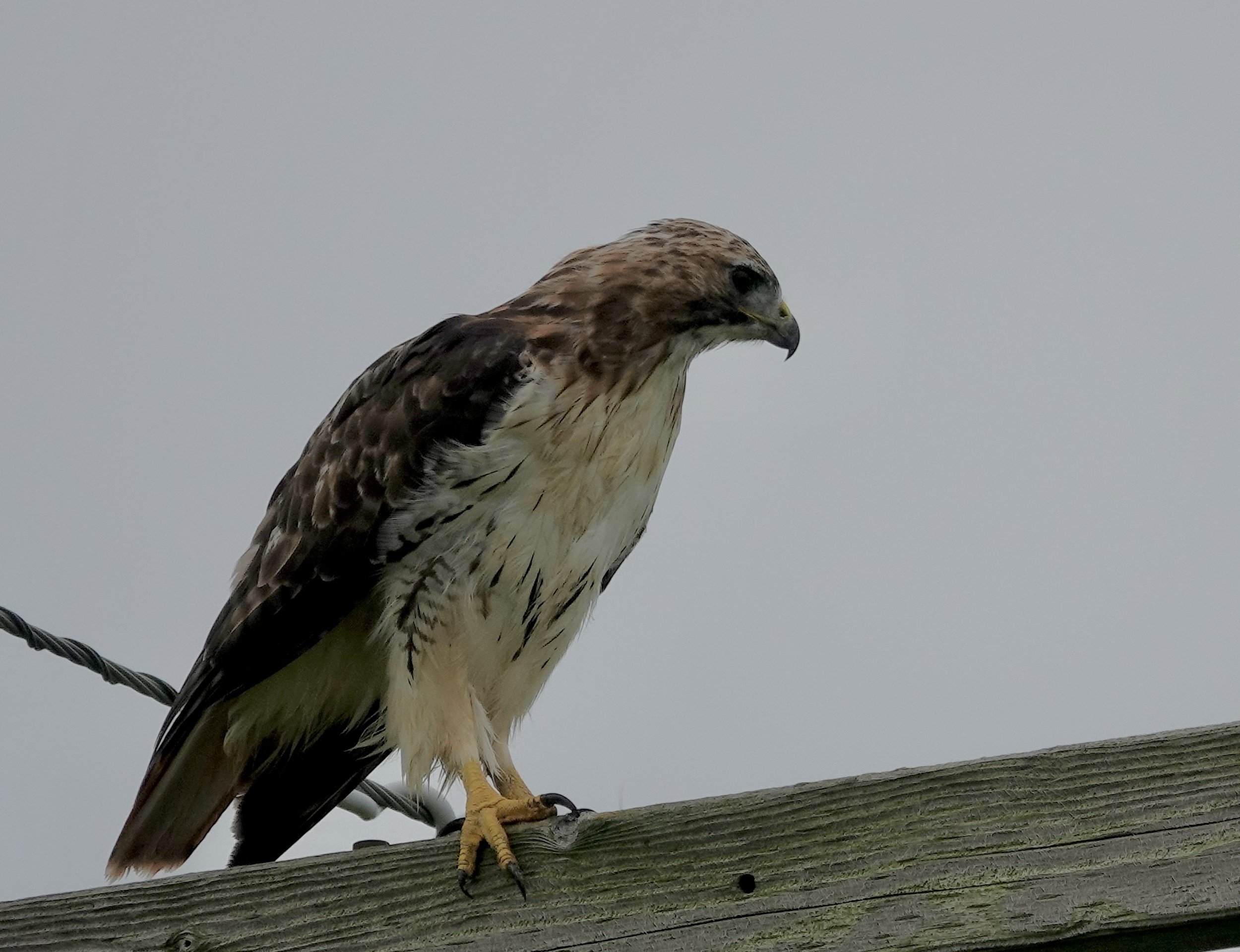
The most widespread and familiar large hawk in Minnesota is the red-tailed hawk. There is a great deal of individual variation in the plumage of this 2- to 4-pound, 19- to 26-inch-long raptor. Small mammals like mice, voles, squirrels and rabbits make up a large part of its diet. The female is larger than the male. This hawk’s eyesight can be eight times that of a human. They are the mile-marker hawks perched along highways. Photo by Al Batt.