
Naturally
Black-capped chickadees are frequenting my feeders. First, I applauded, and then I declared it a national holiday. They had been the Bigfoot of birds in my yard. No means by their size, but by the lack of documented sightings in my yard all winter and spring. I don’t know where they were, but they weren’t in my yard. I missed them. I thought they had become invisible, but I didn’t hear them. You have to love a tiny bird whose call echoes its name.
The Journal of Experimental Biology published a study in which researchers found that in the lab, mosquitoes can learn to associate DEET with a blood meal and become attracted to the scent. I can hear a kind reader saying, “I knew it!”
Q&A
“Do plastic owls keep birds away?” For an abbreviated time, at best. Birds learn quickly. They notice the owl never hunts or changes position. Birds have been seen and photographed perching and nesting on top of plastic owl decoys. I see mallards crowding fake owls on docks. The next time you have an urge to buy a fake owl, give a gift certificate to your mail carrier or subscribe to a newspaper instead. Likewise, fake coyotes keep geese away temporarily, but rarely work as a long-term, standalone solution. Canada geese are smart birds, and once they realize a static decoy never moves, they determine it is harmless and ignore it or walk past it. They leave droppings as evidence of their utter disdain.
“Are dandelions native?” They are not. It is believed that early European settlers brought the dandelion to North America aboard the Mayflower in 1620, likely for the plant’s medicinal value. Minnesota dandelions typically bloom from late March to early November. The peak bloom occurs in late April, May and early June. Heather Babcock wrote, “Dandelions are just friendly little weeds who only want to be loved like flowers.”
“Do smaller raptors migrate before the larger ones?” Smaller raptors like American kestrels and sharp-shinned hawks generally begin their fall migration earlier, starting as early as August. Young and smaller raptors migrate first because they lack hunting skills for wintry weather. They also face a prey shortage. Small species that rely on summer prey like large insects and songbirds find that those diminish in colder weather. Small falcons (American kestrels, merlins) and small accipiters (sharp-shinned hawks) migrate in late August to September. Broad-winged hawks move through in massive flocks called kettles in mid-September. Larger hawks (red-tailed), eagles and rough-legged hawks hit their peak migration in October to November.
“How long does it take a monarch butterfly to fly to Mexico?” It takes a monarch butterfly about two months to fly south from Minnesota to central Mexico, a distance of around 2,000 to 2,500 miles, at a speed of 50 to 100 miles per day. Their journey begins in late August or early September and ends when they arrive at their wintering grounds in Mexico by late October and early November. They fly during the day and rest in trees at night, riding warm air currents to conserve energy. In September, the adults congregate in large numbers in trees and shrubs, and by the end of October, they have left Minnesota.
“What eats zebra mussels?” Zebra mussels have a variety of natural predators, including certain diving ducks (scaup, redhead, goldeneye, bufflehead), fish and crayfish. The fish that enjoy delicious zebra mussels include the freshwater drum (sheepshead), smallmouth bass, yellow perch, pumpkinseed and common carp have been observed feeding on zebra mussels. Mallards (a dabbling duck), occasionally eat zebra mussels, likely when the ducks’ food is scarce.
“I saw two turkeys with one young turkey? What’s going on there?” I saw the same thing—two turkey hens with a lone poult. Turkey hens often join forces to raise young together in a cooperative (daycare) group, even if they have but a single surviving poult left between them. Multiple hens provide more eyes to watch for predators and to protect the young. One hen typically leads the way while the other brings up the rear or remains alert while the others eat. Summer poults face heavy pressure from weather and predators, which can reduce broods to one or two survivors by late summer. Hens that have lost their nests or failed to hatch eggs, occasionally join a mother hen to help chaperone the young.
“I was mowing the lawn when I detected the fruity aroma of pineapple. It made me hungry. What was I smelling?” It was pineappleweed, a low-growing wild annual herb in the daisy family known for its cone-shaped, petal-less, yellow-green flowers and sweet, pineapple-like scent. It has finely divided, feathery and soft-textured leaves, growing alternately along the stems. Crushed foliage and flowers release a strong, distinct odor reminiscent of pineapple and chamomile. It grows 4 to 16 inches tall but can stay shorter in compacted ground.
Thanks for stopping by
"Nature is the art of God."—Dante Alighieri.
“It is an astonishment to be alive, and it behooves you to be astonished.”—John Donne.
Do good.
©️Al Batt 2026
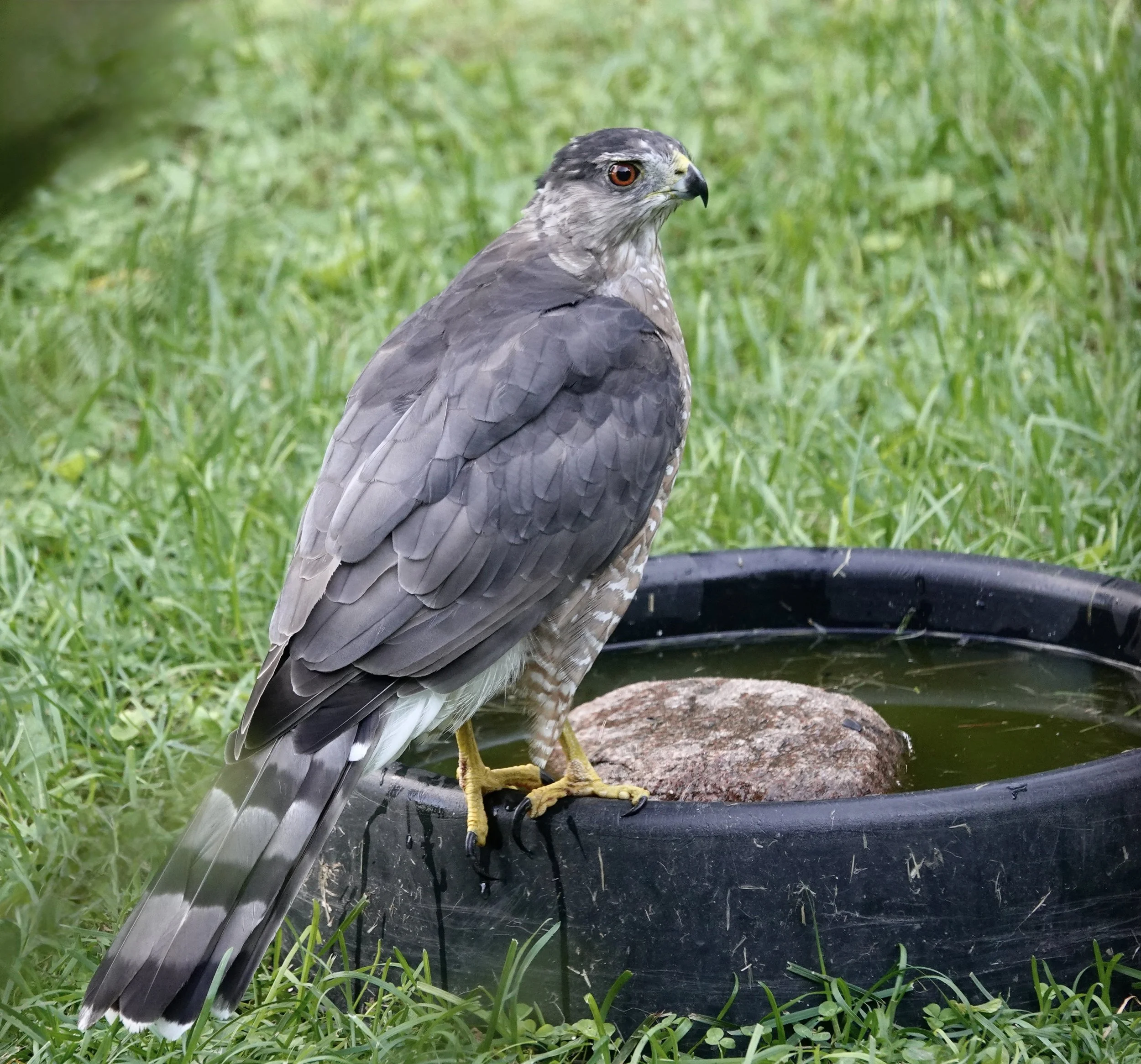
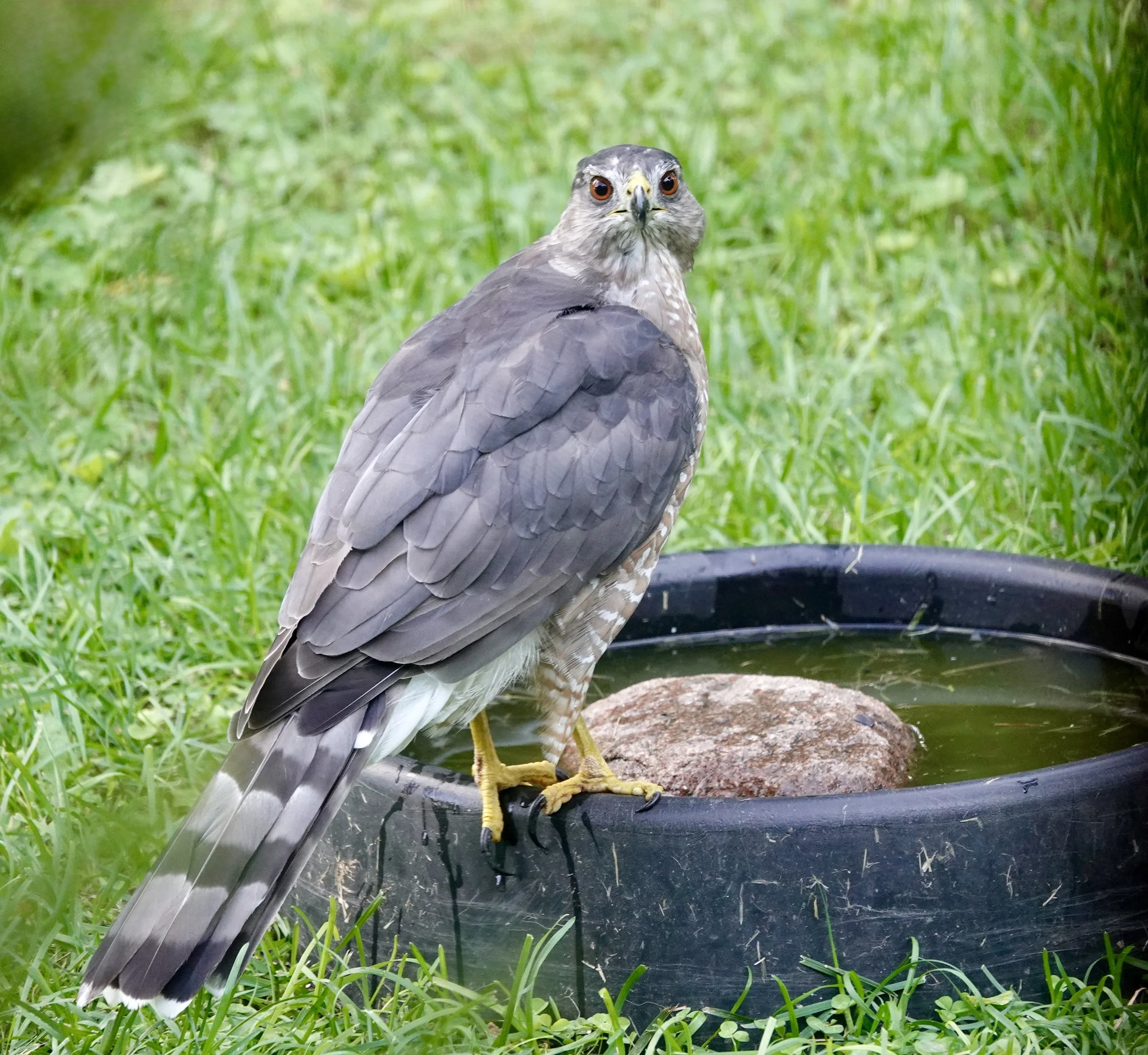
Cooper’s hawks are thriving in suburban and urban backyards. The adults feature blue-gray backs, dark caps, rufous barring on their undersides, red eyes and rounded tails with thick white terminal bands. They are roughly the size of an American crow and exhibit reverse sexual size dimorphism: females are about one-third larger than males. Their primary prey consists of small- to medium-sized birds and small mammals like chipmunks. Coop’s are ambush hunters. Photo by Al Batt.