
Naturally
Blue jays, the information booths of the yard, tell everyone what is going on.
Some leaves tumble to the ground as a fall preview.
I’ve been enjoying insect sounds. Crickets and katydids rub their forewings together to produce sound. Grasshoppers rub their hind legs against their forewings. Cicadas have a special organ called a tymbal on the side of a male cicada's abdomen that flexes to produce mating calls.
I was bitten by things that weren’t there. Minute pirate bugs usually cause those tiny, painful bites in September in Minnesota, also called insidious flower bugs. We call them no-see-ums, which is also the name of the slightly smaller biting midges, which are found near bodies of water in June and July. The good news is that pirate bug days are numbered. They disappear with a hard freeze. Minute pirate bugs are tiny, flat, oval insects that are black with a distinct white "X" pattern on their backs. They are beneficial predators of crop pests all summer. In late summer and fall, when farm crops and field plants dry up or are harvested, they run low on food and land on humans for a "test bite." They don’t feed on your blood. Female biting midges bite humans and animals to feed on blood.
I miss the sound of dickcissels. The dickcissel is one of the last passerine songbirds to arrive in Minnesota during the spring migration. The males, which look like small meadowlarks, sing from late May or early June through August. The vast majority of dickcissels leave by the end of August on their way south to their wintering grounds in Central and South America.
I watched a beaver waddle in and out of the water. The beaver is a keystone species, which is an organism that helps hold an ecosystem together.
I saw three blue birds: eastern bluebird, blue jay and indigo bunting. I didn’t see the much less likely-to-be-seen blue grosbeak. Those four species give me the most blue for my look. Other birds show blue: tree swallow, cerulean warbler, black-throated blue warbler, great blue heron and belted kingfisher.
I tossed an apple core onto my lawn. It received company quickly. Yellowjacket colonies focused on harvesting protein (like caterpillars, flies and spiders) to feed larvae. By September, the queen stops laying eggs, the larvae are gone, and the wasps switch to a sugar diet and aggressively hunt for overripe fruit, sap and human foods like soda and my apple cores. They gather around garbage cans. A yellowjacket nest starts in the spring with a single queen. The population multiplies, and by September, a single nest can contain thousands of wasps.
Q&A
Kate Crowley of Willow River asked why there was a lack of mosquitoes this summer. It’s due to the dry conditions. The lack of rain and a low spring snowmelt was hard on floodwater mosquitoes, the most common species in Minnesota.
Micah of Mankato had swarming bees in his yard and asked a series of questions: “How long will they remain where they are before they find a new location? Are there scouts out looking for a new home? Does the queen pick the new location? Is it possible they have found a small cavity in the walnut, and are working on expanding it?” Bees swarm as part of their natural reproductive process. They swarm to reduce overcrowding in the hive and ensure the survival of their species. Insufficient space, food shortages or the age of the queen trigger swarming. If the queen shows signs of weakness or distress, the colony may decide to leave with a new queen. A part of the population, including the queen bee, departs from the original hive. This event leaves behind a smaller group to care for the remaining queen and larvae. The swarm can be seen hanging from a branch or other structure before moving to its new home. They will swarm for a few minutes to a few days. Scout bees search for a hollow cavity for a permanent home. The queen doesn’t do much searching unless it’s online. Honey bees aren’t capable of chewing or boring into sound wood to expand a tree cavity. They don’t chew tunnels, dig or enlarge structural holes. Yellowjackets occasionally use tree cavities, but they don’t create or expand cavities in live or hard wood. They are strictly opportunistic and use pre-existing hollows, such as natural rotted-out wood spaces, abandoned rodent burrows, or old woodpecker holes. Paper wasps scrape thin layers of fiber from weathered wood.
Thanks for stopping by
“Whether we and our politicians know it or not, Nature is party to all our deals and decisions, and she has more votes, a longer memory, and a sterner sense of justice than we do.”—Wendell Berry.
“Nature is loved by what is best in us.”—Ralph Waldo Emerson.
Do good.
©️Al Batt 2026
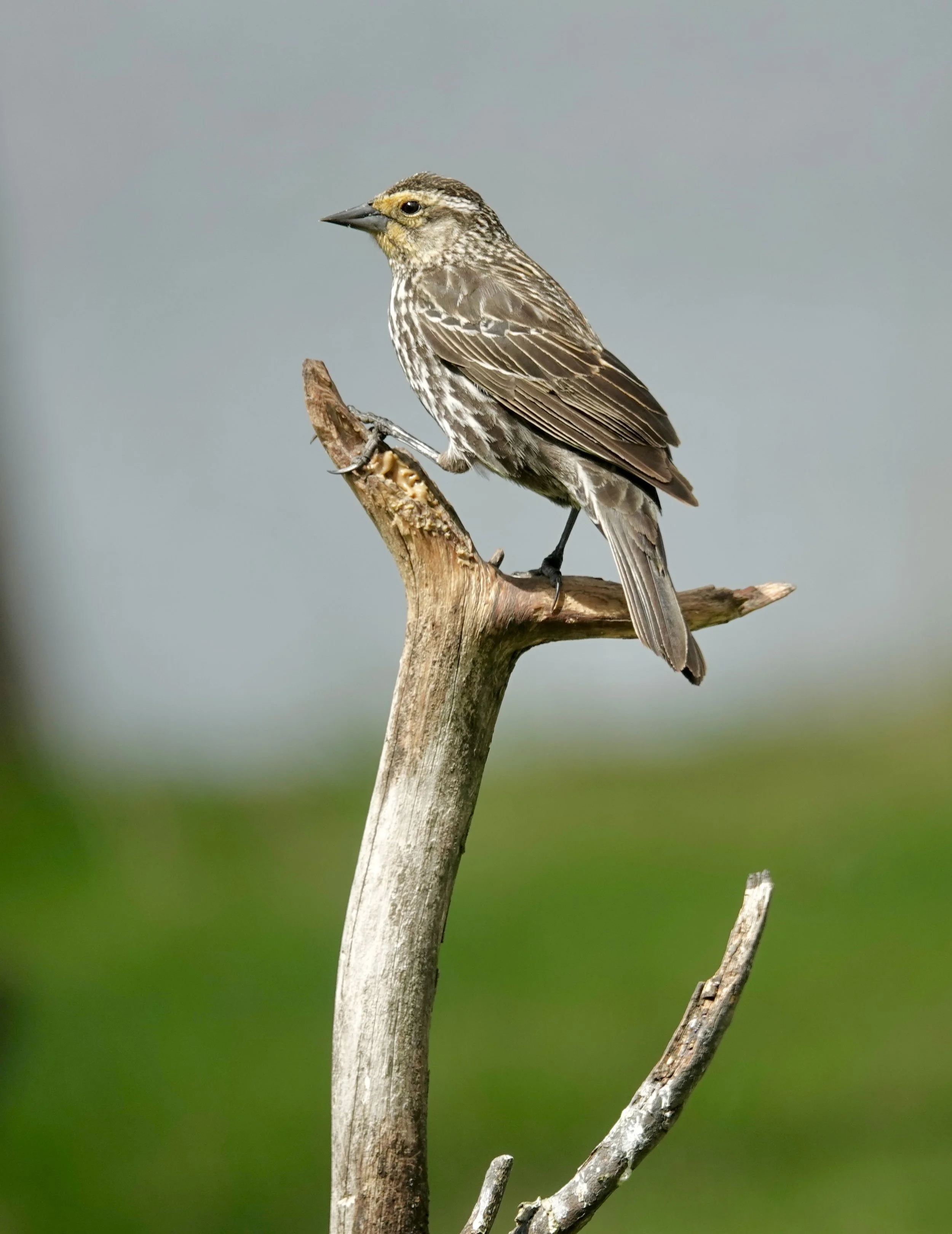
It looks nothing like a red-winged blackbird, but it is a red-winged blackbird. It’s a female red-winged blackbird, and she resembles a large sparrow. Both sexes are sharp-billed, but the male has a glossy black plumage with red-and-yellow shoulder epaulets. It looks like a red-winged blackbird should look. This species is sexually dimorphic, meaning males and females have different appearances. The female is considerably smaller than the male. Photo by Al Batt.