Was Merlin named after the merlin or was the merlin named after Merlin?

Naturally

  The robin is an impressive bird. Its daytime caroling begins in the early morning. The Blackfeet viewed the robin as a symbol of peace, and a camp location was considered to be safe and secure if it had robins. On average, only 40% of robins’ nests successfully produce young, and only 25% of the fledglings survive until November. From then on, about half of the robins will live to the next year.

  A rose-breasted grosbeak sang. Some describe its song as that of a robin that has had singing lessons. A robin that sings opera. This grosbeak sings while incubating eggs. Birds are typically quiet on the nests, not wanting to attract predators. Perhaps grosbeaks use reverse psychology.

  I walked a group of folks around a forest in Bemidji. I stopped and invited them all to listen to an odd sound. I asked if anybody knew what it was. No one did. A good share of the people were from that area, but most guessed it was a bird of some kind. A porcupine had produced the whines, grunts, groans and squeals.

  I’m seeing little concentrations of sticky, frothy bubbles on various plants. The white foam blobs are produced by the nymphs of spittlebugs, small insects related to aphids and other true bugs. They get the name from the blobs of foamy “spit” they create. Spittlebugs produce the frothy mixture by mixing air with fluid excretions, but not from their mouths. We can call it spit, but it really isn’t. Thank goodness spittlebugs don’t chew tobacco.

  Researchers at Tel Aviv University found that the concentration of sugar in the nectar of evening primrose temporarily increased within minutes of sensing vibrations from pollinators’ wings.

Q&A

  “Is merlin, the falcon, named after the wizard, or is the wizard named after the falcon?” The wizard gets his name from the Welsh mythological figure Myrddin Wyllt. Geoffrey of Monmouth translated it into Latin as Merlin around the year 1130. The small falcon derives its name from esmerillon, an Old French word for falcon. The merlin is sometimes called a pigeon hawk.

  “Is the boxelder tree invasive?” The USDA’s definition of an invasive species is: non-native to the ecosystem under consideration, and a species whose introduction causes or is likely to cause economic harm, environmental harm, or harm to human health. A boxelder is native. Not all nonnative plants are considered invasive. Corn and potatoes are a couple of examples.

  Jeff of Janesville asked what birds can sing two songs at once. Certain songbirds (like the wood thrush, veery and gray catbird) can sing two completely independent melodies at once. The vocal organ of these birds, the syrinx (located where the windpipe divides into the lungs), has two separate airways, each controlled by an independent set of muscles and nerves. A single bird can sing in harmony with itself, seamlessly switching between vocalizations without pausing to breathe. While the human voice box can produce only one sound at a time, a bird’s syrinx is a paired structure that allows birds to sing complex, fast-paced songs. Located where the bronchial tubes from each lung come together, both sides can produce sound. They can be used in concert to sing two different notes simultaneously and to complete broad sweeps in pitch quickly. Brown thrasher, northern cardinal, Swainson’s thrush, varied thrush and European starling are said to be able to perform such vocal magic. Some people claim the American robin is capable of a two-voice complexity that creates two notes at once. There is a difference of opinion as to the abilities of the various bird species to produce two sounds at once, but I will say the song of the wood thrush is definitely a gift to the ears.

  “Why are robin’s eggs blue?” The source of the blue is the pigment biliverdin. One theory is that blue acts as a sunblock, striking a balance between being dark enough to protect eggs from damaging UV rays and being light enough not to overheat the eggs.

  “Do purple martins nest in natural cavities?” Purple martins are secondary cavity nesters—they don’t excavate their own cavities. They use cavities that are already created, either by other animals (like humans) or in natural cavities of cliffs and rock formations. Martins traditionally inhabited forest edges or beaver dam backwaters where woodpeckers had drilled holes into dead snags. Purple martins can still be found using natural cavities in the western United States, but in the east, they depend on human-maintained nesting structures like gourds and martin houses. In the Southwest, purple martins sometimes use secondary cavities in saguaro cacti.

Thanks for stopping by

  "On every vernal morning a wave of Robin song rises on the Atlantic coast to hail the coming day, and so, preceding the rising sun, rolls across the land until at last it breaks and dies away upon the distant shores of the Pacific Ocean."—Edward Forbush.

  “I know he’d be a poor man if he never saw an eagle fly.”—John Denver.

  Do good.


©️Al Batt 2026
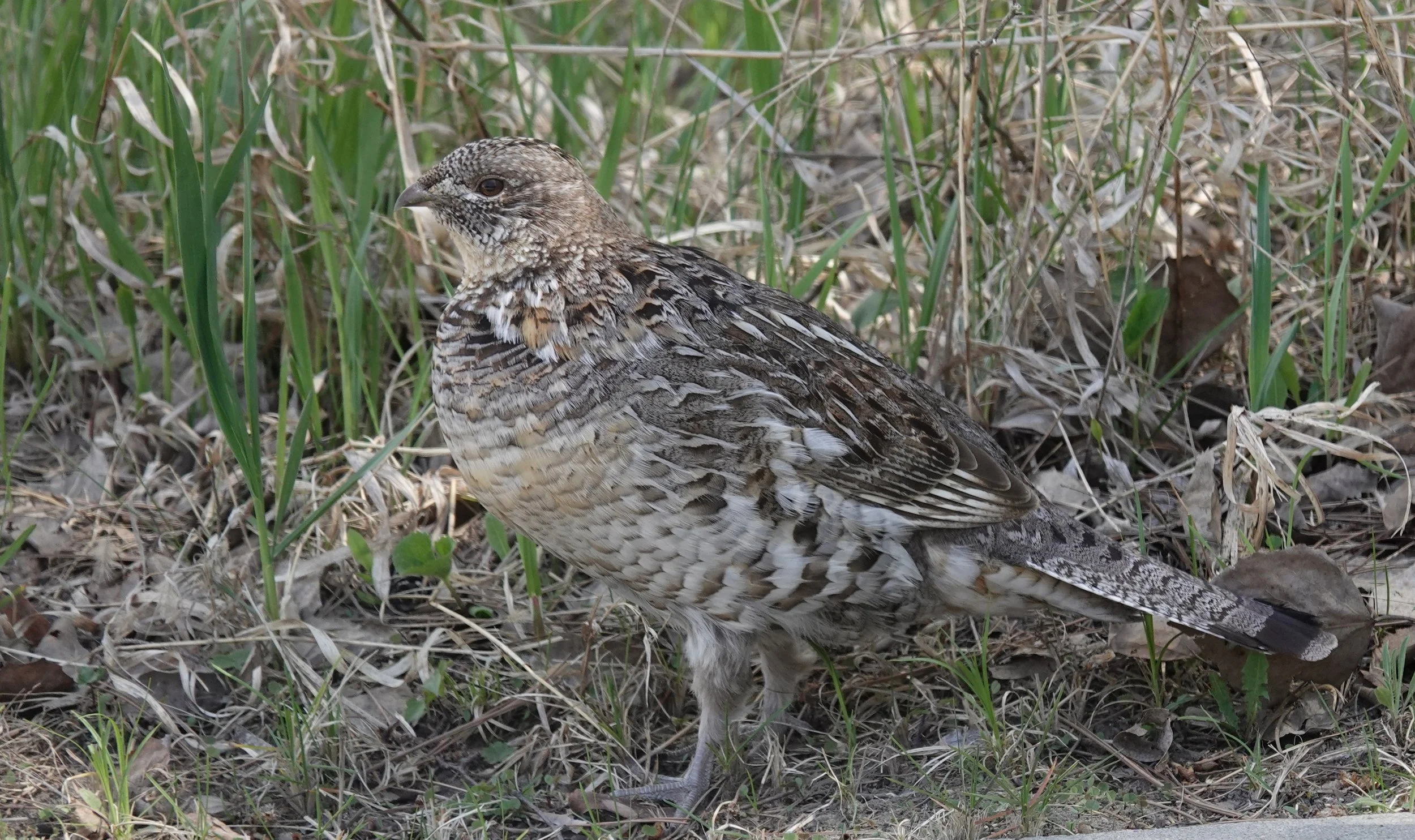
Ruffed grouse males have a concealed neck ruff that they display during courtship. Their toes grow projections on the sides in winter that act as snowshoes to help the grouse walk across snow. The grouse buries itself in soft snow to roost. As a drumming male rotates its wings forward and backward, air rushes in beneath his wings, creating a vacuum that generates a deep, thumping sound wave that carries a quarter of a mile. Photo by Al Batt.

A cotton ball on stilts

Naturally

  I parceled out black oil sunflower seeds to several feeders. I feed the birds and they feed my soul. It’s bird magic.

  I took a lengthy stroll. Starlings were perched on a utility wire. Starlings are good at that. One bird pecked at the birds on each side of it. No surprise. Being on line turns a lot of life forms into jerks.

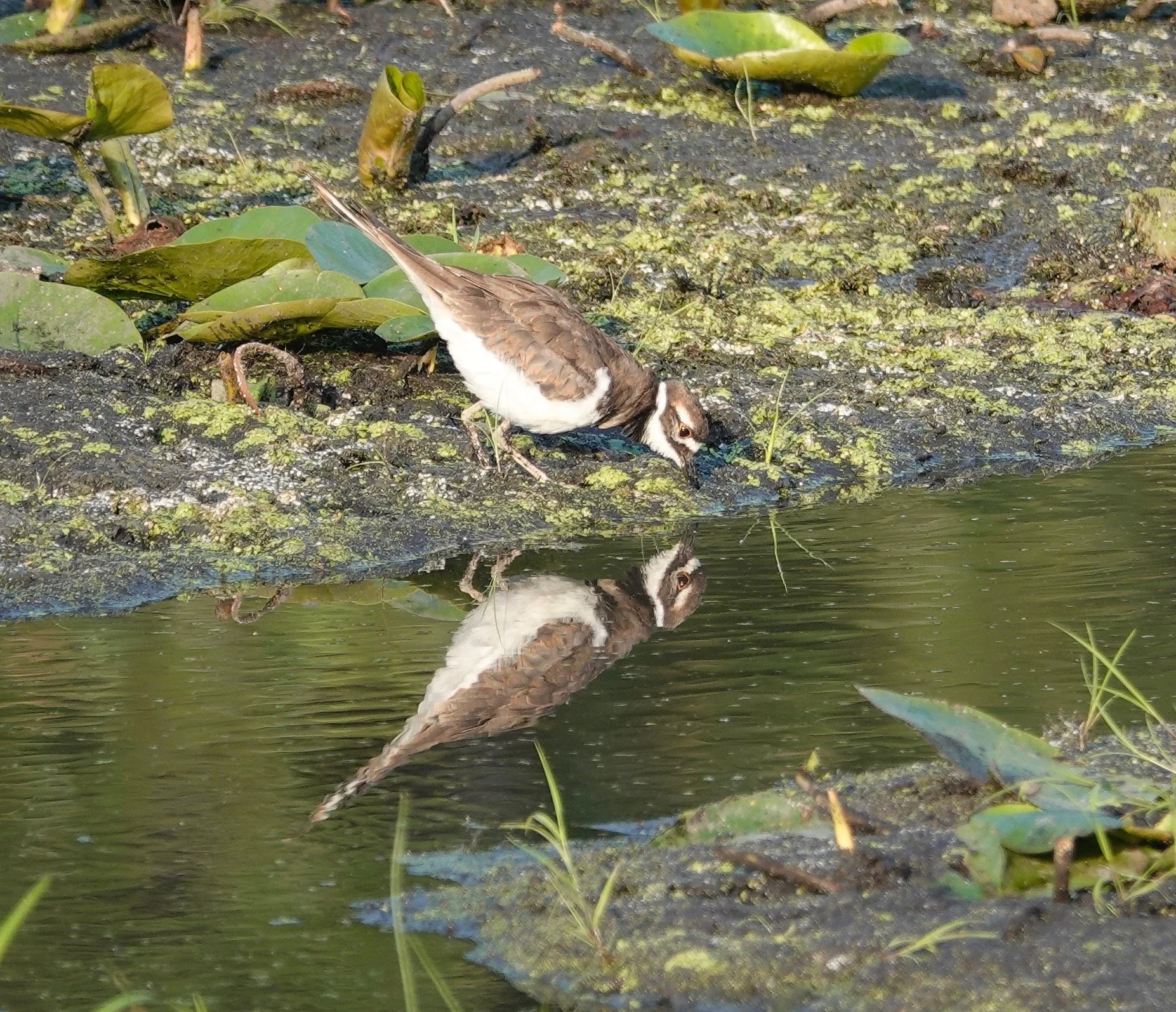
  I was blessed by the sight of baby killdeer. I was wonderstruck. Seeing a bird is a gift. Someone told me they are s’mores on stilts. I call one a cotton ball on toothpicks. Baby birds that hatch with their running shoes on are called precocial. A precocial bird is capable of moving around and foraging on its own soon after hatching. Birds that hatch blind, naked and helpless are called altricial. An altricial bird is incapable of self-locomotion or finding its own food shortly after hatching. Robins, cardinals and blue jays are altricial. Killdeer are precocial. I think I can say without fear of contradiction that precocial birds are the cuter of the two.

  I watched a great blue heron fishing. Its patience was inspiring. I watched as long as I could. The big bird had caught no fish but had way more patience than I had.

  A friend told me, “If a white butterfly comes, summer follows.” I see many cabbage white butterflies, an abundant, exotic species introduced to North America in the 1860s. Its green worms (larvae) feed on plants in the cabbage family, necessitating an application of Bacillus thuringiensis (Bt) in the garden.

  I provided nesting habitat for native bees by cutting older, dry elderberry stems to around 18 inches tall in the late spring. Bees nest in the soft, spongy pith of the stems. Cutting the standing stalks in late spring prevents disturbing any bees that are overwintering in last year's stems.

  I picked black-capped raspberries from their treacherous brambles. I added the tasty fruit to my morning’s shredded wheat. It was scrumptious. The origin of the name raspberry is unclear and is likely to remain so. It comes from raspis + berry, possibly from raspise, a sweet rose-colored wine.

Q&A

  “You said the sex of a turtle is decided by the temperature. What is that determinant in degrees?” The sex of most turtles is determined by the incubation temperature of the eggs, a process called temperature-dependent sex determination. The turtles do not call it that. Generally, cooler temperatures produce males, while warmer temperatures produce females. Hot chicks, cool dudes. Specific temperature ranges vary by species, but for many turtles, the general thresholds are: Males are produced at cooler incubation temperatures, typically below 81.86°F. Females are produced at warmer incubation temperatures, typically above 88.8°F. The intermediate temperatures produce a mix of both male and female hatchlings.

  “Dragonfly or damselfly?” Dragonflies are larger, stronger fliers and rest with their wings spread flat like an airplane. Damselflies are smaller, delicate fliers that typically fold their wings vertically together along their backs. It gives them a sleeker look. Dragonflies look as if they visit the gym regularly, and damselflies look as if they’re trying to cancel their gym memberships because they never go there.

  “There is a goldfinch pecking at a window of my house. What is going on?” Male American goldfinches are highly territorial during the breeding season. They don’t recognize the reflection in the glass as themselves, but rather as an intruder and act aggressively toward the reflection. Robins, cardinals and chipping sparrows commonly battle with windows. I’ve had orioles, great crested flycatchers and indigo buntings attack our windows. Folks who live within range of mockingbirds report that bird shadowboxing with its reflection. Readers have kept me informed about bluebirds, pileated woodpeckers and wild turkeys finding worthy adversaries in images in the glass.

Birding with Batt

  I host “Birding with Batt” on KMSU Radio, 89.7 on the FM dial. It’s my 101st year of talking about the glories of nature on the airwaves. My math might not be working there. We discuss the birds, flowers, insects, mammals, plants, trees, fish, reptiles, amphibians, weather, fungi, arachnids and the kind people who tread lightly upon this good earth. Uffda! Please forgive me if I missed anything on that list. You can listen live or catch up on on-demand archives using the free KMSU streaming app, which can be downloaded from the Apple App Store or the Google Play Store.

Thanks for stopping by

  “Live and let live, be and let be. Hear and let hear, see and let see. Sing and let sing, dance and let dance. Live and let live and remember this line: ‘Your business is your business and my business is mine.’”—Cole Porter.

  “We delight in the beauty of the butterfly but rarely admit the changes it has gone through to achieve that beauty.”—Maya Angelou.

  Do good.


©Al Batt 2026

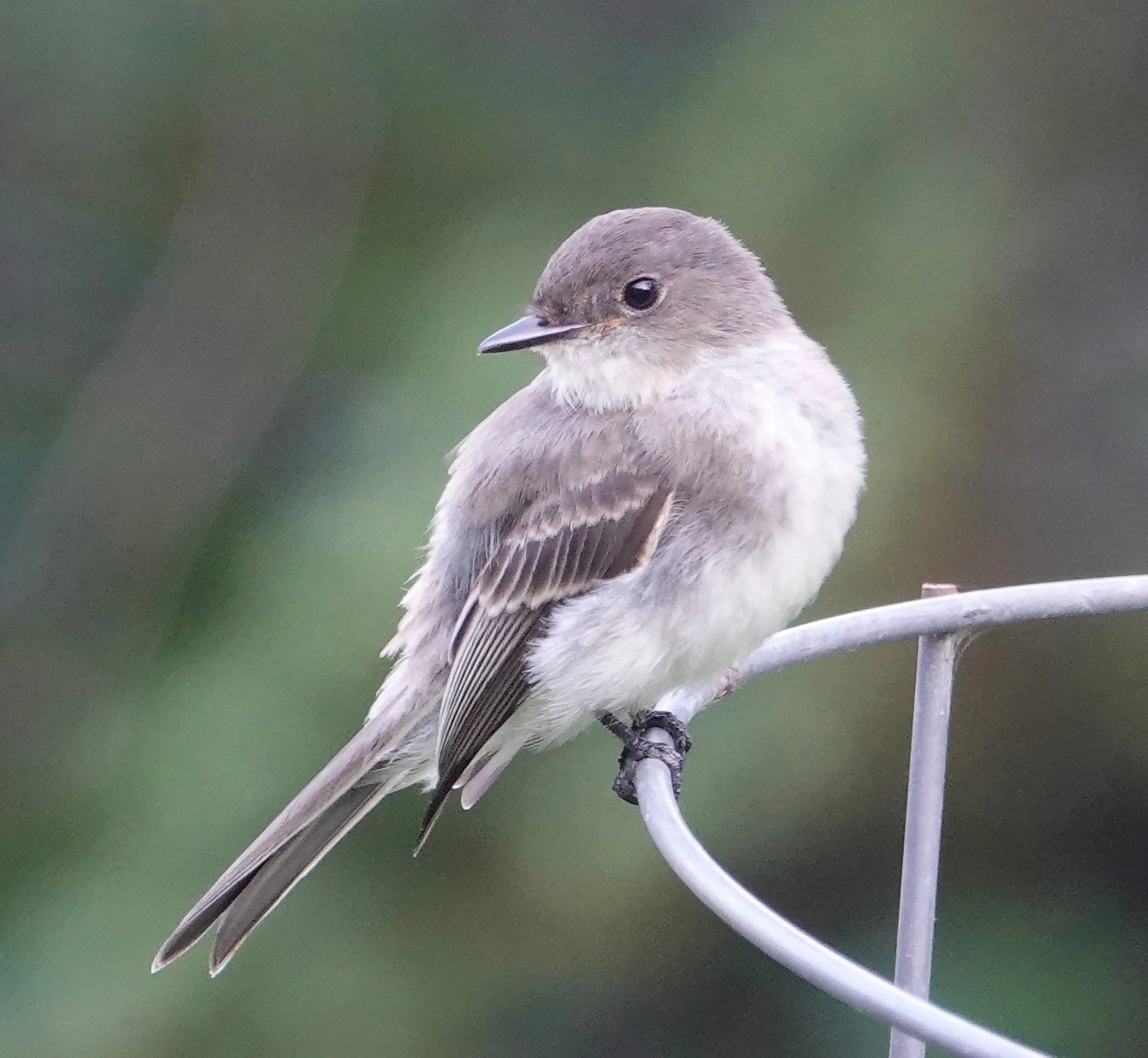
The eastern phoebe twitches its tail, calls out its name, and was the first bird ever banded in North America. In 1804, John James Audubon tied pieces of silver thread around the legs of nestling phoebes to track their migration and see if they returned to the same area. The birds wanted fitness trackers. Photo by Al Batt.
Have you ever seen a moose charge?

Naturally

  I took a walk on the wild side.

  The five-petaled, white flowers of Canada anemone are one of my favorites. It’s a lovely native that grows well in medium to moist soils.

  The sweet music of birds thrills me to no end. A catbird sang its mysterious and varied song. It was obviously a mass communications major. If a human had produced the sounds, it would be called jazz scat, a vocal improvisation technique using wordless vocables, nonsense syllables and rhythmic sounds. Human singers aspire to using their voices like musical instruments or catbirds.

  Fireflies (lightning bugs) used their blinkers and candle bats (moths) circled the yard light. Muggy June and July days welcome fireflies. There was a hit song in 1952 called "The Glow-Worm" by The Mills Brothers, who warbled, “Shine little glow worm, glimmer, glimmer.” Glowworms are firefly larvae. They glow to warn predators that they are toxic. Glowworms are predators of snails, slugs, worms and other insects. Adult fireflies eat insects, pollen and vegetation, but some have no mouthparts and don’t eat.

  I saw some blond mallards—hybrids between mallards and domestic ducks. A female and her young family floated nearby. I was afraid the mallard hen might quack under pressure, but her ducklings were obedient and well-mannered.

  A friend found a lone duckling in her yard. She had no photo, but it was likely a mallard. They are common yard waterfowl. A mallard duckling has a distinct black eyeline that runs from the bill through the eye to the back of the head. On a wood duck duckling, the eyeline begins at the back of the eye and stretches backward. A young wood duck is sleeker.

  I was a co-leader of a birding bus in Detroit Lakes. Detroit Lakes has a population that doubles in the summer and triples on the weekends. I advised the participants that they should keep looking at a tree until it turned into a bird. I love seeing synchronized binocular usage. My binoculars were focused on a lovely raptor perched in a tree. It was like staring at a beautiful mountain, but the mountain was a broad-winged hawk that flew down, caught a vole, flew back to its hunting perch, and ate its prey whole. It was quite impressive.

Q&A

  “Have you ever seen a moose charge?” No, but I did see one in the Juneau (Alaska) Costco once. OK, it was in the parking lot. I don’t know if it entered the store and charged any purchases. I know a guy who broke in his new Toyota by hitting a moose near Fairbanks, Alaska. In that case, the car charged the moose.

  “Did you play Pokémon when you were a boy?” No, I played poke things with a stick. I turned over rocks and fallen logs. I never knew what I’d find on a nature hunt. I knew my search was done when my pockets were full of finds. I didn’t look for my ancestors from Iowa and Utah. As far as I know, none of them had ever lived under rocks. I’m the first in the family to do that. My kin moved to wherever the light was.

  “What do swallows eat?” Tree swallows eat trees; cliff swallows eat cliffs; bank swallows (called sand martin in the UK, Europe and Asia) eat banks; and barn swallows eat barns. That’s not true, although there are fewer barns than there used to be. Makes you wonder, doesn’t it? I don’t think barn swallows are the culprits. Swallows are primarily insectivores, catching flying insects on the wing. Tree swallows also consume berries and seeds—especially bayberries and wax myrtle berries. Being capable of digesting the waxy coating on bayberries helps tree swallows survive when flying insects are unavailable.

  “How fast can a peregrine falcon fly?” I watched Mayo Clinic’s 2026 falcon chicks, which were banded and named on May 22. The female chicks were named: Belle, for the 100th anniversary of the Mayo Clinic Carillon on the Rochester campus, and Vega, after a bright star, evoking strength. The males are Mylo, meaning a soldier or gracious, and Zephyr, meaning a west wind or a gentle breeze. According to Guinness World Records, a dive by Frightful, a peregrine falcon owned by an aviator and a falconer named Ken Franklin of Friday Harbor, Washington, was clocked at 242 mph in 1999. The falcons pay no attention to speed limit signs.

Thanks for stopping by

  “Because all creatures are connected, each must be cherished with love and respect, for all of us as living creatures are dependent on one another.”—Pope Francis.

  “That′s life. That′s what all the people say. You're riding high in April, shot down in May. But I know I'm gonna change that tune. When I′m back on top, back on top in June.” As sung by Frank Sinatra.

  Do good.


©️Al Batt 2026

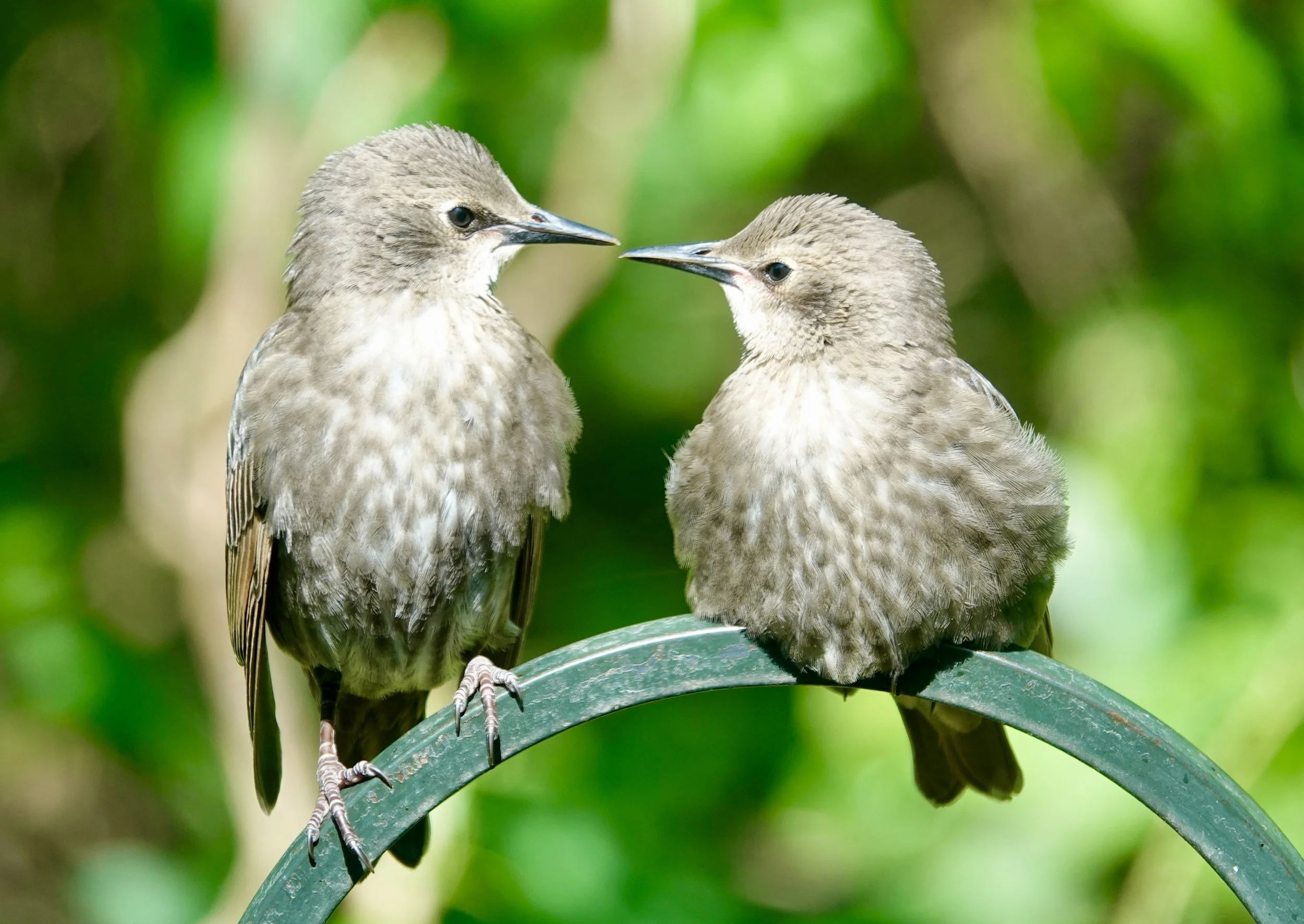
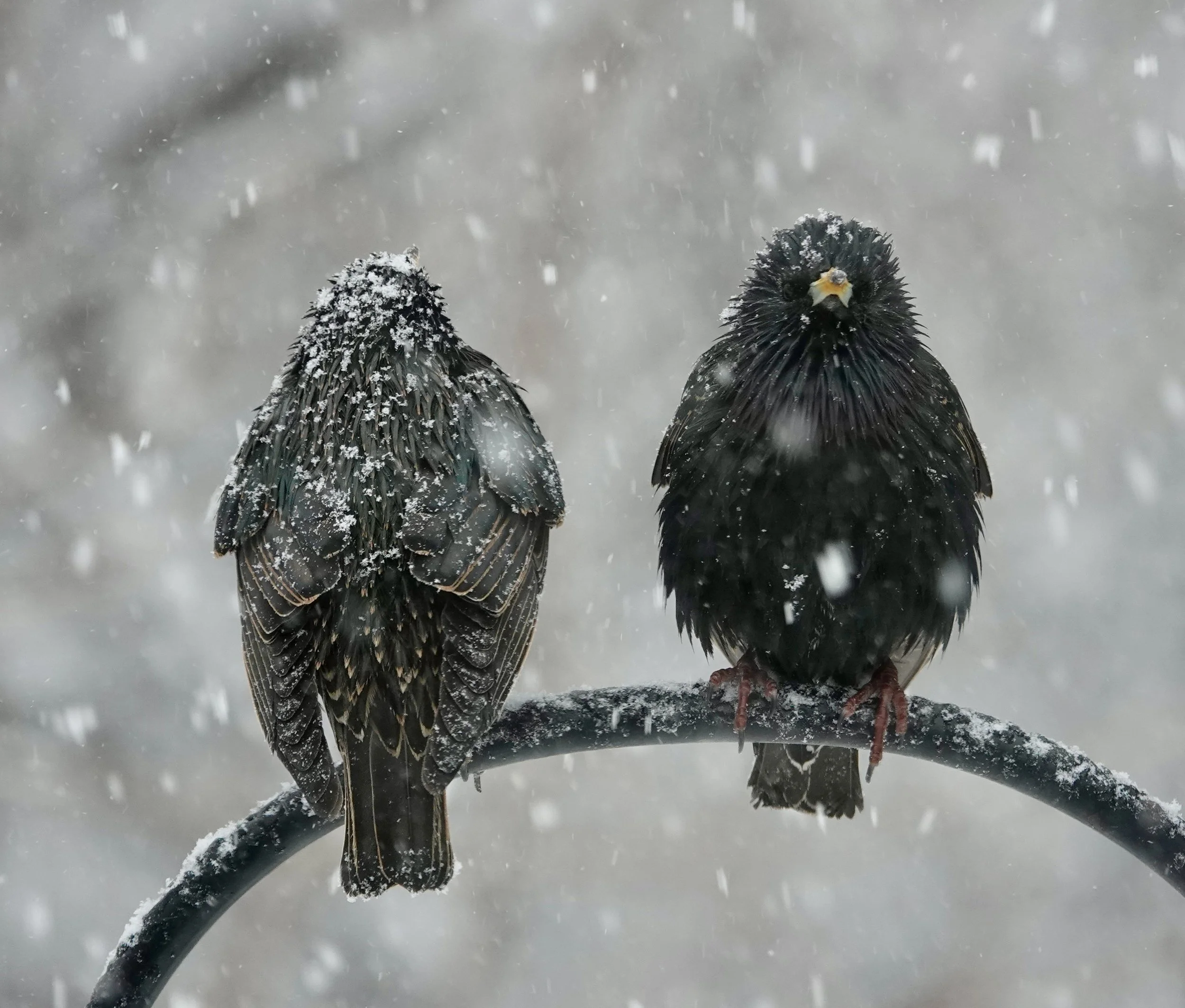
Juvenile European starlings are drably dressed in dusty gray-brown coveralls. They lack the adult’s iridescence. They soon join a flock of other starlings, called a murmuration. It’s a starling college where they can work on their vocal mimicry and other essential life skills. Photo by Al Batt.
Embed Block
Add an embed URL or code.
Embed Block
Add an embed URL or code.

A kingbird is always ready to rumble

Naturally

  I have a watch-eastern kingbird in my yard. A kingbird is always ready to rumble with any other bird species. That includes a bald eagle.

  I watched a robin and a catbird gathering mud for their nests. A kestrel hovered like a kite on a string I held in my hand.

  A starling family discovered my suet feeder. Juvenile starlings are gray-brown. I’ve tried, but I find it impossible to dismiss them as a nuisance. Who am I to judge? A starling may have been someone’s spark bird—the bird that ignited someone’s passion for birdwatching.

  Darkness loomed. An eastern screech-owl, about the size of a 12-ounce soda can, perched on the peak of the garage. Theodore Roosevelt was an avid birder who kept a detailed checklist of bird species seen on the White House grounds. Among his documented sightings was an eastern screech-owl. The word owl originated in early European languages. In Old Norse, it was called "ugla", and in Old German, it was "uwila." Both were likely created to describe an owl's call. In Old English (about 600 A.D. to about 1000 A.D.), owl was "ule", a word similar to the original Dutch word. In India, owls were once referred to as "oo-loo," and in Hebrew, "o-ah. "The female screech-owl incubates the 2 to 6 eggs for 30 days; the nestling stage is approximately 30 days. The young had fledged in my yard. The parents continue feeding them for 8 to 10 weeks after they leave the nest.

  A pileated woodpecker made the suet fly in my yard. Its diet consists mostly of insects, about 97% of which are carpenter ants that had failed woodshop, and wood-boring beetle larvae. They also eat caterpillars, cockroaches, flies, grasshoppers, moths and termites. They supplement this with wild fruits, berries, nuts and suet.

Kentucky

  I spoke in Kentucky and birded there. The tiny brown-headed nuthatch is a highly localized and critically imperiled bird in Kentucky. They seek mature stands of pine trees with an open understory. They sound like a squeaky rubber toy duck. I saw a worm-eating warbler, summer tanager and hooded warbler. It was great seeing them, and the shy Kentucky warbler with the dandy sideburns that would have made Ambrose Burnside envious. Sideburns are named after Ambrose Burnside, a flamboyant Civil War general and politician from Rhode Island.

Q&A

  “I saw a kingfisher pecking away at a gravel pit. Was it getting grit for its gizzard?” It was likely digging a nest burrow. The belted kingfisher uses its sturdy bill to excavate burrows in the vertical banks of streams, rivers, lakes, ditches and gravel pits. They don’t need grit. Pellet-producing birds rely on powerful stomach acids and enzymes to dissolve soft tissues. Harder indigestible materials (bones, teeth and fur) are coughed out as pellets. Grit is typically required by birds that consume seeds or vegetation whole and require help to grind down plant matter in the gizzard. All birds of prey—owls, eagles, hawks and falcons—produce pellets, as do kingfishers, crows, gulls, herons, jays, terns, swallows, cormorants, shorebirds, ravens and others. Any bird that eats something indigestible, which is unable to pass through the intestines, could produce a pellet.

  “How much does a fawn weigh at birth?” A white-tailed deer fawn weighs between 5 and 8 pounds. By the time this fawn is 2 weeks old, it will outrun most predators.

 “Do you think grape jelly feeders are a bad thing?” Eating too much of one thing is not good for any of us. That’s why vultures eat both road-killed skunks and road-killed opossums. I feed the orioles more oranges than grape jelly. The birds that feed on the grape jelly are short-lived, with lasting long-term effects probably not a major concern. They have a diet balanced with insects and other natural foods. Many things are more worrisome—habitat loss and cats. Just my take.

  “What hawks nest in Minnesota?” I’ve widened your question to, “What birds of prey with fistfuls of sharp steak knives nest in Minnesota?” Bald eagle and osprey. The hawks are the red-tailed, broad-winged, red-shouldered, Swainson's, sharp-shinned, Cooper's, northern goshawk and northern harrier. The falcons include the peregrine falcon, Merlin and American kestrel. Owls: great horned, barred, eastern screech, great gray, northern hawk, boreal, northern saw-whet, short-eared and long-eared. Some species are common, others not so much.

Thanks for stopping by

  “The animal shall not be measured by man. In a world older and more complete than ours, they move finished and complete, gifted with extension of the senses we have lost or never attained, living by voices we shall never hear. They are not brethren; they are not underlings; they are other nations, caught with ourselves in the net of life and time, fellow prisoners of the splendor and travail of the earth.”—Henry Beston.

  “The earth is what we all have in common.”—Wendell Berry.

  Do good.


©️Al Batt 2026

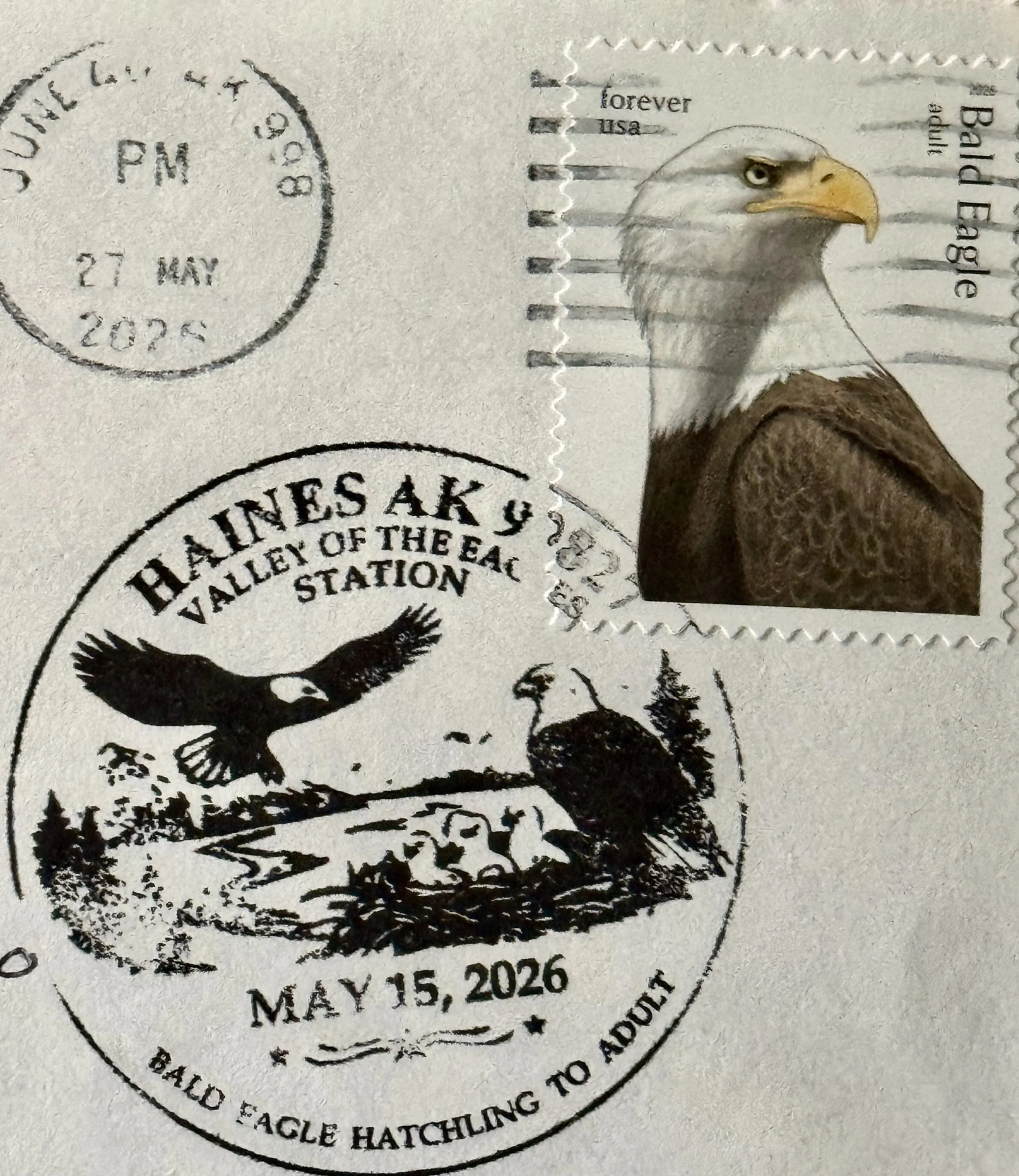
A supercool postage stamp. Photo by Al Batt.
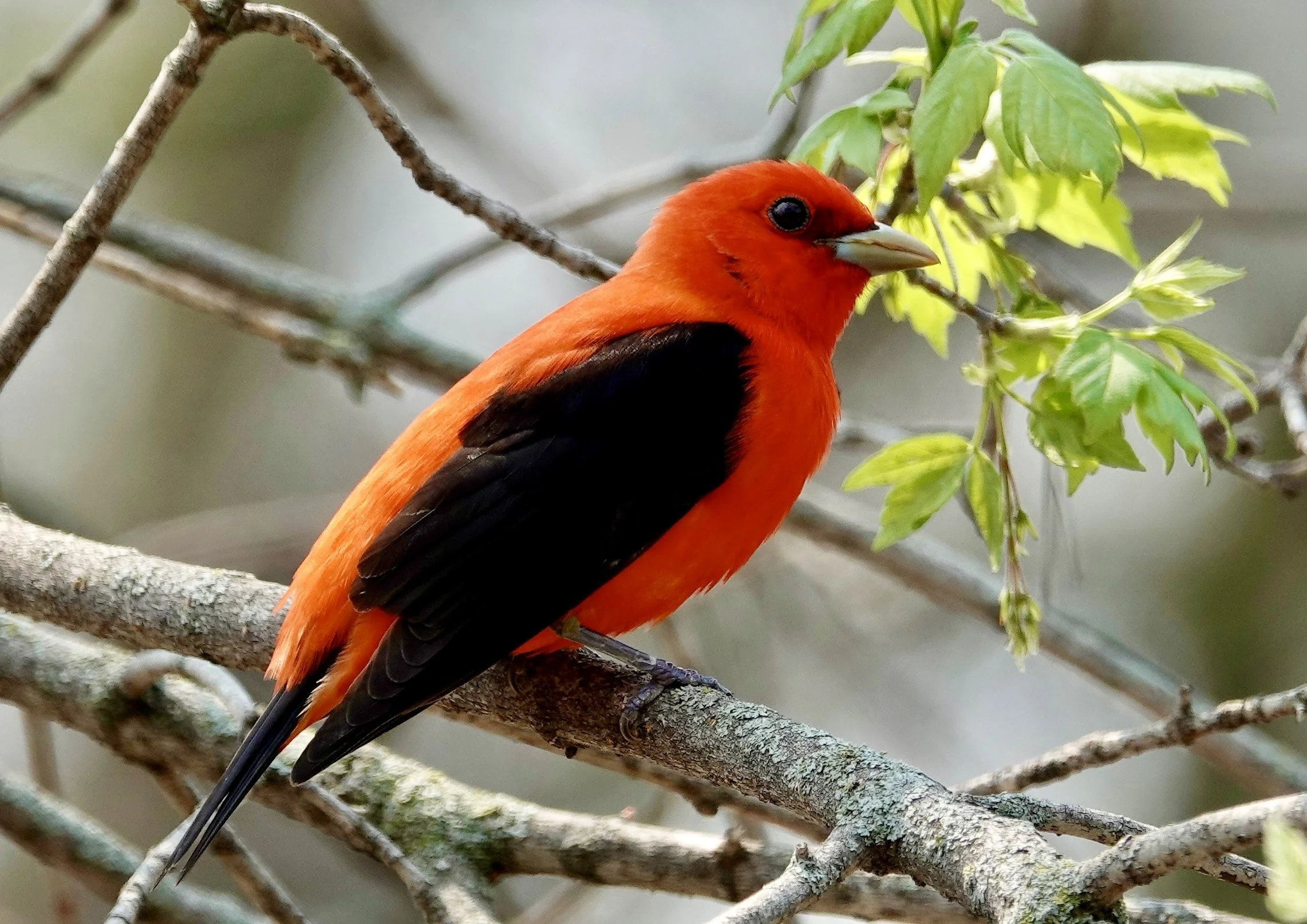
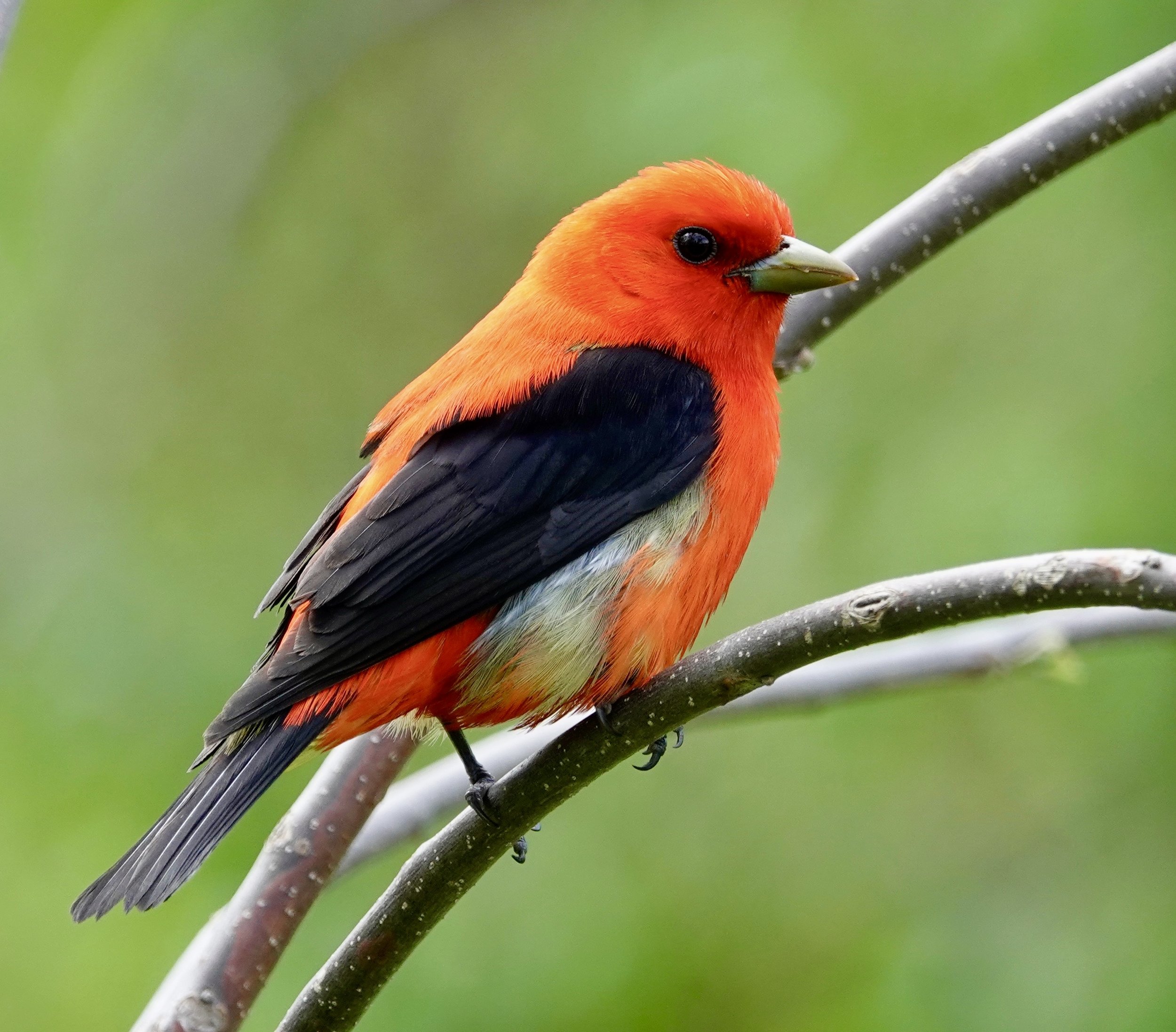
A black-winged redbird. Scarlet tanager photo by Al Batt.

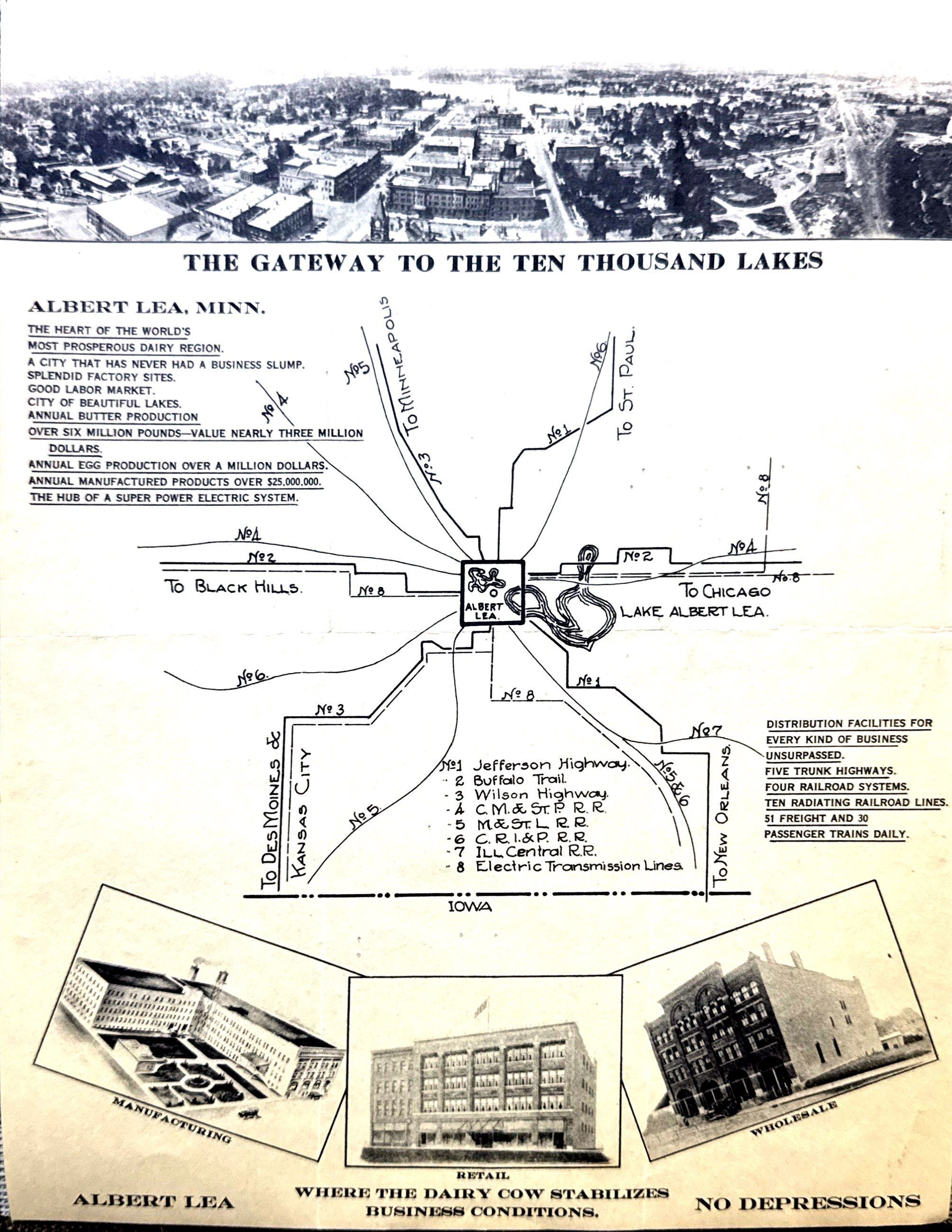
Albert Lea, Minnesota—1926.

But-I-DO-love-you

Naturally

  A Baltimore oriole male shadowboxed with his image in a window. It was a heated rivalry. Monarchs fluttered by and barn swallows catapulted through the air. A red-eyed vireo called persistently. It sounded as if it were asking a question and then answering it.

Tamarac National Wildlife Refuge

  I walked with cohorts at Tamarac NWR. We saw golden-winged warblers. Roughly half of the population of that warbler breeds in Minnesota.

  Cotton Lake, near Rochert, Minnesota, is known for a unique geological feature: An island in an island. A large island within the lake that contains its own small, enclosed island. The north shore of Cotton Lake directly borders the 43,000-acre Tamarac National Wildlife Refuge.

  One in our esteemed flock of birders had taught environmental philosophy at Southwest Minnesota State University in Marshall. He used the writings of Aldo Leopold, widely considered the father of wildlife ecology. His seminal contribution to environmental philosophy was the "Land Ethic," which expanded our moral community to include soils, waters, plants, animals and the biosphere. Leopold’s environmental philosophy is summarized in his 1949 book, “A Sand County Almanac.” Leopold argued that human beings aren’t conquerors of the Earth, but members and citizens of the biotic community. His definitive philosophy is captured by the principle: "A thing is right when it tends to preserve the integrity, stability and beauty of the biotic community. It is wrong when it tends otherwise.” Leopold maintained that true conservation goes beyond mere economic self-interest or government regulation. It requires an ecological conscience driven by individual responsibility and a deep emotional respect for nature.

In memoriam

  Lori Naumann, a devoted wildlife conservationist and long-time employee of the Minnesota DNR, died recently. She was a team member of the DNR’s Nongame Wildlife Program. Lori was known for her passionate leadership of the DNR EagleCam, DNR FalconCam, Nongame Wildlife Program’s tax donation campaigns, and the Minnesota Loon Restoration Project. According to Lori, research has shown that the sense of isolation and loneliness is reduced when people watch birds outside their windows. When we watch birds at the feeders, it helps to improve and maintain brain function and memory. Lori left a lasting legacy and will be missed. She was a joy to work with.

Q&A

  “Where do barn swallows nest?” Look for barn swallows near human habitation. They nest nearly exclusively on or in buildings that offer overhead protection. Preferred locations include the rafters and eaves of barns, sheds, stables, garages, bridges, docks and culverts. Their distinctive forked tails and bright colors are a delight to watch.

  “When is the rice harvest in Minnesota?” Harvesters may take ripe wild rice during the harvesting season that runs from August 15 through September 30.

  “I saw orchard orioles and scarlet tanagers at my jelly feeders. Where do these birds nest?” Orchard orioles construct hanging, basket-like pouches woven from grass and plant fibers, suspended 10 to 20 feet high in deciduous trees in open woodlands, forest edges and riparian groves near water. They nest throughout Iowa in shade trees near farmlands, along the edges of marshes and lakes, and are concentrated in river floodplains and corridors, and in the southern and west-central parts of Minnesota. River valleys are popular places for orchard orioles. They frequently nest close to eastern kingbirds, an aggressive bird that chases off predators and cowbirds. Breeding populations of orchard orioles depart on their southward migration by mid-to-late July. Scarlet tanagers nest in mature deciduous forests and undisturbed woodlands, favoring large, unfragmented canopies often dominated by oaks. In Minnesota, they primarily nest in the central and southeastern mixed woodlands. In Iowa, they are sparsely distributed, mostly nesting in mature timber along major river valleys and slopes in the eastern and western parts of the state.

  “I walked with you at the Detroit Lakes Festival of Birds when you said what the western meadowlark was saying. What was it again?” The western meadowlark’s beautiful song is a series of clear, flute-like whistles that descend in pitch, followed by a bubbling gurgle. There are several mnemonics used to remember the melody. "I was here a year ago." "Gosh darn my feet are cold." "Please give me some squid." The nearly identical eastern meadowlark has a simpler, two-part whistle remembered as "but-I-DO-love-you," or "spring-of-the-year."

  “What are baby porcupines called?” Porcupettes. The collective noun for porcupines is a prickle, but porcupines are rarely seen in groups. Porcupines cannot throw or shoot their quills. For a quill to embed, the porcupine must physically press or swing its tail into the attacker. I petted one in Red Deer, Alberta. I started at the head and went in the direction of the quills.

Thanks for stopping by

  “Bugs are not going to inherit the earth. They own it now. So we might as well make peace with the landlord.”—Thomas Eisner.

  “The secret to life is finding joy in ordinary things.”—Ruth Reichl.

  Do good.


©️Al Batt 2026

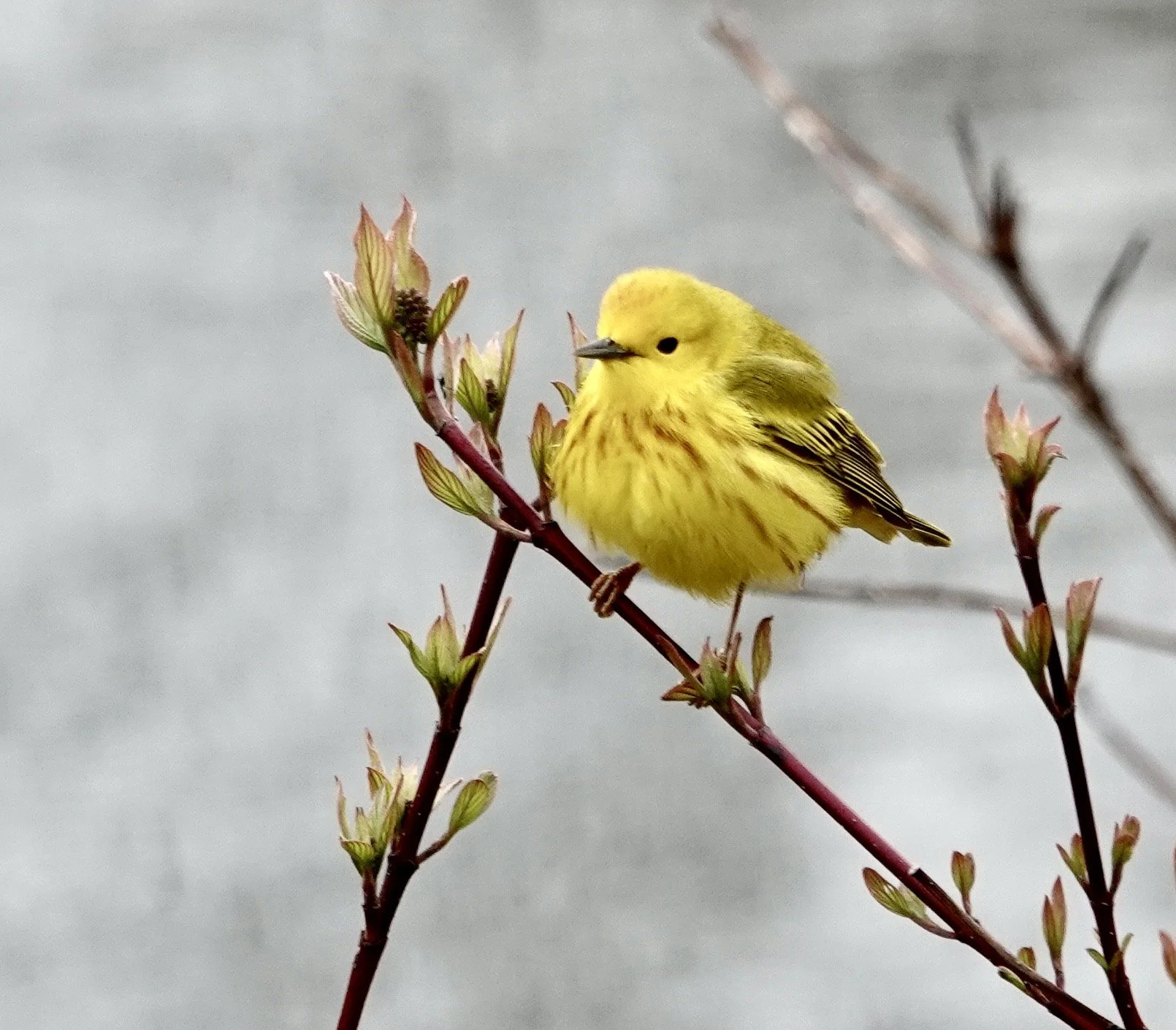
My father called it the summer warbler. That made sense as we had summer cows—summer black and summer brown, or was it some are black and some are brown? The northern yellow warbler’s song is so sweet that people use the mnemonic “Sweet-sweet-sweet-I’m so sweet” to remember it. Photo of a somewhere between buttery-yellow and lemony-yellow male northern yellow warbler by Al Batt.

The sun'll come out tomorrow. Bet your bottom dollar.

Naturally

  The Earth is waking up. I can see it.

  And it’s brought to me in living color.

  There is a famous band named Green Day. This day was a green day. It was verdant everywhere I looked. It was a grand day in May to discover things that were already there. The thunderstorm had ended. It wanted us all to know there is no “e” in “lightning.” The sun came out. Annie sang, “The sun'll come out tomorrow. Bet your bottom dollar.” She was a day off. The sun came out today. Charming goldfinches glowed as if they were plugged in. I suspect being hatched as a goldfinch means they had no ambition to become an eagle. Marsh marigolds bloomed, with vivid yellow flowers contrasting with their deep green leaves.

  Thankful that my emotional support orioles had arrived, I sauntered toward my bird chores. I replenished the bird feeders and watched the patrons eat. My mother told me how much she enjoyed watching people eat the meal she had prepared. I get enjoyment from watching the birds eat the food I give them. It takes a will and a way to become happier. Birds are a way.

  I heard a yellow-bellied sapsucker’s drumming. It’s slower and more irregular than other woodpeckers. It has a stuttering cadence that some compare to tapping out Morse code. It was doing FaceTime on a tree, knocking the sap out of it. The sapsucker makes two kinds of holes in trees—round holes are deep and a sapsucker inserts its bill into the hole to probe for sap. Rectangular holes are shallower, and a sapsucker licks the sap from these holes. A sapsucker usually makes new holes in a line with old holes or in a new line above the old ones. Yellow-bellied sapsuckers dip insects, especially ants, in sap before eating them. The sapsucker produces a nasal mewing call.

  Dame’s rocket is an invasive, non-native plant that blooms May-August in Minnesota. The pinkish-purple flowers look like a native phlox. Dame's rocket (closely related to garlic mustard) has four petals, while native phlox has five.

  Pelicans magically disappear in the sky due to a mix of sunlight reflection, steep banking and high-altitude soaring. As pelicans soar, their wings catch or deflect the sun, causing the birds to vanish from sight, only to reappear as they bank and turn again. When a flock spirals together to catch a thermal, the birds disappear and reappear repeatedly as the entire flock rotates out of the sun's glint.

CAUTION

  Woods on one side of the road and wetlands on the other make for a wildlife crossing.

Q&A

  “I had yellow-rumped warblers at my suet feeders this spring. Is that normal?” The “butterbutts” readily visit suet feeders during chilly spring and fall migrations. They demonstrate kleptoparasitic behavior by stealing insects from spider webs. The webs provide a quick and easy meal with little hunting.

  “If a bird were raised by another species, does it think it is that kind of bird?” Not all birds imprint. Imprinting is most common in precocial species—birds that are active, open-eyed, and able to leave the nest shortly after hatching, such as ducks, geese, chickens and turkeys.

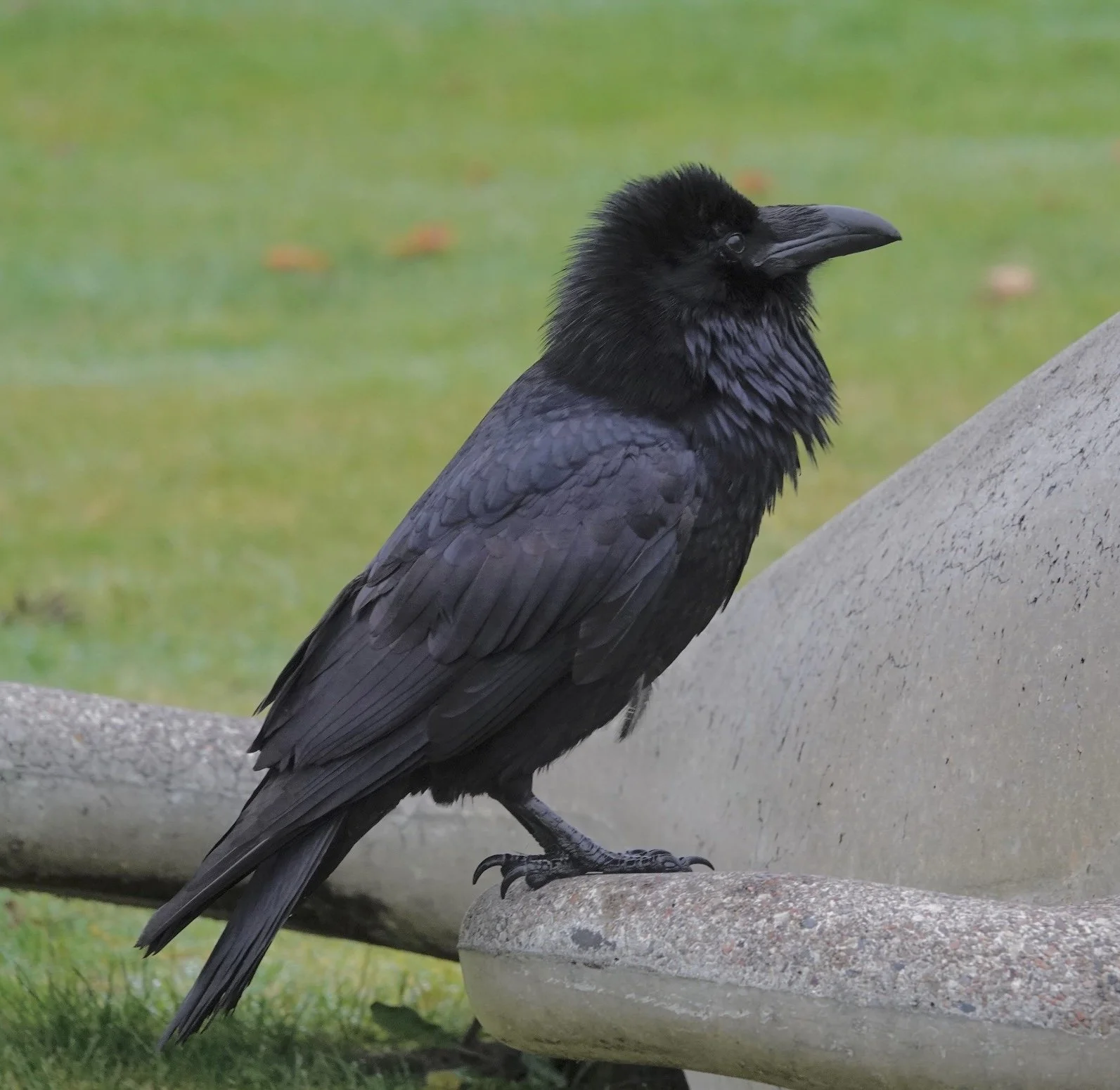
  “Do any songbirds eat carrion?” Ravens, crows, jays, shrikes, nuthatches, chickadees and starlings are the most likely.

  “When is the mating season for coyotes?” In Minnesota, it runs from January through March, with the peak occurring in February—let’s say on Valentine’s Day.

  “What are waspers?” I led a nature walk in Kentucky when one of the group said there had been a lot of waspers around. Waspers is a regional, colloquial term for wasps. “Waspers” is easier to say than “Wasps.”

  “What Minnesota county has the most lakes?” According to Minnesota Sea Grant, Otter Tail County has 1073 lakes, St. Louis 969, and Itasca 897 lakes. Mower, Olmsted, Pipestone and Rock counties have no natural lakes.

  “Where are badgers found in Minnesota?” I walked with a busload of birders when my co-leader stepped into a badger hole and took a fall. Thankfully, he was uninjured. Badgers inhabit most of Minnesota, except in the heavily forested northeast. They are nocturnal creatures that prefer open prairie but will make their homes in farmland.

 “Why is there dried grass in my jelly feeder?” Orioles occasionally drop nesting materials into jelly feeders when multitasking. When the females weave complex, hanging pouch nests, they often carry food and building fibers simultaneously. They sometimes drop the fibers to eat, and then either forget them or are banished from the feeder.

Thanks for stopping by

  “In nature, nothing exists alone.”—Rachel Carson.

  “It’s a dangerous business, Frodo, going out your door. You step onto the road, and if you don’t keep your feet, there’s no knowing where you might be swept off to.”—J.R.R. Tolkien, “The Fellowship of the Ring.”

  Do good.


©️Al Batt 2026

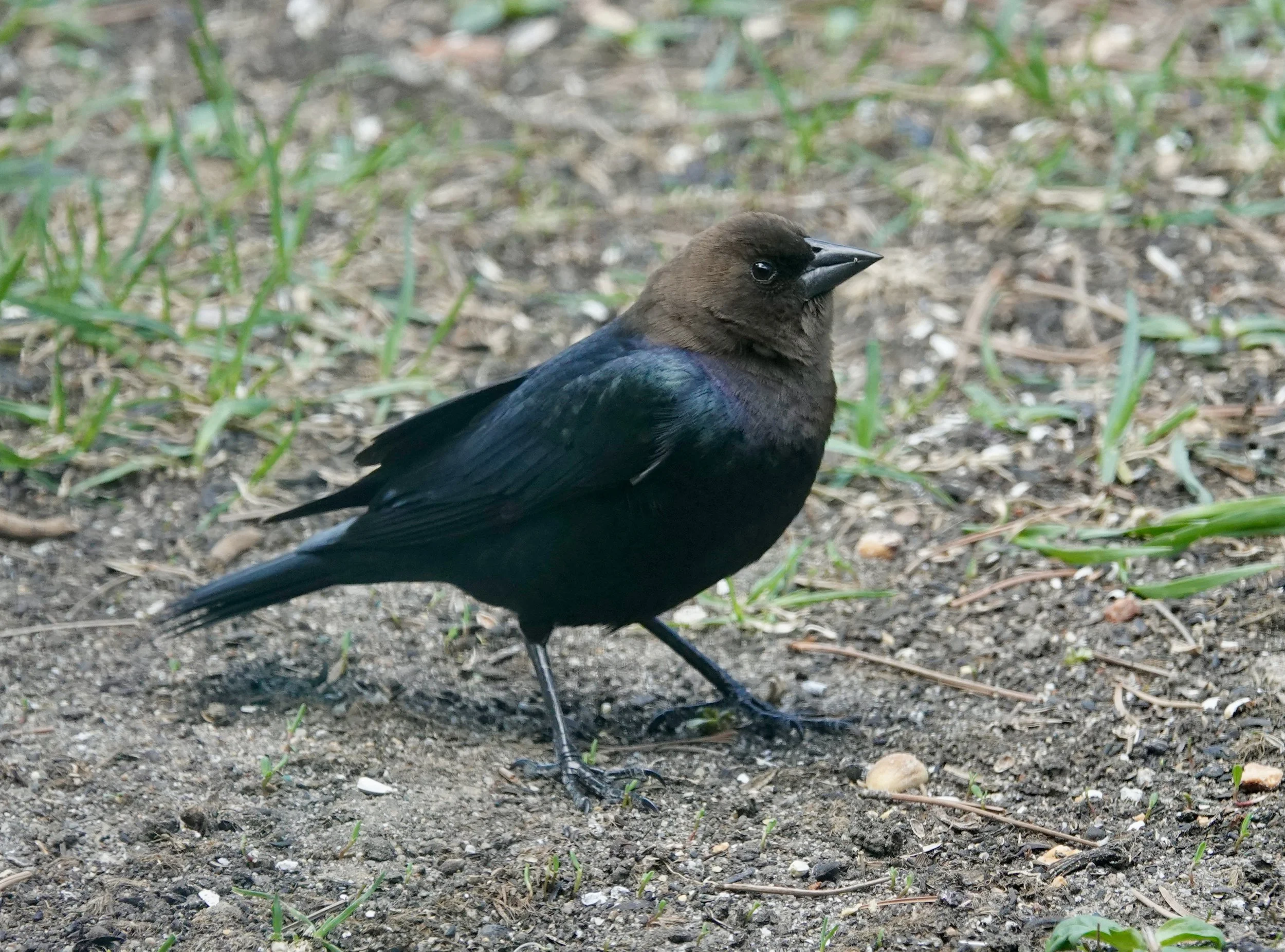
The male brown-headed cowbird is disguised as a Coppertop battery. The cowbird is the most common brood parasite in North America. The female builds no nest; she lays her eggs in the nests of other bird species, which raise the young cowbirds. The cowbird parasitizes the nests of over 220 different species. Some host species reject or abandon the foreign eggs, resulting in cowbird young being raised in the nests of only about 150 species. Photo by Al Batt.

Comparing a scarlet tanager to the Grand Canyon

Naturally

  Seasons change gradually, and then they change suddenly. Each is an unfolding mystery.

  I hiked a trail. Each bend in the trail held the promise of remarkable things. Blue jays were trash-talking poor creatures who had the misfortune of being neither blue nor a jay. This trash-talking encouraged me to pick up trash, but I hadn’t brought a bag to put the detritus in. So, I piled the trash here and there, intending to continue my walk and gather the trash on my next trip around. Later, after grabbing a bag from my car, I began walking to where I’d left the trash. I discovered that all the trash piles were gone. Someone had picked them up—every one of them. On the old Lone Ranger show, an innocent bystander might say, “Who was that masked trash picker-upper?” It wasn’t the Lone Ranger. I do not know who to thank, but thank you, whoever you are.

  A bright beacon lured me to the window. It was a bird that even people who ignore birds need to take a second look. A bedazzling black-winged red bird. A gorgeous scarlet tanager tunneled my vision. It was like seeing the Grand Canyon, only smaller. A grand bird, there is no doubt. I hear what you’re saying, “You’re not going to compare a scarlet tanager to the Grand Canyon, are you?”  Who would do that? Me, that’s who. The bird is an amazement.  Mervyn Peake said, “I am too rich already, for my eyes mint gold.” He might have seen a scarlet tanager.

  A brown thrasher sings a loud, long series of doubled phrases, described as “plant a seed, plant a seed, bury it, bury it, cover it up, cover it up, let it grow, let it grow, pull it up, pull it up, eat it, eat it.”

  Carpintero is the Spanish word for woodpecker. Woodpeckers are crucial keystone species that create essential nesting and roosting cavities in trees, which benefit a wide range of other animals. Their ability to excavate holes, which they might use for only one season, provides homes for cavity-nesting birds, mammals and insects, while aiding forest health by controlling pests and assisting in decomposition. Some pairs reuse a cavity for subsequent nestings.

  I was in Garrison, on the shore of Lake Mille Lacs, when I saw a bald eagle carrying a mammoth stick to a nest. Home improvement project? Hockey stick?  Because the fishing season had just opened, it could have been a fishing pole. That way, the raptor wouldn’t get its feet wet. With a population of 205, Garrison is the smallest city in the world to have a McDonald's restaurant.

  Red-winged blackbird males and females exhibit extreme sexual dimorphism, appearing so different that they are mistaken for separate species. Males are glossy black with bright red-and-yellow shoulder patches, while females are streaky brown, resembling large sparrows.

Earth Day             

  I was on KEYC-TV on Earth Day and said that I liked dandelions. I’ve eaten dandelion greens. Not bad, but I like dandelions because I love honey. Dandelions are vital to honey bees, acting as one of the first abundant, accessible food sources in early spring. They provide nectar for energy and pollen for protein, helping colonies rebuild after winter. Dandelion pollen isn’t the most nutritious pollen, but the widespread, consistent availability of dandelions makes them a reliable lifeline for bees before other flowers bloom.

Q&A

  “If parakeets are hatched in another country, will they be able to communicate immediately with parakeets from this country? Or would they have to learn a different language or dialect?” Parakeets raised in different countries could communicate with each other, although they might initially possess different regional dialects or accents. Parakeets rely on a combination of innate calls and learned vocalizations, allowing them to adapt their communication quickly. Parakeets of the same species share a basic, instinctual language of whistles, chirps and body language that is universal, regardless of where they hatched. Research shows that parakeets (specifically Monk parakeets) introduced to different areas develop unique regional dialects, similar to human accents. Because parakeets learn and adjust their vocalizations to fit in with their current flock, two birds from different regions would likely learn each other's language rapidly. Monk parakeets (Quaker parakeets) are native to South American grasslands—but if you're looking for them in North America, look in cities such as New York, Chicago, Portland (Oregon), San Diego, Houston, Dallas, New Orleans or Miami, where escapees or releases of this popular cage bird have started feral populations.

  “How are hummingbird populations faring in North America?” Ruby-throated hummingbirds are doing relatively well, but rufous, Allen's, broad-tailed and Calliope hummingbirds are in significant decline. The Anna's hummingbird has an increasing population and a range expansion due to its ability to adapt to human-modified landscapes that offer environments rich in food.

Thanks for stopping by

  “Life is not always perfect. Like a road, it has many bends, ups and down, but that’s its beauty.”―Amit Ray.

  "A weed is a plant that has mastered every survival skill except for learning how to grow in rows."—Doug Larson.

  Do good.


©️Al Batt 2026

A bear sign in the woods. Photo by Al Batt.

A bedazzling black-winged red bird (scarlet tanager). Photo by Al Batt.

The robin keeps going long after Rocky Balboa would have given up

Naturally

  Blooming crabapple makes it look as if the world is having a party. The morning chorus of birds sounds like a symphony. The feathered musicians’ performance is stirring. Birdsong inspired Izaak Walton to say, "Lord, what music hast Thou provided for Thy saints in heaven, when Thou affordest bad men such music on earth!"

  I cleaned the birdbath. Apparently, the birds had been holding a mud-wrestling tournament in it.

  My ears welcomed the lovely song of the American robin, even though there is a rockin’ robin battling with his reflection in my bedroom window. He keeps going long after Rocky Balboa would have given up. Still, I appreciate the bird’s pep talk, “Cheerily, cheer-up, cheer-up, cheerily, cheer-up.”

  I sliced an orange in half and hung it up for the orioles (Baltimore and orchard) to enjoy. Other birds eat sliced oranges: red-bellied woodpecker, rose-breasted grosbeak, gray catbird, scarlet tanager, red-headed woodpecker, northern mockingbird, house finch and others.

  "When oak leaves are the size of a squirrel's ear, it's time to plant corn" is a reliable, traditional farming adage.

Q&A

  “How did the toadstool get its name?” Its origin is rooted in folklore and superstition. Medieval Europeans believed that toads sat on poisonous mushrooms, making them dangerous to touch or eat. The name has evolved and is now commonly used as a general term for any mushroom.

  “Are the Detroit Red Wings named after the red-winged blackbirds? Are Red Wing Shoes named after that bird?” James Norris invested in the Detroit Falcons hockey team in 1932 and changed its name to the Detroit Red Wings. The winged wheel was adopted as the team’s logo because Norris had played hockey for the Montreal Winged Wheelers. Red Wing Shoes aren’t named after the red-winged blackbird either. The company is named after its hometown of Red Wing, Minnesota, which was named after a local Native American leader, Chief Red Wing.

  “My mother told me I am never more than three feet away from a spider. Is that true?” This line is from William Shakespeare's “Hamlet,” “There are more things in heaven and earth, Horatio, than are dreamt of in your philosophy,” was spoken by Hamlet to his friend after seeing his father's ghost. It argues that human knowledge is limited and cannot explain all mysteries of existence. A 1995 article by arachnologist Norman Platnick said, "Wherever you sit as you read these lines, a spider is probably no more than a few yards away." That considered remark morphed into “three feet away” after much repetition. It’s a myth. How close the nearest spider is to you depends on where you are. Did your mother work on a spider farm?

  “What determines the size of a deer’s antlers?” Deer antler size is determined by a combination of five key factors: age, nutrition, genetics, Photoshop and AI. A white-tailed deer buck's antler potential is dictated by its genes, but its ability to reach that potential depends on proper nutrition and age, typically peaking around 5 to 7 years of age. A buck's antlers often double in size between 1.5 and 2.5 years of age.

  “What does a rainbow in the morning mean?” A rainbow in the morning gives you fair warning. A morning rainbow appears when there is rain to the west, the direction from which weather is likely to come. A morning rainbow is a scientifically sound warning of approaching rain because it indicates moisture in the west and weather typically moves west-to-east. This means the rain-producing clouds are likely heading toward you. Rainbows appear opposite the sun. Conversely, an evening rainbow (sun in the west, rain in the east) signifies that the storm has already passed, hence "evening rainbow, sailor's delight.”

  “Because birds don’t have external ears, how good can their hearing be?” Good question. They don’t read lips. They can’t because they don’t have lips. They can’t read bills because they just can’t. Birds have ears, but as you said, they lack external ear flaps. What they have are small, funnel-shaped openings on the sides of their heads behind and below the eyes. These openings are covered and protected by specialized, soft feathers called auriculars, which reduce wind noise while allowing sound through. An average bird’s hearing is OK, but its range isn’t as wide as ours. Birds are good at hearing the sounds that they need to hear: those made by prey, predators, their babies and other birds of their species.

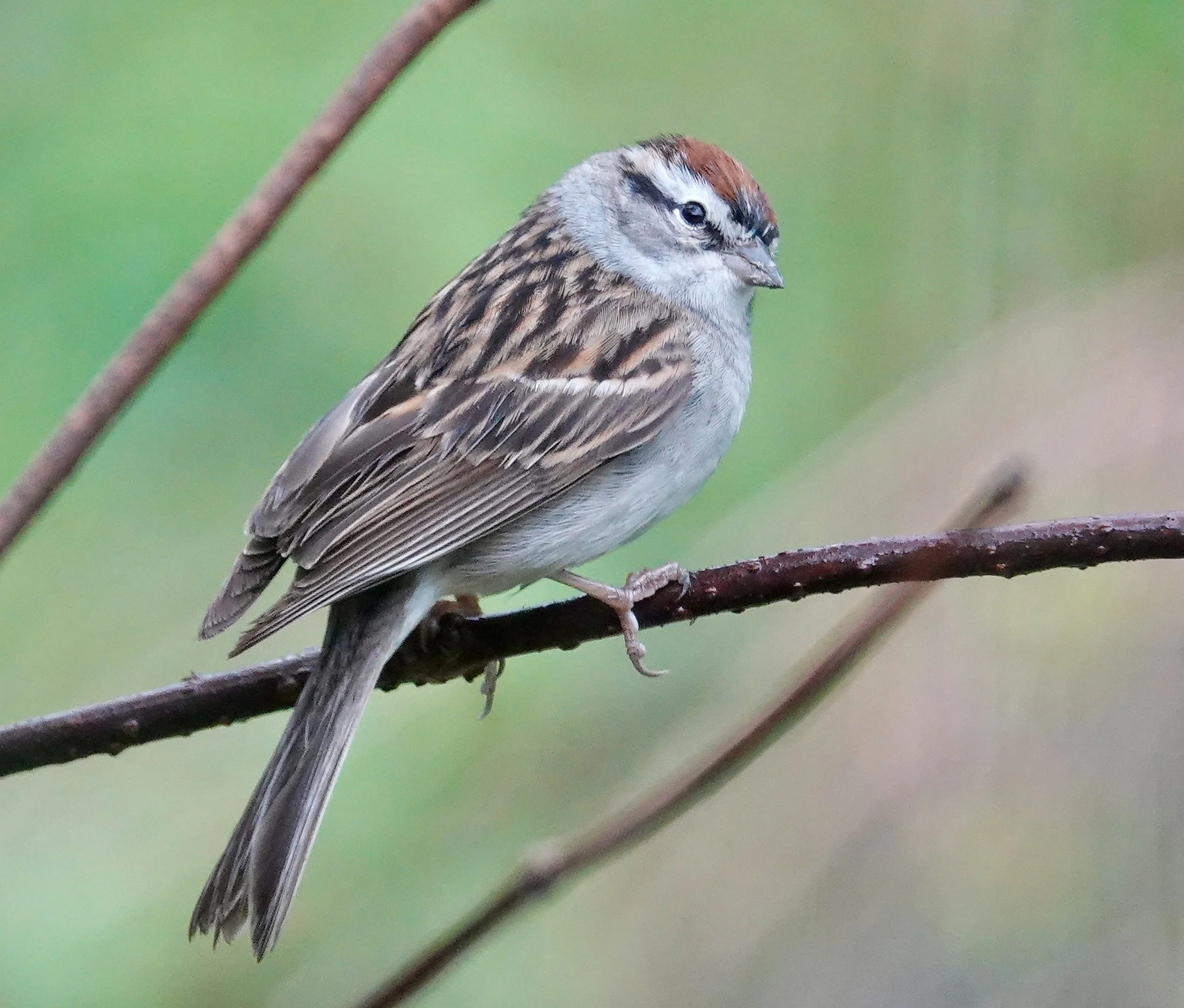
  “Last winter, I had some American tree sparrows keeping company with the juncos in my yard. What could I have fed them?” They would enjoy millet.

Thanks for stopping by

  “Having respect for animals makes us better humans.”—Jane Goodall.

  “The butterfly flitting from flower to flower ever remains mine, I lose the one that is netted by me.”—Rabindranath Tagore.

  Do good.

©️Al Batt 2026

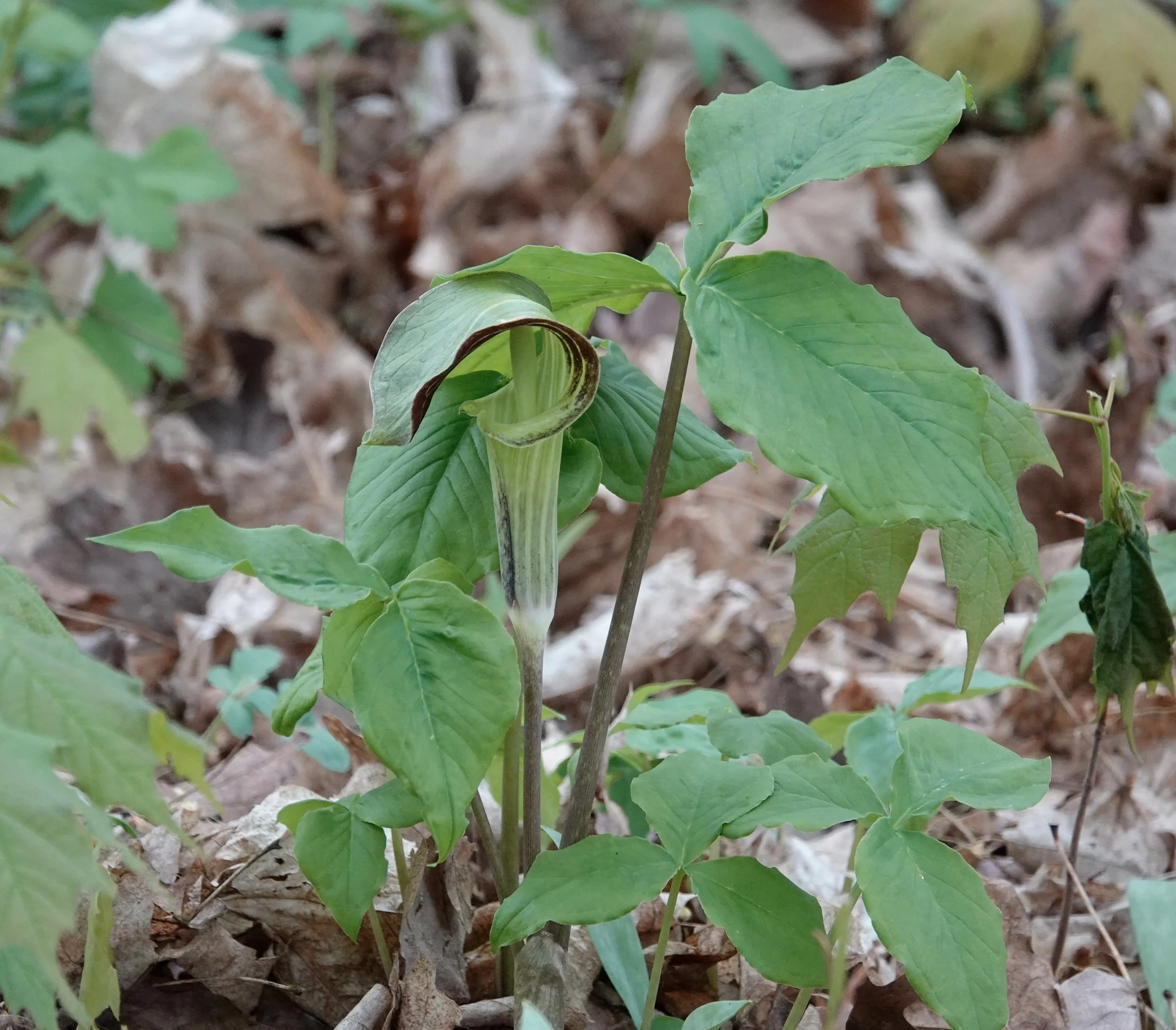
The Jack-in-the-pulpit is a native woodland perennial that can change its sex from male to female year-to-year based on stored energy. It features a unique, striped "pulpit" (spathe) shielding a "Jack" (spadix), smells like fungus to attract pollinators, and produces scarlet berries that are poisonous due to oxalic acid. Native Americans used the root for food, but only after extensive preparation to remove toxic calcium oxalate crystals. Photo by Al Batt.

Pigeon or dove? Millipede or centipede?

Naturally

  I walked a familiar path. I didn’t need a dog to walk with me. I’d enjoy the company, but we’d be doubling up on some duties, because I am easily distracted by squirrels too.

  Eastern bluebird males perch on nest boxes to survey a territory, attract mates and to guard against competitors and predators. I saw one perched on a little free library box. He was looking for a mate who was a reader.

  Male goldfinches were golden rays of sunshine. Their chattering was nice to hear. The birds were in prime form, but it was as quiet as cotton on a cottontail when an eastern cottontail doe gave birth to young rabbits in a flowerbed in our yard. Cottontail rabbits typically have 3 to 8 kits per litter, with up to 4 litters in Minnesota and as many as 6 in Iowa. Rabbits are hairless, sightless and helpless at birth. They weigh about an ounce when they join this world and are no bigger than a person's thumb. To keep them warm, the mother digs a shallow saucer-shaped nest in the ground and lines it with vegetation and her own belly hair. Baby cottontails leave the nest after three weeks. I’d rather have a dozen rabbits in my yard than a single stray cat. The range of one cottontail is no more than five acres (about the size of four football fields).

  I heard the harsh sounds of grackles while I watched a couple of ring-billed gulls squabbling over a french fry. They are french fry gulls that patronize the parking lots of fast-food joints offering fries.

  I have been seeing ground squirrels on the sides of roads. The Minnesota Golden Gophers have a mascot named "Goldy Gopher," a character modeled after this 13-lined ground squirrel. This ground squirrel is also called a striped gopher or a squinny. Goldy is definitely not a pocket gopher, but many people think he looks more like a chipmunk than a 13-lined ground squirrel.

This and that and the other

  A rose-breasted grosbeak sings like a lovesick robin.

  I watched a small lake this spring. There were many ducks. It was the Duck Ages.

  A Canada jay, known as a camp robber, once stole my tent. It was in a dream.

  He landed close to the deck. He cawed, a bit arrogantly to my ear. I called him Russell Crow. That’s probably not his real name. “Oh, crow up!” I yelled his way. He pretended he didn’t hear me.

  Mary Oliver wrote, “Around me the trees stir in their leaves and call out, ‘Stay awhile.’ The light flows from their branches. And they call again, ‘It’s simple,’ they say, ‘and you too have come into the world to do this, to go easy, to be filled with light, and to shine.’”

Q&A

  “What’s the difference between a pigeon and a dove?” There is no formal distinction between a pigeon and a dove. They are all part of the family Columbidae. Which birds are called doves and which are called pigeons is decided by those who name them. They are all close relatives of chunky, small-headed birds that feed mostly on seeds and fruit. Historically, people have used dove to refer to smaller species in this family, and pigeon to refer to larger species.

  “What do great blue herons eat?” Birds are survivors. A great blue heron (nicknamed shite poke, long John, big cranky, blue crane, GBH and poor Joe) eats what is within its reach, which includes fish, amphibians, reptiles, small mammals, insects and other birds. I have seen a great blue heron eat ground squirrels, chipmunks and muskrats. A GBH is 3 to 4.5 feet tall and weighs 5-6 pounds.

  “Is it a millipede or a centipede?” Millipedes have two pairs of short legs on each body segment, a rounded body, and a hard external skeleton. Their legs are tucked under the body and are difficult to see. The number of body segments varies with the species, but the number of pairs of legs ranges between 40 and 400. Centipedes have only one pair of legs per body segment, which are easily spotted protruding from their flattened bodies. Centipedes have an odd number of pairs of legs that vary from 15 to 191. Millipedes have short antennae and move slowly, eating their way through moist leaf litter, fungi and decayed plant material on the ground. Centipedes are fast, have long antennae and back legs nearly as long as their antennae. Centipedes eat spiders, insects, worms and other arthropods.

Thanks for stopping by

  “When you learn a thing a day you store up smart.”—Festus Haggen on “Gunsmoke.”

  “If you can find a path with no obstacles, it probably doesn’t lead anywhere.”—Frank A. Clark.

  “To walk into nature is to witness a thousand miracles.”—Mary Davis.

  Do good.


©️Al Batt 2026

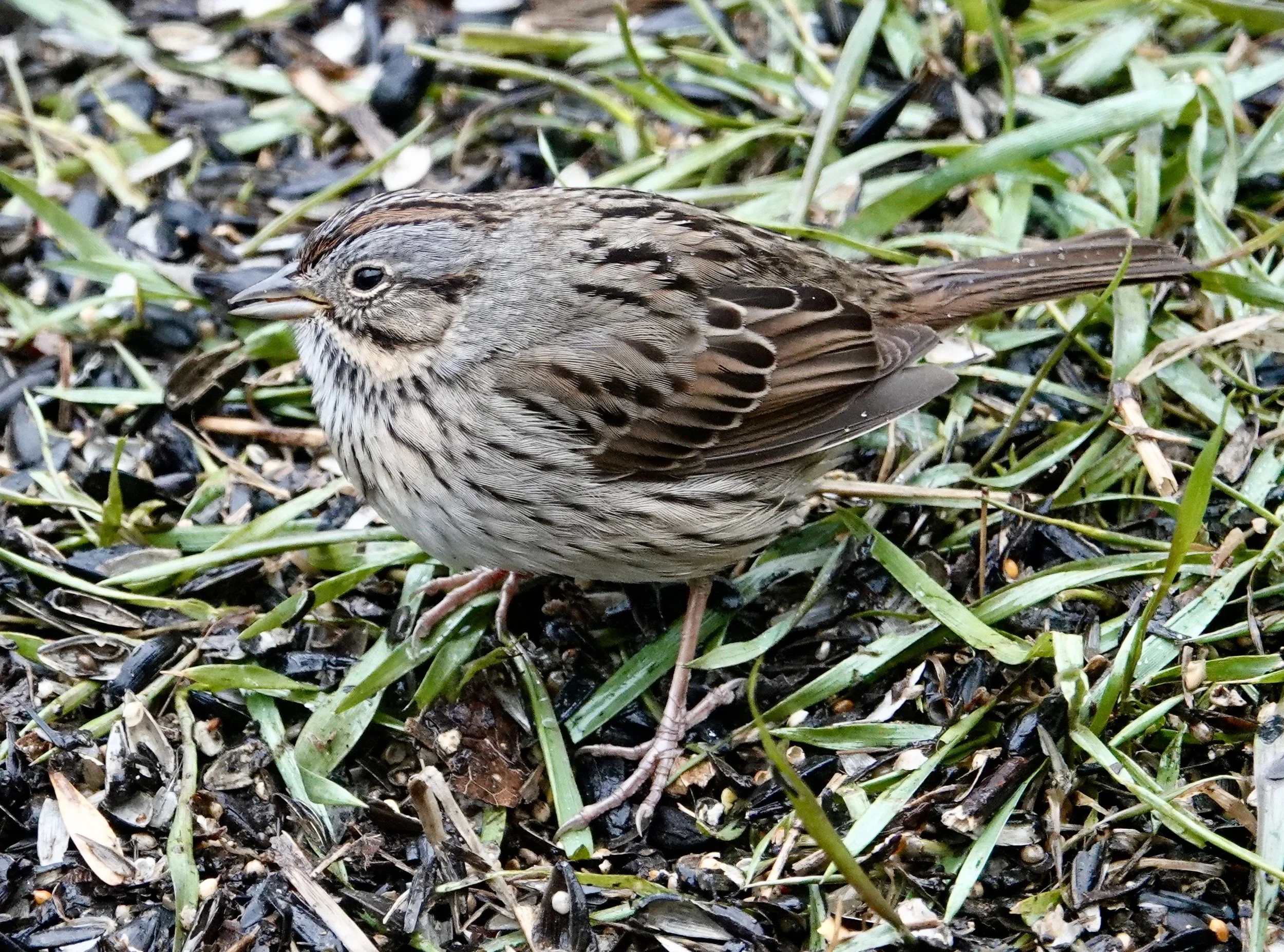
A field guide doesn’t always work. Sometimes birds defy description. One day, that LBJ (Little Brown Job)   becomes a Lincoln’s sparrow. That’s a good day when that happens. No field guide, no matter how incredible it is, does a bird justice. John James Audubon named this cute, secretive, tiny sparrow after his companion, Thomas Lincoln. Photo by Al Batt.

Where do the multicolored Asian lady beetles go after leaving our homes in the spring?

Naturally

  “Cow-CAT!”

  That’s what I heard. Ring-necked pheasant roosters crow loudly most often in spring and summer, especially at dawn and dusk. A rooster's crow is often followed by a loud, rapid beating of the wings that can be heard only from relatively close distances. Roosters frequently cackle when they fly. Ring-necked pheasants were first successfully imported from China to the United States in 1881. Their first successful release in Minnesota came in 1916. Pheasants were introduced to Iowa in 1900 or 1901, originating from an accidental release when a windstorm destroyed a game farm in Cedar Falls.

  I celebrated Earth Day at Meadowlark Prairies Outdoor Lab in St. James. We don’t have a spare Earth. We need to take care of this one.

  Common grackles picked at things on the ground as gulls flew overhead, getting a sky view of the world. Baltimore orioles return to Minnesota right around the time plum trees blossom.

  Ants are primary seed dispersers for wild violets. The dispersal of seeds by ants is called myrmecochory. Wild ginger, with its brownish–purple flowers, depends upon ants both for pollination and seed dispersal.

  A dashing male house finch found the sunflower seeds to his liking. A jaunty looking male goldfinch joined it at the platform feeder. The word "finch" originates from Old English finc (related to German fink), referring to a small, colorful songbird, and was a nickname for a cheerful or lively person. That fink is not to be confused with “rat fink," a slang term for a contemptible, treacherous or undesirable person, specifically an informer, stool pigeon, narc, squealer or snitch. “Rat fink” was famous as a grotesque counterculture mascot created by Ed "Big Daddy" Roth as an anti-hero to Mickey Mouse.

  My yard hosted many purple finches this spring. The male is a handsome fellow often described as a sparrow dipped in raspberry juice. The breeding range for this species includes northwestern Minnesota, Canada, the northeastern U.S., the Great Lakes region, and the Pacific coast.

  A male robin battles with a bedroom window here in the Batt Cave. He is attacking his own reflection, mistaken for a rival. This behavior is best curtailed by breaking up the reflection on the outside of the glass. The robin is persistent and robust. He is the energizer birdy.

  Dandelion seeds develop apomictically , which means without fertilization. Each dandelion plant produces as many as 20,000 viable seeds, according to the University of Wisconsin. Seeds are spread by the wind. Each seed has a pappus , a feathery white structure that acts like a parachute. Their long taproots can sprout two to five shoots when damaged, which is a reason it seems as if every time we pull a dandelion, several take its place.

Q&A

  “What state has the most trumpeters?” I think Louisiana has produced the most trumpet players, but California and Tennessee have had so many musicians, that their numbers of trumpeters must be high. If you’re talking about the trumpeter swans, I’d guess Alaska would have the most, and Minnesota the second highest population. A trumpeter swans has 25,000 to 35,000 feathers. A standard queen-size feather pillow may contain 2,500 feathers in a single pillow. Feather pillows consist of 51% or more feathers (often from ducks or geese) and might be blended with down for comfort.

  “Where do the multicolored Asian lady beetles go after leaving our homes in the spring?” After leaving homes in the spring, multicolored Asian lady beetles (MALBs) disperse to find food, primarily feeding on aphids in trees, shrubs, and early vegetation before major crops are available. They are voracious predators, they feed on mites, scale insects and aphids on ornamental plants and early-spring flowers before moving to field crops like soybeans.

  “Can birds shut down half their brains?” Yes, it’s called unihemispheric slow-wave sleep, which will never be an answer on a crossword puzzle. A brain that can function while half-asleep is important to survival. Ask any man trying to stay awake through two televised NFL games in one day. Birds can shut down one hemisphere of their brain while the other hemisphere stays alert. This adaptation allows birds to rest during long flights or remain vigilant at the edge of a flock or roost, with one eye open to watch for threats. This ability allows some migrating birds to get shuteye on the wing. Another good reason to be a birdbrain.

  “What do robins eat in the spring?” Robins are omnivorous, so in addition to earthworms, they eat beetles, spiders, caterpillars, grasshoppers, grubs, crickets, snails, and the berries of chokecherries, hawthorn, dogwood, staghorn sumac, crabapples, hackberries, eastern red cedar, holly and juniper.

Thanks for stopping by

  “Wherever there are birds, there is hope.”―Mehmet Murat ildan.

  “What sunshine is to flowers, smiles are to humanity. They are but trifles, to be sure, but scattered along life’s pathway the good they do is inconceivable.”—Joseph Addison.

  Do good.


©️Al Batt 2026

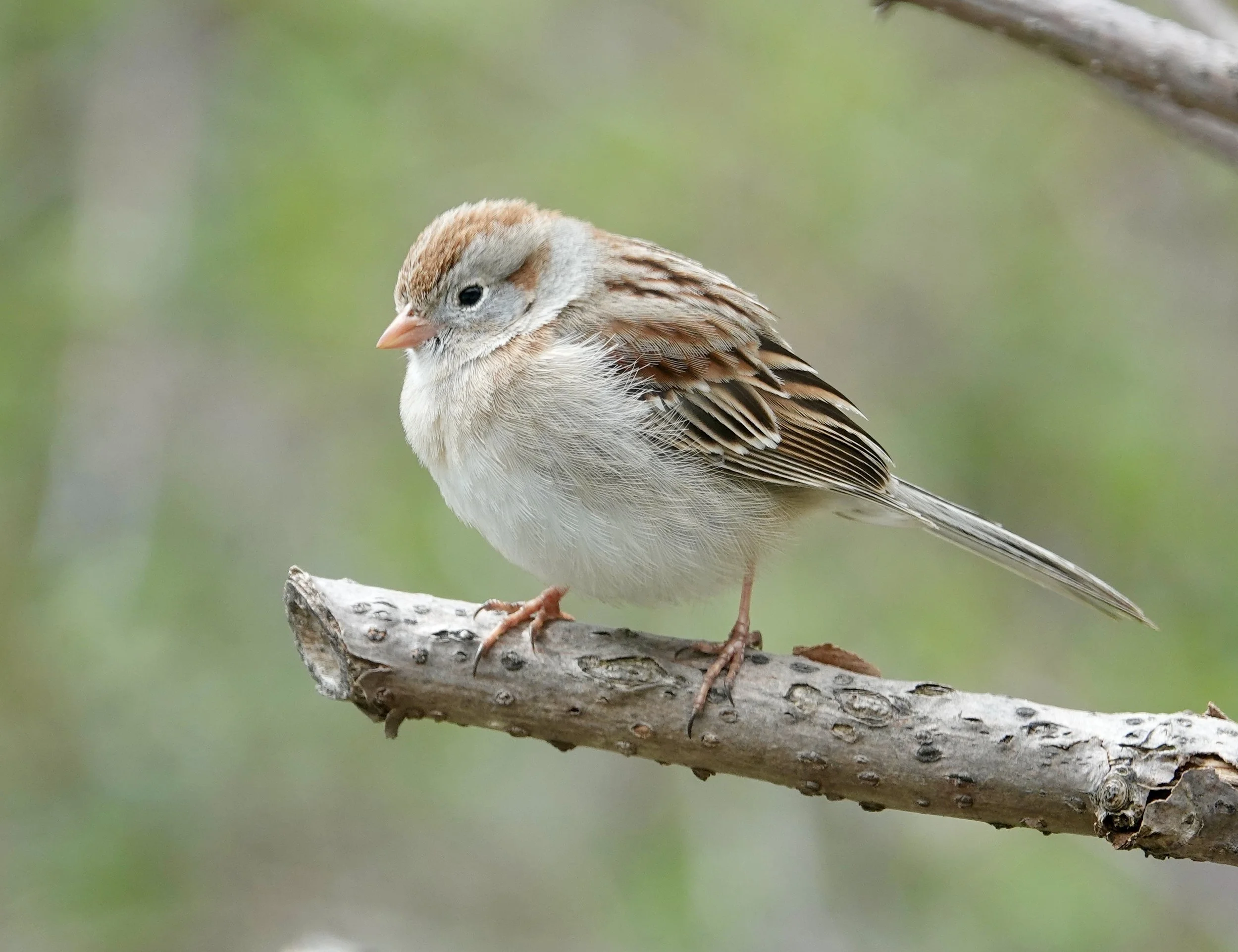
I led a walk on Earth Day. The birds we encountered most often were field sparrows. The field sparrow is a small, pink-billed songbird of open, shrubby habitats, pastures, dry fields and wooded edges. It prefers areas of grass interspersed with shrubs or small trees. Its song is a series of sweet, clear whistles that accelerate into a dropped-ping-pong-ball trill before coming to a rest. Photo by Al Batt.

Who’s awake?  Me too!

Naturally

  Painted lady butterfly and bumblebee welcomed the morning.

  I saw no chickadees in the yard. I saw none at my feeders all winter. I miss these tiny ambassadors of avian ambrosia.

  “Who’s awake?  Me too!” had heralded the night’s darkness. A series of five rhythmic, muffled hoots from the woods surrounding the house. It was a great horned owl.       

  When I was a boy, I heard someone described as not worth a hoot in a hailstorm. When I heard all the reports of damaging hail, I’m glad I got the hoot instead.

  I went for a leisurely meander where I was verbally assaulted by a goose, intent on beginning a nest. I admired the beauty of hepatica, bloodroot, Virginia bluebells and Dutchman's breeches. These early flowers depend upon ants for seed dispersal. The leaves of Virginia waterleaf (which appeared water-stained) provided more entertainment for my eyes.

  A song sparrow serenaded my stroll. The bird is recognized by a song beginning with three short notes followed by a longer, lower note, closely mimicking the iconic "da-da-da-dum" opening of Beethoven’s Fifth Symphony.

  An eastern cottontail rabbit built a nest in a flower bed near the house. It’s a shallow cup scraped into the soil, lined with fur and dried vegetation. Rabbits nest in unusual locations—the middle of a lawn, along a sidewalk, on a playground or in a garden. To avoid attracting predators, the mother visits her kits only briefly at dawn and dusk for quick feedings. She conceals the nest with dried vegetation between feedings.

The Feather Wars

  I enjoyed reading “The Feather Wars: And the Great Crusade to Save America's Birds” by James H. McCommons. It’s an expansive account of bird conservation that chronicles the sky-darkening flights of passenger pigeons in the 19th century that were so overwhelming that they caused people to drop to their knees in prayer. The pigeons created a continuous sound of thunder and buffeting winds from their wings, turning day into dusk. Descriptions noted that the flocks brought a startling power that felt like a "great wind, the rumble of a tsunami, or the tremor of an earthquake." Then the bird became extinct.

  Birds of many species gave their lives so that feathers might adorn women’s garments.

  The book related the story of Charles Bendire, a 19th-century US Army officer, known for his work in oology (the study of birds' eggs). While collecting eggs, Bendire had a delicate egg in his mouth for safekeeping while he climbed, and it became stuck. In his efforts to pry his mouth open to free the egg, he broke one of his teeth. The egg, identified as belonging to a zone-tailed hawk, survived and is preserved at the Smithsonian.

  I found the book wonderfully worthy and absorbing.

Q&A

  Mike Bonner of Courtland asked if grape jelly is OK to feed orioles. Grape jelly isn’t likely harmful in small amounts but doesn’t provide the nutrients orioles need. Think of it as a snack or dessert, not an entree. It’s OK to provide in a shallow dish about 1 inch deep during peak spring migration. Smaller amounts are less probable to spoil in hot weather or get sticky residue on feathers. Organic, natural or bird feeding store grape jelly is better for orioles because it avoids high-fructose corn syrup. Orioles enjoy sliced oranges and drink nectar made of one part granulated white sugar to four parts non-distilled drinking water. Heat the water if necessary to dissolve the sugar.

  “Why do I see so many deer in my residential neighborhood?” Deer are found in such areas because the landscapes provide an ideal habitat with abundant food, limited hunting and few natural predators. Safety and high-nutrition resources are attractive to deer. Wooded areas and parks provide cover, resting places and travel corridors.

  “How much can a wild turkey eat?” A single adult wild turkey is an opportunistic omnivore that can eat up to one pound of food per day, with consumption rates varying by age, sex and season. Hens typically consume about one-third of a pound daily, while toms can eat between half a pound and a pound, increasing intake to build fat reserves during fall. Insects, such as grasshoppers and beetles, make up a significant portion of a poult’s diet in summer. Wild turkeys generally travel 1 to 2 miles per day foraging for food, though they can travel up to 5 miles in a single day depending on habitat and food availability.

  Ken Nelson of Clarks Grove wondered if there was a way to discourage common grackles from feeders. Switch to safflower or striped sunflower seed, or use caged feeders with small openings to restrict access. Use weight-sensitive feeders that close under a grackle’s weight.

Thanks for stopping by

  “The world is mud-luscious and puddle-wonderful.”–E.E. Cummings.

  “Sunshine is delicious, rain is refreshing, wind braces us up, snow is exhilarating; there is really no such thing as bad weather, only different kinds of good weather. —John Ruskin.

  Do good.


©️Al Batt 2026

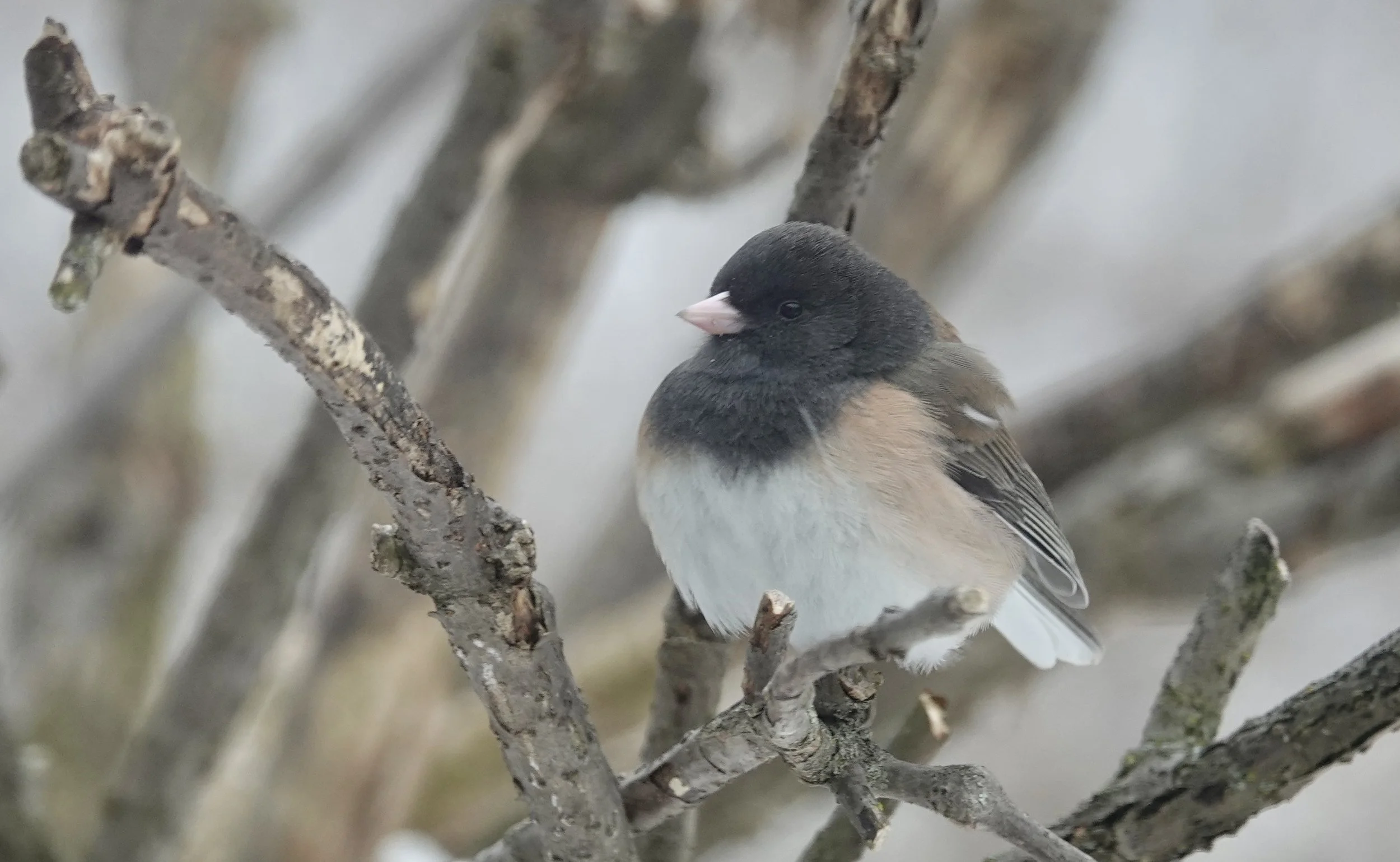
The name junco has Latin origins, meaning "rush" or "reed." It derives from the Latin word "juncus," referring to various types of reed-like plants—an odd name for a bird not partial to that habitat. The scientific name for the dark-eyed junco is Junco hyemalis, which translates to "winter rush" or "winter bunting." Many here call it a snowbird. Photo by Al Batt.

Troubling tree sparrows?

Naturally

  “The sun shone, having no alternative, on the nothing new.”

  Samuel Beckett wrote that in 1938.  "Nothing new under the sun" is a phrase from Ecclesiastes, suggesting that human nature, life experiences, and core events repeat throughout history, making true novelty an illusion. I’m not disputing anything written in the Bible, but with our varied weather, everything is new under the sun—and under the clouds.

  A beautiful morning gave a beautiful voice to the birds.

  By April 3, more than 20 baby owls had been admitted into The Raptor Center’s hospital since March 3rd. The earliest spring baby arrivals at TRC’s raptor hospital are great-horned owls. A barred owl, found stuck to ice in the Twin Cities metro area after a weekend blizzard, arrived on March 17. The young owl was reunited with its parents and siblings after healing from its wounds. The next day, an eastern screech owl chick fledged too early. It was healthy and returned to its nest cavity the same day. In the past 10 years, only two young screech owls were admitted in mid-April (in 2015 and 2020) with the rest of the young screech owls admitted in May at the earliest. The parents of this one started nesting early.

 The International Owl Center’s JR the eastern screech-owl has had plush toys for 8 years. Rarely, an owl will eat a small piece of a toy, but it comes out with the next pellet. One day, JR was not his normal self. He hadn't eaten his food from the night before, which was out of character for him. Security camera footage showed he had eaten the entire wing of a bird toy, which was about as long as he was tall. JR went to The Raptor Center in St. Paul where radiographs confirmed the giant piece of plush in his stomach. The toy’s wing was removed by the use of an endoscope. JR went home, where the good people at the International Owl Center (in Houston, Minnesota) said he sang (albeit a little hoarsely), and his appetite had returned. I hope JR has lost his appetite for toys.

Wesley the Owl

  While on the subject of owls, I read, “Wesley the Owl: The Remarkable Love Story of an Owl and His Girl,” a memoir by Stacey O'Brien about her 19-year relationship with Wesley, an injured barn owl she adopted. Their years together required O’Brien to provide 28,000 mice for Wesley’s dining pleasure. The author wrote that a barn owl could accurately locate a mouse under 3 feet of snow by homing in on the rodent’s heartbeat. The book chronicles their unique bond, discoveries about owl behavior and intelligence, and how Wesley helped O’Brien through a life-threatening illness. The book is heartwarming and engaging.

The Hall of Fame

  I am a proud member of Ray Brown’s Talkin’ Birds Hall of Fame. I’d been enshrined into the living category of that HOF. That is the one to be in.

Q&A

  Nelson Miller of Ohio asked if Eurasian tree sparrows were going to be troublesome for bluebirds. In 1870, a shipment of birds from Germany was released in St. Louis, to provide familiar bird species for newly settled immigrants. That shipment included 12 Eurasian tree sparrows. These chestnut-capped, white-cheeked arrivals prospered in the hedges and woodlots of the region, spreading through parts of Missouri, Illinois and Iowa. Now I see them in my yard. Unlike its relative, the more aggressive house sparrow, it isn’t a bird of the cities, preferring farms and wooded residential areas. They do compete with native cavity nesters, such as bluebirds and chickadees, but as to how big a problem they might become—time will tell.

  In 1958, Mao Zedong launched a campaign in China to eradicate that species to protect grain crops. That plan backfired. Without sparrows to eat them, insect populations surged, leading to crop failure, and when combined with adverse weather, led to a catastrophic famine that killed millions of people. China imported sparrows from the Soviet Union to restore the ecological balance.

  Steve Weston of Eagan, the Christmas Bird Count compiler for Minnesota, said this about the last CBC: “The story of the count was the 28 Eurasian tree-sparrows found on 5 counts. This is up from 3 birds a couple of years ago, which shattered the ‘casual’ designation of the species at the time. Later counts at a couple of the sites indicated that even these numbers were a fraction of the birds at these locations.”

Thanks for stopping by

  “When you arise in the morning, think of what a precious privilege it is to be alive. To breathe–to think–to enjoy–to love.”—Marcus Aurelius.

  “Though we travel the world over to find the beautiful we must carry it with us or we find it not.”—Ralph Waldo Emerson.

  Do good.


©️Al Batt 2026

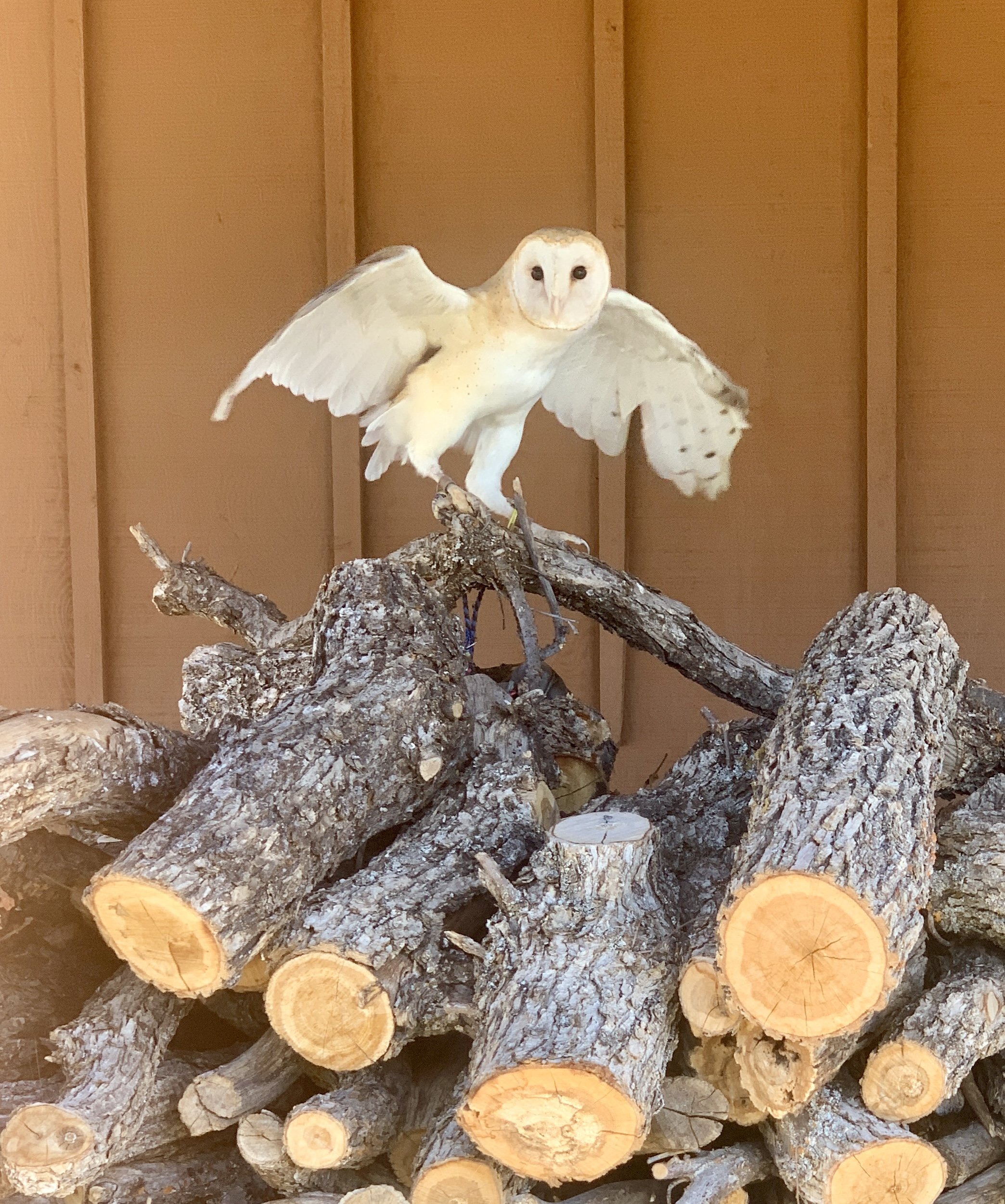
They are called barn owls because they tend to nest, roost and hunt from structures like barns, silos and church steeples. Barn owls appear ghostly white when gliding over the landscape at night. The heart-shaped facial disc acts like a satellite dish, funneling sound to the ears, allowing an owl to locate prey in darkness. Barn owls don't hoot; they screech. Nicknames include: ghost owl, monkey-faced owl and steeple owl. Photo by Al Batt.

Thrilled by seeing a dandelion

Naturally

  It’s spring when the first dandelion is a thrill and sneezing is a sign of spring to many.

  Near a wetland, I listened hard to a marshing band, but I couldn’t tell how far a frog can jump by its croak.

  April Fool’s Day brought the full, Pink Moon, named for the early spring bloom of a native wildflower of eastern North America, commonly called creeping phlox or moss phlox.

  Sidewalk anthills appear in early spring, shortly after the ground thaws, as pavement ants repair tunnels and expand colonies, pushing sand and soil to the surface. The small, volcano-shaped piles are routinely seen in concrete cracks.

  Pinfeather leaves appear on trees while Dr. Killdeer calls out his name and Frasier Crane (a sandhill crane) flies overhead. Flying V’s join the crane in the sky—turkey vultures.

  I watched a brown creeper spiral up a tree trunk, using its stiff tail feathers for balance. The small bird with a streaked brown back is an insectivore probing bark crevices for spiders, insects, pupae and eggs. It completed its spiral, then flew down to the base of another tree to climb. They rarely come to feeders.

Michigan Bluebird Society

  I had the pleasure of speaking at the MBS Bluebird Festival at a college in Ann Arbor. Speakers offered helpful hints for bluebird landlords. Barnyards where livestock is fed aren’t recommended sites for bluebird boxes because those areas are attractive to house sparrows. To reduce competition from house wrens, locate boxes at least 100 feet from treelines and shrubs. Because bluebirds are territorial and won’t allow other bluebirds to nest close to them, locate nest boxes at least 100 yards apart. If tree swallows use the boxes, put up boxes in pairs 15 to 25 feet apart. The swallows will defend both boxes from other swallows but will tolerate the presence of bluebirds in the second box. Bluebird houses can be mounted on a metal pipe/pole using pipe clamps—materials found in the plumbing section of a local hardware store. The pipe clamps should be attached above and below the nesting chamber of the house. A smooth, round pipe is the best and simplest mounting system. An ideal pole is a 1/2-inch electrical conduit. Metal poles can be polished with steel wool and coated with carnauba wax. The easiest and best type of predator guard to put on the pole is a cylindrical metal stovepipe-shaped baffle with a metal top with a hole in the middle, through which the pole goes. The metal baffle rests on a collar clamped onto the pole. The baffle should be made of galvanized steel or heavy-duty aluminum. This prevents squirrels or raccoons from chewing it and making it easier to climb. The cylinder should be a pipe baffle between 6 and 8 inches in diameter for maximum effectiveness. The top of the baffle needs to be solid with minimal gaps between the baffle and the pole. This is to prevent chipmunks or snakes from squeezing through the gap. Place the boxes at least 50 feet from bird feeders and houses. Raccoons are the biggest concern for many bluebird landlords, although cats and squirrels can be problems. Hawk attacks cannot be prevented. Deterring cats is difficult, because they leap at the adult bluebirds as they leave or enter the box. Cats can jump over 5 feet high. A cone-shaped baffle of at least a 30" diameter put on top of the cylinder baffle could help. Mealworms should be used as a supplemental treat, not a diet staple, and fed in limited quantities (100/day per pair) to avoid nutritional imbalances. They’re best used during the winter or in harsh weather. Bluebird boxes should face away from large bodies of water to prevent fledglings from flying directly into the water and drowning on their first flight.

Q&A

  “Where do flying squirrels nest?” They glide up to 80 yards using a special skin membrane and nest in tree cavities or large dreys built high in trees. Dreys are balls of twigs and leaves that keep the squirrels safe, dry and cozy. Moss serves as insulation. As winter approaches, squirrels move from dreys into tree holes.

  Kathryn Sloan of Mankato asked what else sounds like a mourning dove. A common mnemonic of the Eurasian collared-dove is a persistent, fast "Col-LARRRED-dove" or "who-WHOO-who," unlike the slow, mournful "Huu-lah, hoop-hoop-hoop" of a mourning dove.

  “Why are tree swallow populations declining?” It’s a combination of reduced food availability (aerial insects), pesticide exposure, climate-driven habitat changes, and challenging weather, resulting in a roughly 30% decline from 1966 to 2019.

Thanks for stopping by

  “I step outside each day with the intention of being blown away by something ordinary.”—Rachel Wolchin.

  “In this life we cannot always do great things. But, we can do small things with great love.”—Mother Teresa.

  Do good.


©️Al Batt 2026

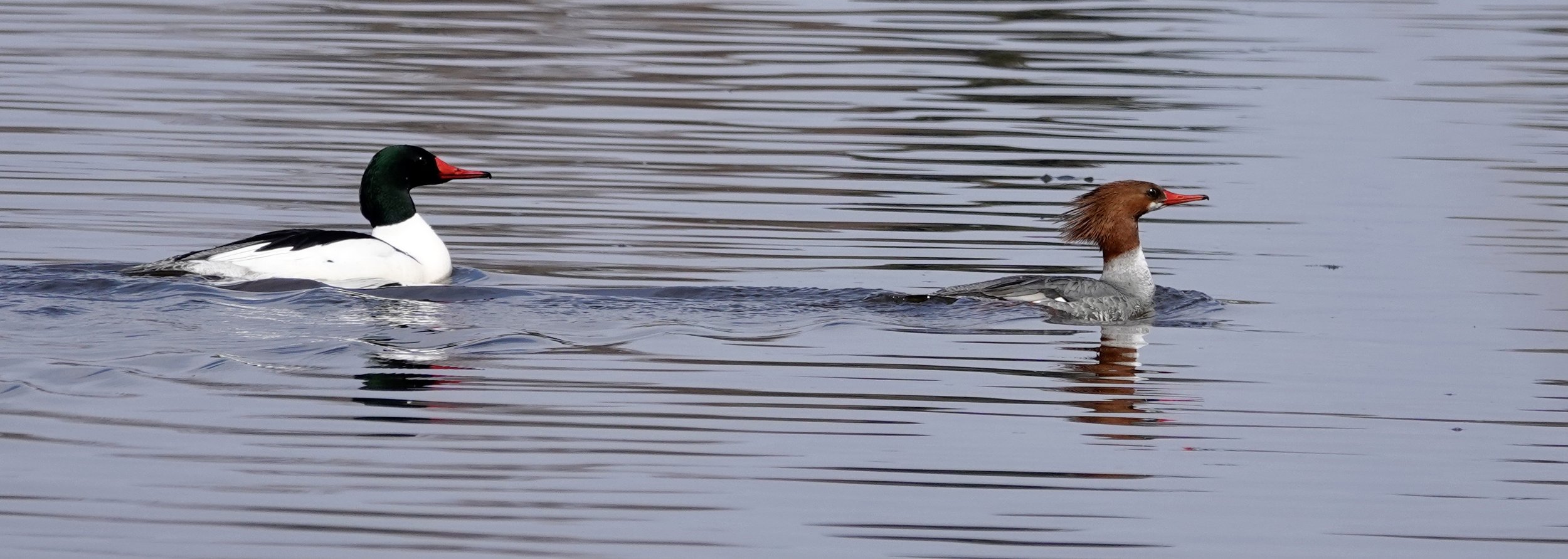
Common mergansers are large, fish-eating, diving ducks nicknamed "sawbills." Because they’re primarily piscivorous, they are sometimes called “fish ducks.” A male has a dark green head, a white body and a black back. A female has a gray body and a reddish-brown head. They have slender red bills with serrated edges, and nest in tree cavities. “Merganser” comes from the Latin and translates to “plunging goose.” Photo by Al Batt.

Never shake hands with a great horned owl

Naturally

 A melodious whistling came from a male cardinal wearing his Sunday best.

 The robins were noisy; the chorus frogs were noisier. A flock of red-winged blackbirds, common grackles and brown-headed cowbirds swept from tree to tree. It was a giant reunion of birds.

 An owl made a personal appearance in my yard.  Being an owl is what owls do for a living. A great horned owl's eyes are so enormous relative to its head that if human eyes were of similar proportion, they would be the size of oranges. Owl eyes make up as much as 5% of these birds' total body weight. That may not sound like a lot, but for comparison, my eyeballs are about 0.0003% of my total weight. The grip strength in the great horned owl’s feet is 200 to 500 pounds per square inch. An average man’s handshake is 80-100 PSI.

Q&A

 Jack May of Mankato asked if the red-winged blackbirds covering the lawns in March are finding anything to eat or just passing the time practicing. The red-winged blackbirds on our lawns are likely foraging for leftover seeds and early-season insects. They visit farm fields to consume seeds from grasses, weeds like ragweed and cocklebur, and waste grains like corn. As the weather warms, they begin hunting for protein-rich insects such as beetles, caterpillars and spiders. They’re good at finding food. They have to be. At feeders, they are drawn to cracked corn, millet and sunflower seeds scattered on the ground.

 “What bird makes the biggest nest?” There are a few contenders. The southern Africa region is inhabited by a small bird (5.5 inches long and weighing an ounce) called the sociable weaver, which builds community nests. The social weaver is known for its elaborate nests built on trees and other tall structures like utility poles. The birds weave the nest branch by branch and twig by twig to construct huge nests that have separate chambers. A nest can reach 23 feet wide, weigh as much as 2,000 pounds, and have over 100 chambers housing 100 families or more. White stork nests are massive structures measuring 3 to 7 feet in diameter and 3 to 10 feet in height. These nests are built from branches, twigs, straw, grasses, rags and paper, and because they are reused and added to annually, they can weigh over one ton. Each spring, returning pairs across Europe add new layers of material to the existing structure. Because of the size and weight of their nests, storks choose sturdy platforms such as rooftops, chimneys, electricity pylons and large trees. Golden eagles build large nests 2 feet deep and 5 to 6 feet wide. The largest golden eagle nest on record was 20 feet tall and 8.5 feet wide. A typical bald eagle nest is 4 to 5 feet in diameter and 2 to 4 feet deep. A nest could weigh 1,000 to 2,000 pounds. The largest bird nest ever recorded was a bald eagle nest found in St. Petersburg, Florida, in 1963, measuring 9.5 feet in diameter, 20 feet deep, and weighing over 4,400 pounds (over 2 tons). Bald eagles are known to build the largest, heaviest nests of any individual bird pair, and expand the structure over many years.

 “I was in your group tour in Kansas and saw black-bellied whistling ducks there. Are they common?” Black-bellied whistling ducks have rapidly expanded northward from their core range in Mexico and South Texas since the 1970s, establishing populations as far north as Wisconsin and Nebraska. They are becoming more common during warmer months in Kansas. These tropical, long-legged ducks with pink bills and whistling calls, frequently nest in Kansas, using tree cavities and artificial boxes. The ones we saw were near Ellinwood, between Cheyenne Bottoms and Quivira NWR. They typically migrate south to Mexico or the Gulf Coast for the winter.

 “What do flying squirrels eat?” The southern flying squirrel is a native, nocturnal species found throughout Iowa, generally inhabiting mature oak-hickory forests. Minnesota has the northern flying squirrel, which finds the northeastern Arrowhead region a suitable habitat, with a mix of coniferous and deciduous trees. Southern flying squirrels are most common in Minnesota’s eastern counties—wherever there are sufficiently large numbers of hardwood trees like oak, maple and hickory. Their populations do overlap.  The chipmunk-sized squirrels eat nuts, seeds, berries, fruit, fungi, buds, beetles, moths, insect larvae, spiders, bird eggs and nestlings, baby mice, shrews, lichens and carrion. They don’t hibernate, so they cache food for winter.

Thanks for stopping by

 “He who laughs most, learns best.”―John Cleese.

 “There is a quiet light that shines in every heart. It draws no attention to itself, though it is always secretly there. It is what illuminates our minds to see beauty, our desire to seek possibility, and our hearts to love life.”–John O’Donohue.

 Do good.


©️Al Batt 2026

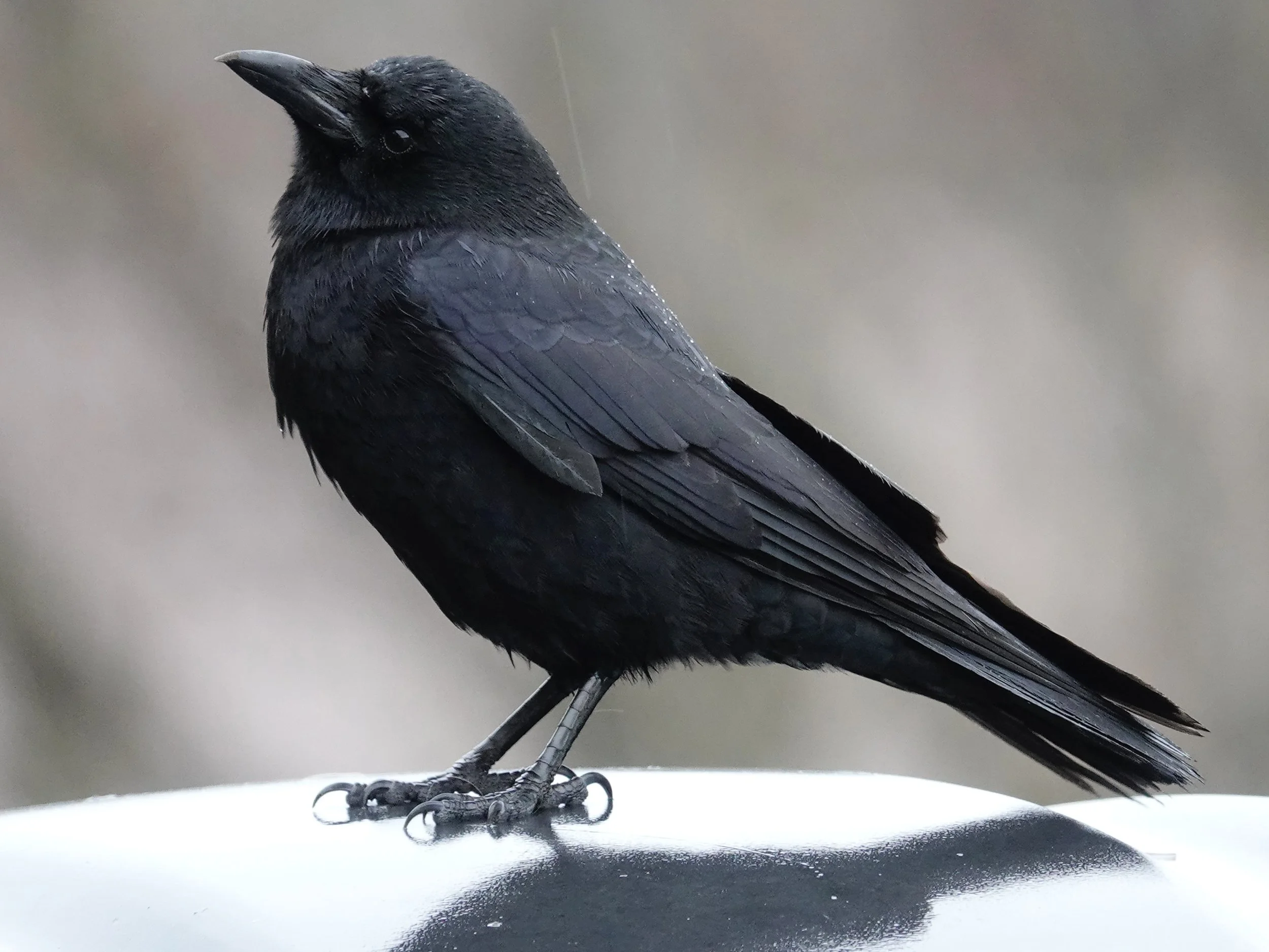
In American crow populations, older offspring help their parents raise new chicks for a few years, and this could include as many as 15 individuals, with offspring from five different years pitching in. They feed the young, defend the territory and the nest, stand guard while other family members forage, and feed their mother while she’s sleeping on the nest. American crows lay a clutch of 3 to 9 eggs, with 4 to 6 being most common. Photo by Al Batt.

  I was brought up right, but I had left home without a jacket.

Naturally

  I was brought up right, but I had left home without a jacket.

  It was a beautiful March day. Spring had sprung. March can leave humans befuddled, but birds become twitterpated. The most exuberant songsters in the yard were the cardinals, house finches and Eurasian collared-doves. The squirrels still wished their coats had pockets. Killdeer yelled their names.

  Then the band showed up. A couple of trees in the yard became blackbirds. A flock of red-winged blackbirds is commonly called a cloud or a conspiracy. They are a boisterous bunch, for sure. Their merriment is restorative. They depend on photoperiods (increasing day length) to trigger their hormonal shifts for spring migration, but they use temperature to determine the precise timing of their return. Red-winged blackbirds are polyglots able to understand the vocalizations of other birds. When researchers played a warning call used by yellow warblers to signal the presence of a parasitic brown-headed cowbird, the redwings reacted and went on full alert. Red-winged blackbirds visit bird feeders offering sunflower seeds and cracked corn.

  A friend called to tell me his lawn robins had returned and brought spring with them. He recognizes two kinds of American robins—winter robins and lawn robins. A winter robin isn’t his harbinger of spring. He said, “I’m not all tore up about spring being here.”

  I watched sandhill cranes and a pair of trumpeter swans fly over. Species like cranes, geese, ducks and swans fly with their necks outstretched. Herons and egrets fly with their necks pulled back in an "S" curve. Trumpeter swans were extirpated from Iowa and Minnesota by unregulated hunting for feathers and meat, combined with wetland habitat loss. The last native breeding pair in Iowa nested in 1883, and they disappeared from Minnesota around 1885. Successful restoration programs that began in the 1960s-1990s, restored the population. Kudos to the clever work of many people.

  One of my favorite children’s novels is “The Trumpet of the Swan” by E.B. White about Louis. I am a huge fan of E.B. White, and he penned a wonderful story of a trumpeter swan born without a voice, who overcame his disability to win the love of a swan named Serena. A treasured book from my boyhood was “Charlotte's Web,” a classic children's novel about the friendship between a pig named Wilbur and a barn spider named Charlotte, who saved Wilbur from slaughter by writing messages in her web.

  March’s generous moisture will create temporary vernal ponds that will make frogs happy. Frogs are happy with the water and with the ability to eat what bugs them.

Q&A

  “Do both members of a pair of great horned owls and bald eagles incubate the eggs?” The female great horned owl begins brooding immediately after laying the first egg. The clutch size ranges from one to four eggs, rarely five, with two being the most common. Only the female has a brood or incubation patch, which is a featherless area on her abdomen designed to keep the eggs warm. The eggs are incubated for 30-37 days. The male delivers prey to the female. Hatching is asynchronous, often two days apart. Bald eagles begin incubation after the first egg is laid. Both sexes have brood patches, although the female's patch is more well-developed than that of the male. The incubation period is generally 35 days, with the female doing the majority of the incubating. Hatching is usually asynchronous, with 1 to 4 days between eggs hatching.

  “How many birds are named after a city?” There is no Minneapolis magpie or Des Moines duck, but there is the Nashville warbler, Cape May warbler and Philadelphia vireo. These birds were named by early naturalists who typically first identified or documented the species in those areas. “Whoa, wait up just a second, birdbrain. What about the Baltimore oriole?” I hear you. A fair point. Baltimore is a city and an oriole is a bird, but both the bird and the city were named for Lord Baltimore. The bird’s orange-and-black plumage matched the colors of the heraldic crest of Cecil Calvert, known as Baron Baltimore or Lord Baltimore, who founded Maryland. The major league baseball team, the Baltimore Orioles, was named after the bird, which is also the state bird of Maryland.

  “How do squirrels find buried acorns?” A squirrel has a rocking spatial memory, a keen sense of smell, and a treasure map.

Thanks for stopping by

  “You can sometimes count every orange on a tree but never all the trees in a single orange.”—A.K. Ramanujan.

  “We open our mouths and out flow words whose ancestries we do not even know. We are walking lexicons. In a single sentence of idle chatter we preserve Latin, Anglo-Saxon, Norse: we carry a museum inside our heads, each day we commemorate peoples of whom we have never heard.”—Penelope Lively.

  Do good. 

©Al Batt 2026

This bushytail is taking a walk on the dark side. Black squirrels aren’t a separate species, but are a melanistic color variant of the eastern gray squirrel. The dark fur is caused by a genetic mutation (melanism) that offers a thermal advantage, giving the squirrel a leg up on surviving cold winters. A black squirrel will be coming to a tree near you. Photo by Al Batt.

I was traveling the 37-degree isotherm

Naturally

  Winter casts a giant shadow, and we can never be certain when winter will storm out of the room, but we can find hope in signs of spring. Red-winged blackbirds return—the males before the females—and post themselves on territory, where they call “look-at-me.” It’s said that American robins need three snows on their tails before it is truly spring. The robins that went south return in the spring to follow their food sources—earthworms and insects—as the ground thaws. They track a 37-degree Fahrenheit isotherm (a line connecting areas with similar temperatures) to find areas where soil warms enough for worms to surface. Their northward journey is driven by food availability and the need for nesting, rather than by temperature, although they travel according to that 37-degree isotherm. Spring brings the need to stake out breeding territories, often before the snow has disappeared. Robins sing "cheerily, cheer up, cheer up, cheerily, cheer up" to establish these territories. Look for eastern bluebirds, killdeer and common grackles. Common mergansers, buffleheads, ring-necked ducks and wood ducks find open water. Cardinals offer their spring songs. They are clear, high-pitched whistles that sound like "what-cheer," "cheer-cheer-cheer" or "birdie-birdie-birdie." The spring song of the white-breasted nuthatch is a rapid, nasal, low-pitched series of notes described as "what-what-what" or "why-why-why." Black-capped chickadees shift from their "chick-a-dee-dee" call to a clear, two-note "fee-bee" whistle; a song that says, “Spring’s here.” The bugling calls of sandhill cranes are heard. Woodpeckers are like that junior high kid who wanted to be Ringo Starr and drummed on anything that made a resonant sound. Woodpeckers drum on trees or metal chimneys. Tiny snow fleas (springtails) appear on top of melting snow on warm, sunny days. Ground cover, like creeping Charlie and weeds, starts turning green. It becomes nearly impossible not to notice the red osier dogwood (redstem or red-twig dogwood). Its vibrant colors are evident in moist, sunny areas. There are little green buds on willows—pussy willows. Red-tailed hawks are generally solitary, but they perch side-by-side as mated pairs, reflecting bonding, hunting coordination or territorial behavior. The females are larger. Package delivery people wear shorts. March 15 is officially celebrated as Buzzard Day in Hinckley, Ohio, marking the annual return of turkey vultures (incorrectly called buzzards) to the Cleveland Metroparks' Hinckley Reservation. The annual return of the cliff swallows to Mission San Juan Capistrano (California) is celebrated on March 19, marking their arrival from South America. Some people believe spring begins when the Blue Jays return to Minneapolis. The Toronto Blue Jays are scheduled to play the Minnesota Twins at Target Field in Minneapolis on April 30.

Q&A

 Cheryl McRoberts of Haines, Alaska, spotted a flock of crows gathered around a dead crow and wondered if it was a crow funeral. It appears to be an organized respect for the dead, but it’s thought that crows don’t hold funerals to grieve in a human sense but gather in a large (not restricted to family members) chaotic, noisy and highly social "wake" to investigate the death of a fellow crow. It might be a fact-finding mission meant to identify the cause of death, potential predators or environmental dangers to avoid in the future. Death becomes data used to stay safe. Crows are social and extremely intelligent. Is it a recognition of loss? It looks like it. The crows know.

  Jennifer, Lily, Duncan and Derek of Pipestone asked how animals know when to change their coats. Maybe their mothers tell them as ours do. The primary trigger is a change in the photoperiod (length of daylight), which generates hormonal responses. As days shorten in the fall, hormones direct the body to grow thicker, often differently colored fur. Longer daylight hours in the spring cause the body to shed the winter coat. Temperatures and food availability play secondary roles in signaling. Warmer temperatures and delayed snowfall can cause mismatches, where animals (like weasels or hares) turn white and little snow falls. This causes the animals to be obvious, which makes them vulnerable to predators or unable to hunt effectively.

  Marlyss Johnson of Wells saw over 100 bald eagles gathered on a small lake named Penny Lake and wondered why they were holding a convention there. Bald eagles congregate on small lakes primarily due to an abundance of accessible food, such as winter-killed fish or fish concentrated in shallow areas. They might assemble there because of the open water for fishing or for socializing. The eagles could also be attracted to tall roosting trees near water, which are essential for resting and hunting.

Thanks for stopping by

  “Orbiting Earth in the spaceship, I saw how beautiful our planet is. People, let us preserve and increase this beauty, not destroy it!”—Yuri Gagarin, first human in space.

  “We are not an endangered species ourselves yet, but this is not for lack of trying.”—Douglas Adams.

  Do good.

©️Al Batt 2026

Robert Louis Stevenson wrote, “A birdie with a yellow bill Hopped upon my window sill, Cocked his shining eye and said: ‘Ain't you 'shamed, you sleepy-head!’"
These European starlings with yellow bills appeared to be somewhat less than enamored with the blizzard. Photo by Al Batt.

I wasn’t as warm as a common eider

Naturally

  March provides us with varied weather, most of which would be considered a brutal winter day in much of the world. It brings us hope and warm thoughts.

  A south wind brought birds—red-winged blackbirds and common grackles. New avian arrivals are lovely bringers of a new day. Canada geese honked while flying overhead. I’ve been told spring generally moves northward at an average speed of about 15 to 16 miles per day. Some say it’s 20 miles per day. Spring travels 100 feet uphill per day.

  I watched rock pigeons lift off from a grain storage unit. Often called barn pigeons, a flying pigeon’s heart beats can reach 600 per minute. The wind helped carry them away. The birds wore no puffy jackets.

  On a frigid day with a blistering wind. A shivering friend said he wished he had an eiderdown jacket. I’ve heard of eiderdown jackets often, but I’m not sure that I’ve ever seen one in person. I know they represent the pinnacle of luxury, warmth and rarity in insulating outerwear. They feature ethically harvested, ultra-light down from Icelandic or Canadian eider ducks. Top brands offering genuine, high-end eiderdown products include Vollebak, Härkila and Paul & Shark. None of those brands are available at the local Put It Back! Store. I asked my friend why he didn’t get himself an eiderdown jacket. He told me he’d checked the prices, and they were $4,000–$6,000. He added that they could last decades. They should.

  The down used is that of the common eider, a large migratory sea duck with a range along the northern coasts of eastern Siberia, Europe and North America.

  One species of eider is native to the Arctic coasts of Alaska and eastern Siberia. It’s the spectacled eider, a sea duck with bold white rings around its eyes that look like goggles. Before 1995, the winter location of this threatened species was a great ornithological mystery. That site was confirmed during aerial surveys in March 1995 and further documented in 1997. The entire world population of spectacled eiders was found huddled in small patches of open water surrounded by sea ice in the Bering Sea south of St. Lawrence Island. They dive to feed on clams and mollusks, equipped with a thick plumage meant to withstand harsh conditions.

  Back to the common eider, eiderdown is a type of down feather, a soft and fine layer of feathers found on the breast of the female eider duck. When the nesting season begins, she plucks the down feathers and uses them as nesting material to keep the eggs warm. People harvest the down when the young and adult birds abandon the nests in the summer. The ducks aren’t disturbed or harmed. The collected down is cleaned and used to produce filling for bedding and clothing. Approximately 85-90% of the world’s eiderdown comes from Iceland, and 10-15% comes from Canada. This down is exceptionally soft and has insulating properties superior to goose down, wool, cotton or synthetic fills. In the eiderdown business, profits are down.

  A 2026 Canadian study reported by New Scientist found that expert birdwatchers have greater brain tissue density in regions responsible for attention, perception and working memory compared to novices. Birding reshapes the brain in much the same way as learning a language or mastering a musical instrument does. Athletes exhibit similar adaptations in motor areas. These structural differences, likely driven by neuroplasticity, enhance bird identification skills and may help build cognitive reserve, potentially protecting against age-related decline.

Q&A

  “I watched dragonflies hunt one day last year. They never seemed to miss. How successful are they?” Harvard University researchers found dragonflies capture prey in 90 to 97% of their attempts.

  “How do I tell an immature bald eagle from a golden eagle?” Young bald eagles have a dark brown plumage mottled with white with large, heavy beaks and bare legs. They take 4 to 5 years to reach plumage with a white head and tail. Young golden eagles have more uniform, dark chocolate plumage, a golden nape, smaller beaks, legs feathered down to the feet, and a distinct, broad white band at the base of the tail and white patches under the wings, most visible in flight. An adult golden eagle is mostly dark brown with a golden wash on the back of the head and nape. An adult has a faintly banded tail. A young bald eagle’s beak is a dark brown/black and gradually transitions to yellow over 4-5 years. A golden eagle has a consistent tri-colored beak (dark tip, greyish-blue middle, yellow base) throughout its life.

Thanks for stopping by

  “I took a walk in the woods and came out taller than the trees.”—Henry David Thoreau.

  “Each species is a masterpiece, a creation assembled with extreme care and genius.”—Edward O. Wilson.

  Do good.


©️Al Batt 2026

The American tree sparrow (winter) and chipping sparrow (summer) are similar small birds with rusty caps. The tree sparrow has a central breast spot (sometimes hidden), bicolored yellow/black bill, dark legs, and rusty eyeline. A chipping sparrow has an unspotted breast, black bill, light-colored legs, and black eyeline. Edward Forbush nicknamed the chippy the "little brown-capped pensioner" because it foraged for crumbs around farmhouses. Photo of a chipping sparrow by Al Batt.

What is a kitty hawk?

Naturally

  Because an icy wind was turning my head around, I sought shelter in the south. I enjoyed a speaking gig on the Outer Banks of North Carolina, famous for being where the Wright Brothers achieved the first controlled, powered airplane flight on December 17, 1903. The moment the impossible became possible. The flights technically took place at Kill Devil Hills, a few miles away, but the Wright brothers used Kitty Hawk as their base of operations.

  What is a kitty hawk? The name is believed to have evolved from an Algonquian term, likely "Chickahauk" or "Chickahawk," which referred to "a place to hunt geese." Other theories suggest it developed from the early settlers' pronunciation of "skeeter hawk" (a local term for dragonflies) or the nickname of the wren, which was "kitty."

  Mallards kept me company in the Outer Banks. Mallards are found in every state at specific times of the year and are year-round residents of North Carolina. They are sometimes overlooked because they are so common. The male mallard is called a "greenhead" because of its green head. Adult male mallards have distinctive curled tail feathers called drake feathers. Drakes don’t have curled tail feathers until they molt into adult plumage. Scientists surmise that a curled tail is attractive to females. When the drakes go through an eclipse molt after the mating season, they lose their drake feathers, which grow back in time for the next breeding season.

  I’ve seen small flocks of red-winged blackbird males. This species prefers nesting in wetlands, marshes and damp fields, placing their nests in cattails, rushes, shrubs, sedges, saplings and phragmites. These locations protect their eggs and young from predators. They will readily nest in prairies, meadows, roadsides, hayfields and cornfields. Females construct cup-shaped nests using grasses, sedges, reeds, mosses and mud. The breeding season begins in early spring, with nests taking 3 to 6 days to build. The males return before the females to claim the best territories and defend them from rival males. Males typically return to their previous territories each year. The average territory is approximately .5 acres in size. Redwings often nest in loose colonies, with males aggressively defending territories that can contain multiple females. The males sing “look-at-me” to defend territory or to attract females. He spreads his wings enough to display red epaulettes and yellow feathers. The females claim a smaller territory within a polygamous male’s territory.

Q&A

 “I saw a tufted titmouse in my yard last year. What’s the plural of titmouse?” Both titmice and titmouses are acceptable as the plural of titmouse, though titmice is far more common. Titmice is preferred by the Cornell Lab of Ornithology, National Geographic and the dictionaries I checked. The name originated from the Old English mase, meaning "small bird."

  “Something killed one of my chickens. What could it have been? Could an opossum be the culprit?” Chickens have a big problem. They taste just like chicken. Opossums are opportunistic omnivores that consume insects, slugs, earthworms, fruits and berries, pet food, chicken feed, baby birds (chicks), snakes, frogs, and things in compost piles. They eat eggs because everything does and eat a dead chicken as opossums are scavengers. Opossums are more of a threat to the eggs, chicks and sick birds easy to catch. Prime suspects include raccoons, weasels, foxes, coyotes, mink, hawks, owls, bobcats, dogs and cats. A chicken found in a pen with its head missing was likely the victim of a raccoon that reached in, grabbed the fowl, and pulled its head through the wire. If a chicken inside a pen or a coop had its head and crop missing, it’s probably the work of a raccoon. If the head and the back of the neck of the chicken are missing, a likely suspect would be a weasel or mink. If the head and neck are missing, the probable perpetrator is a great horned owl.

Thanks for stopping by

  “Birds should be saved for utilitarian reasons; and, moreover, they should be saved because of reasons unconnected with dollars and cents. A grove of giant redwoods or sequoias should be kept just as we keep a great and beautiful cathedral. The extermination of the passenger-pigeon meant that mankind was just so much poorer…And to lose the chance to see frigate-birds soaring in circles above the storm, or a file of pelicans winging their way homeward across the crimson afterglow of the sunset, or a myriad of terns flashing in the bright light of midday as they hover in a shifting maze above the beach-why, the loss is like the loss of a gallery of the masterpieces of the artists of old time.”—Theodore Roosevelt.

  “People from a planet without flowers would think we must be mad with joy the whole time to have such things about us.”—Iris Murdoch.

  Do good.


©️Al Batt 2026

Killdeer return in March. They are harbingers of spring. Killdeer is an onomatopoeia of the bird’s piercing call, a shrill “kill-deer.” It’s been called a noisy plover and a chattering plover. Its movements are typical of plovers—running a few steps, stopping, and tilting its head to look and listen for prey. A killdeer’s nest is a shallow depression lined with pebbles. The chicks resemble cotton balls atop two toothpicks. Photo by Al Batt.

I could never cache 80,000 sunflower seeds one at a time

Naturally

  I love seeing birds. On a day in our second winter when the wind was angry enough to blow the whiskers from my face and the blowing snow had a bite; I discovered once again that I’m happy to watch house sparrows. Not everyone enjoys their company, but the bird once known as an English sparrow is a beautiful, interesting creature that is doing what it needs to do to get by. The sparrows chirped away happily on a day when a human had to look hard to find a smile.

  I put peanuts in the shell in a feeder. The blue jays were busy casing another joint, but the radar of the white-breasted nuthatch worked, and the nuthatch enjoyed the peanuts. It got exercise as it hammered the legume shells to get to the nut meats. The nuthatch enjoyed a few before the peanut-early warning system of the blue jays kicked in.

  Trumpeter swans are checking out nesting sites and will claim the perfect spots for raising their cygnets. More beautiful birds. Trumpeters build their nests on top of muskrat or beaver lodges, or they pile sedges and cattail tubers into a mound on sites surrounded by water. The swans warm the eggs by covering them with their webbed feet.

  Chickadees are cute. Black-capped chickadees cache food items to ease their way through winter. Not only do chickadees remember their seed cache sites, they also remember which seeds had been eaten by them or by thieves. Researchers at Columbia University discovered that chickadees create neural barcodes, providing them with a system for managing their larders. During peak hoarding, a chickadee can store as many as 1,000 food items in a day. A study of a related species showed that as many as 80,000 seeds and insects were stored by one chickadee each fall. Work at the University of Toronto revealed that black-capped chickadees can accurately relocate caches for as long as 28 days. Chickadees spend most of their precious time near the caches where they had hoarded the most nutritious food. Chickadees remove cached items and hide them again in a new place, moving them repeatedly until they are eaten. It’s a meaningful game of hide-and-seek. The hippocampus is critical to the formation of these types of memories. Avian researchers found that the hippocampus in chickadee brains expands as the tiny birds gather and store seeds each fall. To support that incredible memory, chickadees grow 30% more neurons to add to their memory center in the fall when caching behavior peaks.

Q&A

  Casey McGill asked why Albert Lea Lake was noisy in February. It was caused by the ice expanding and contracting. The singing of a nice ice ballad is due to temperature fluctuations, which create booming, cracking, groaning or growling sounds that travel across the frozen surface. This phenomenon is common during rapid temperature changes when ice shifts, cracks or forms pressure ridges that act like a drum skin. Sounds are most pronounced when there’s little to no snow cover on the ice that might muffle the sounds.

  “I found a seashell in my grandmother’s house. I held it to my ear and heard the ocean. Why does that happen?” The seashell acts as a resonator, amplifying ambient environmental noise. The shell's hard, hollow and curved cavity captures surrounding sound waves, bouncing them around to create a low-frequency, echoing hum that resembles ocean waves. The shell acts as a filter, enhancing specific frequencies while dampening others. The sound is normal background noise—traffic, wind or distant conversations, which our brains interpret as the white noise of waves lapping a shore. You could get the same effect by cupping your hand over your ear, but it’s not as interesting when done by a snowbank or while shopping for peanut butter.

  “Are hummingbirds found anywhere else other than in the Americas?” No, hummingbirds are found only in the New World (the Americas), ranging from Alaska to Tierra del Fuego. They live in North, Central, and South America, and in the Caribbean. Fossil evidence shows they were once present in Europe during their early evolutionary history. Attempts to introduce them to Europe in the 19th century failed, as they aren’t native to those ecosystems.

Thanks for stopping by

  "Between every two pine trees there is a door leading to a new way of life."—John Muir.

  “Somewhere, always, the sun is rising, and somewhere, always, the birds are singing. As spring and summer oscillate between the Northern and Southern Hemispheres, so, too, does this singing planet pour forth song, like a giant player piano, in the north, then the south, and back again, as it has now for the 150 million years since the first birds appeared.”—From the book, “The Singing Life of Birds: The Art and Science of Listening to Birdsong” by Dr. Donald Kroodsma.

  Do good.


©️Al Batt 2026


Common ravens are the largest species of Passeriformes in the world, an order commonly known as perching birds or songbirds. Ravens have wedge-shaped tails, shaggy throat feathers and deep croaking calls. They have a heavier bill than crows, which are smaller with fan shaped-tails. The raven is an opportunistic omnivore immortalized by "Quoth the Raven, 'Nevermore,'" a famous refrain from Edgar Allan Poe's poem, "The Raven." Photo by Al Batt.

The earth has music for those who listen

Naturally

  The temperature hit the high 40s in February, and a chipmunk bopped out of its burrow to have lunch and do some grocery shopping. When cold weather hits, a chipmunk enters a state of torpor, which is a period of reduced activity and restless hibernation, in its burrow, where it can avoid the harsh elements and predators. It wakes regularly to eat from its cache of nuts and seeds.

  Shakespeare wrote, “The earth has music for those who listen.” I listened to the white-breasted nuthatch, nicknamed a "tree mouse" or an “upside-down bird” that moves headfirst down trees. It commonly produces a nasal "yank-yank" call that pairs exchange while foraging. But what I heard was a male nuthatch singing a rapid, nasal, fairly low-pitched wha, wha, wha that is sometimes described as “hey, hey, hey,” “why, why, why,” “what, what, what,” or “ha, ha, ha.” Males sing these songs in late winter and spring. I take it as a welcome sign of an approaching spring or the presence of a false spring. The bird was probably wondering what sort of critter I am and if I’m a big goofy bird, perhaps an odd duck, why I can’t fly. Then it laughed at me.

  A swishing shot in basketball can be called “string music.” A nuthatch can provide “spring music.”

From The Raptor Center (edited for brevity)

  Male great horned owls attract mates with hoots. If the female is interested, she gives a hoot. This leads to a courtship dance of bowing, cooing and beak touching. The male might share his food with the female, a big deal for a solo predator. A mouse might be the owl equivalent of flowers, chocolates and a steak dinner. At the end of January through February, the female lays eggs (generally 1-3) in an abandoned crow, hawk or squirrel nest. Why nest so early? It's theorized that since young great horned owls require a long period to learn survival skills (6-7 months), the parents need an early start. The chicks begin exploring the branches around the nest at around 6 weeks old and are fully flighted at 8 weeks. The Raptor Center anticipates its first owlet patients will arrive in early March.

Q&A

  Jennifer, Lily, Duncan and Derek of Pipestone asked if a chicken could survive in the wild. Chickens can survive in the wild, particularly if the wild is in a warm, tropical area. Think Hawaii. They do best in places that offer ample foraging and few predators. Chickens are adaptable, capable of flying to tree roosts, and can establish feral populations. They struggle in cold climates. Smaller, camouflaged or gamefowl breeds survive better than large commercial chickens. The bigger cluckers are walking billboards for hungry predators.

  “Do wild turkeys and domestic turkeys interbreed?” Yes, wild turkeys can and do hybridize with domestic turkeys because they are the same species. Hybrid offspring often have lower survival rates due to abnormal plumage or reduced physical abilities compared to pure wild birds. Authorities often prohibit the release of pen-raised turkeys because they can introduce diseases and threaten the genetic purity of wild flocks. If you see a white turkey in a gang of wild turkeys, does that mean it’s a hybrid? That could be the case, but it’s more likely because of genetic variation or a mutation. The color could make them a target for predators.

  “Does the early bird get the worm?” The saying “The early bird catches the worm” appeared in a collection of proverbs published in 1636, titled “Remaines Concerning Britaine” by William Camden. It suggests that being proactive and timely provides a competitive advantage. Modern behavioral ecology confirms that early-morning foraging confers measurable benefits. A 2021 analysis published in Behavioral Ecology and Sociobiology reviewed 87 field studies across 32 passerine species. It was found that birds initiating foraging within 30 minutes of sunrise consumed, on average, 22% more caloric intake per hour than those starting after 7:30 a.m. During a drought, worms burrow deeper. This means the early birds might expend more energy searching with diminishing returns. In urban environments, artificial light extends nocturnal insect activity, making dusk feeding more productive. Socially dominant birds may stay lean and agile during the day, and eat later, before a cold night. If you’re a bird stuck in a low position in the pecking order, you’ll likely need to look whenever, wherever and however possible for food, be it a juicy worm or not.

Thanks for stopping by

  “There’s a whole world out there, right outside your window. You’d be a fool to miss it.”—Charlotte Eriksson.

  “You cannot get through a single day without having an impact on the world around you. What you do makes a difference and you have to decide what kind of a difference you want to make.”—Jane Goodall.

  Do good.


©️Al Batt 2026

I saw this horned lark in February. The horned lark is the only lark native to North America. It prefers open spaces—the bare ground with sparse vegetation found in empty places like tundra, heavily grazed pastures, prairies, shores, airports and fields. The horned lark’s song is a high-pitched tinkling. Collective nouns for a group of larks include an ascension, chattering, exaltation and happiness. Photo by Al Batt.